
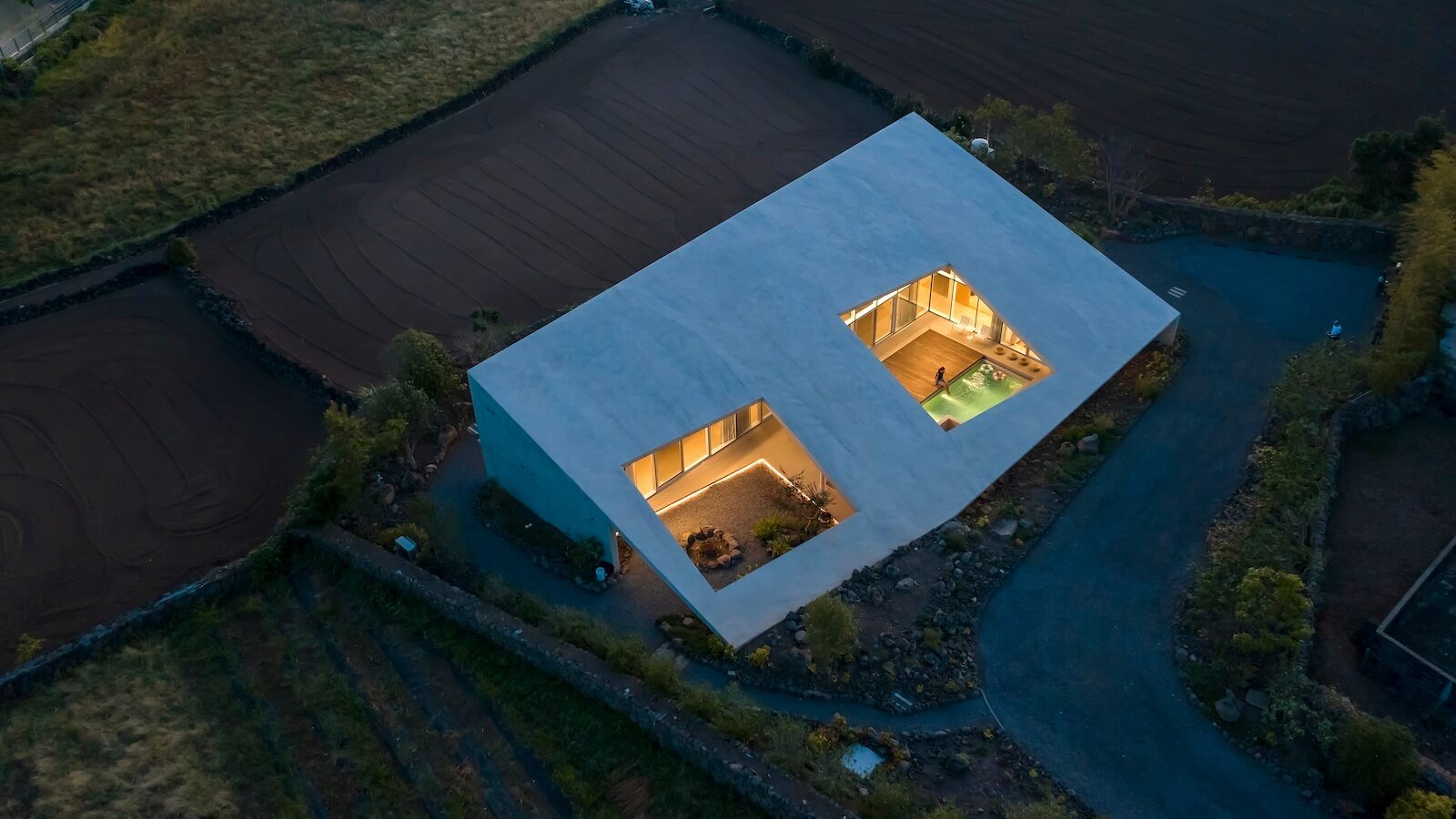
Jeju, at the southern edge of Korea, is known for its volcanic landscapes and singular scenery. The site for the Sloped Roof House, designed for a family with four children, lies on the island’s southern coast — on flat land that stretches toward the shoreline while facing the dramatic mass of Sanbangsan Mountain. Although picturesque, the environment is challenging to live in, marked by humidity, intense sunlight, and strong sea winds. “It was essential to create an open frame that could capture Sanbangsan and the sky while sheltering the house from the wind and sun,” recalls Byoung Cho, the architect behind the 221-square-metre project and founder of Seoul-based BCHO Architects Associates.
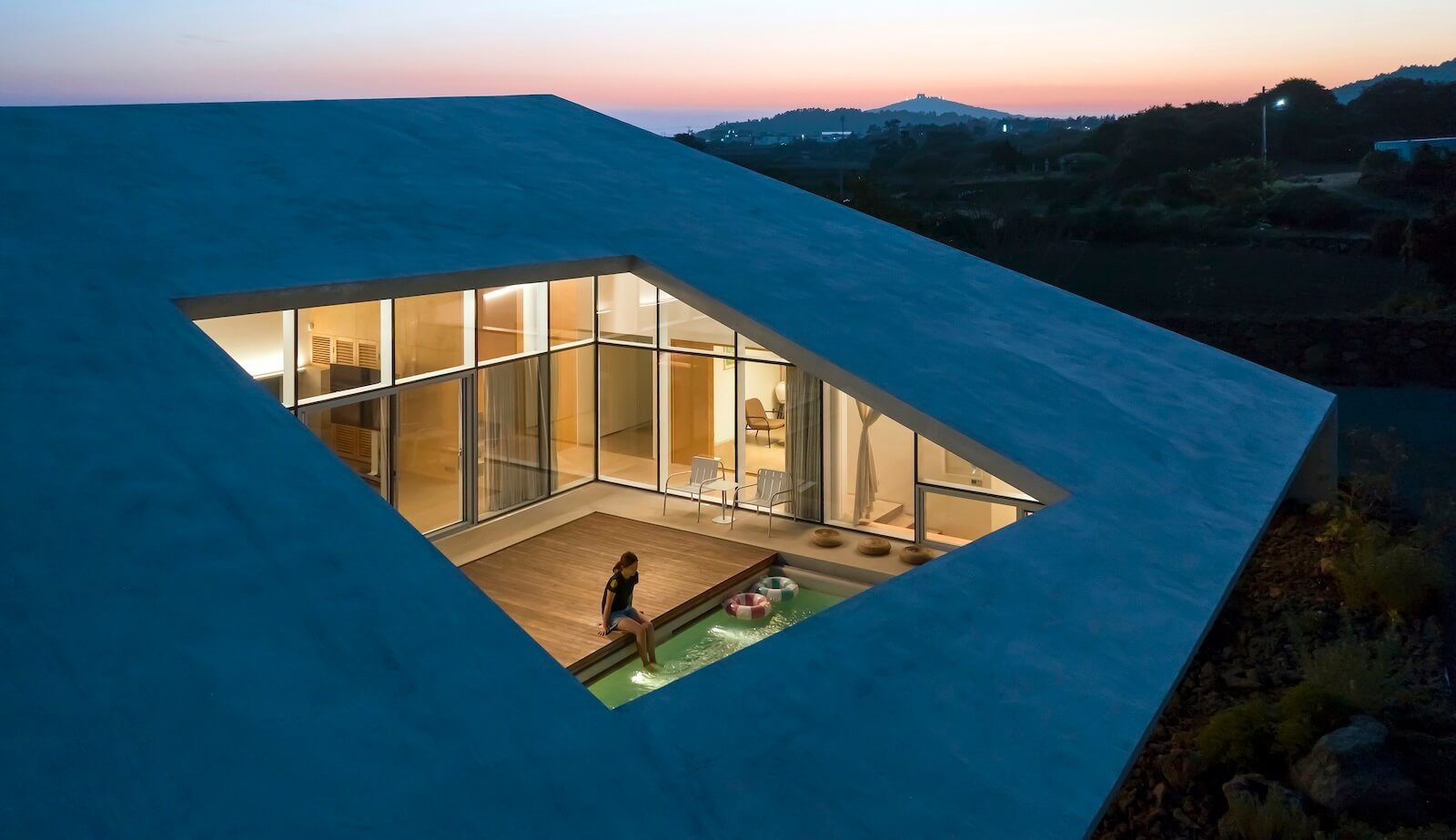
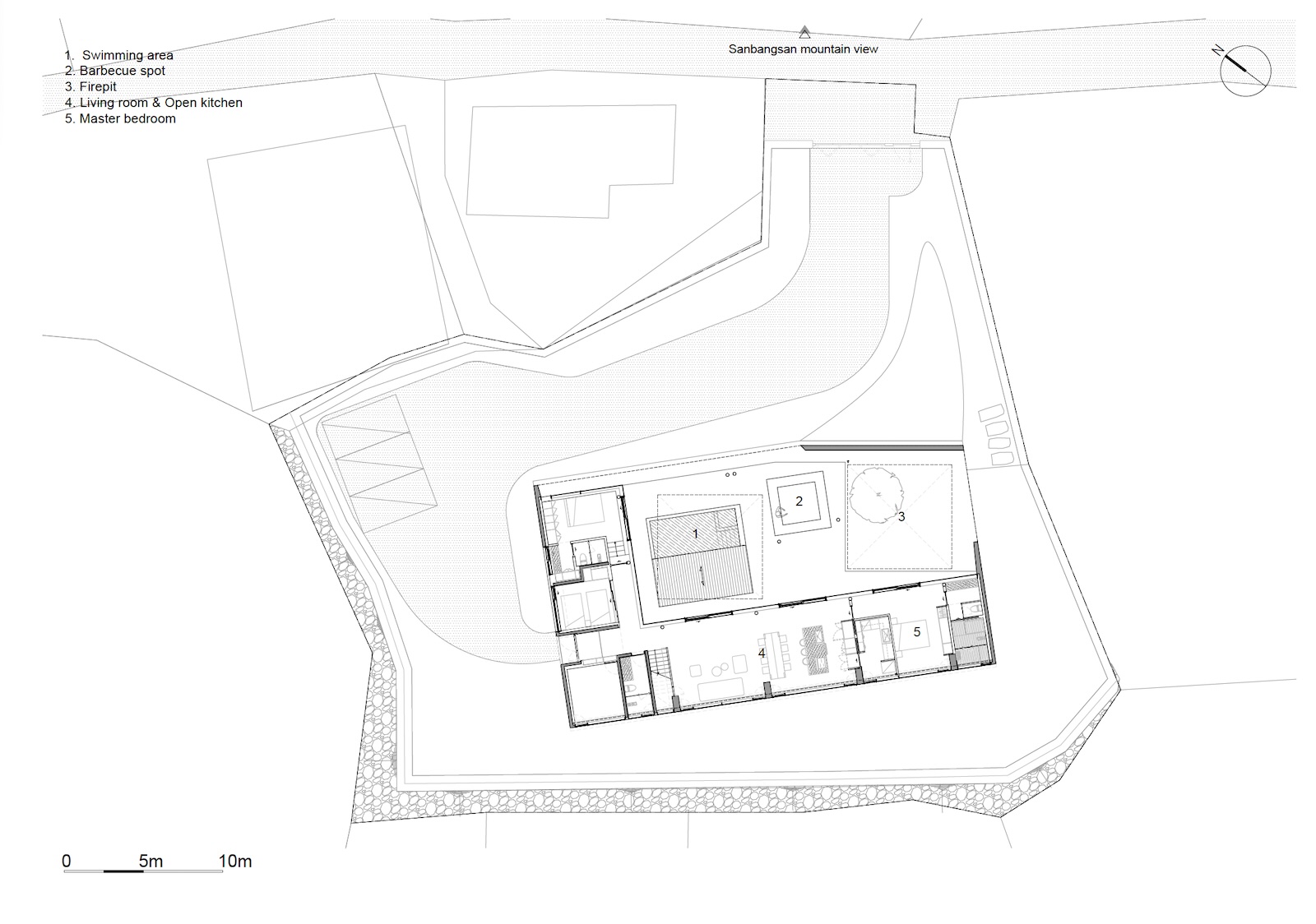
To that end, BCHO angled the roof — an almost heroic poured-concrete slab — so that it meets the ground. The 414-square-metre expanse forms a protected exterior zone with two large surface openings that frame the sky and the silhouette of Sanbangsan while also doubling as a climbable plane from which to enjoy the surrounding sights from an exhilaratingly uncommon viewpoint. Inside and along the courtyard perimeter, the kitchen and living room sit at the centre of the plan, flanked by the main bedroom, while the children’s rooms and the guest room hug the home’s western edge. All the spaces also enjoy exposure on the south side via a long band of glazing. The result is a one-stroke house that draws in views from every part of the interior.
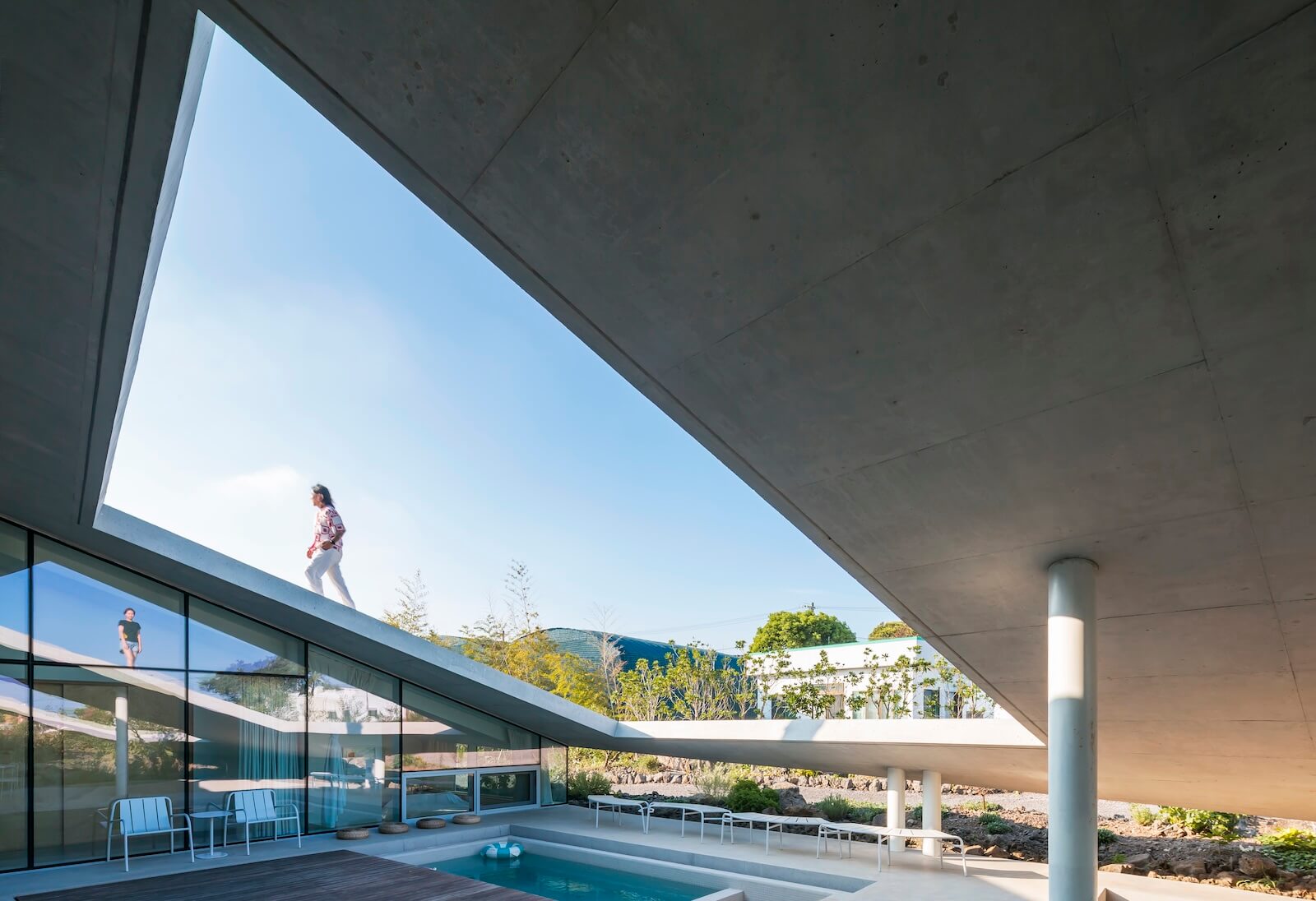
Beneath the sheltering roofline, there is a pool on one side for the children and a small firepit on the opposite; in the middle, a recessed place invites everyone to sit and rest. “When a building stretches horizontally, a roof that stays close to the ground feels more stable,” Cho says. His work has long emphasized how simple forms shape spatial experience, and he approached the design of this project by studying how the building should meet the terrain. Observing the natural flow of the land led to the decision to lower the roof until it touched the ground — a gesture that reduced its apparent scale while creating a functional shelter. The gentle roof slope was also informed by construction logic.
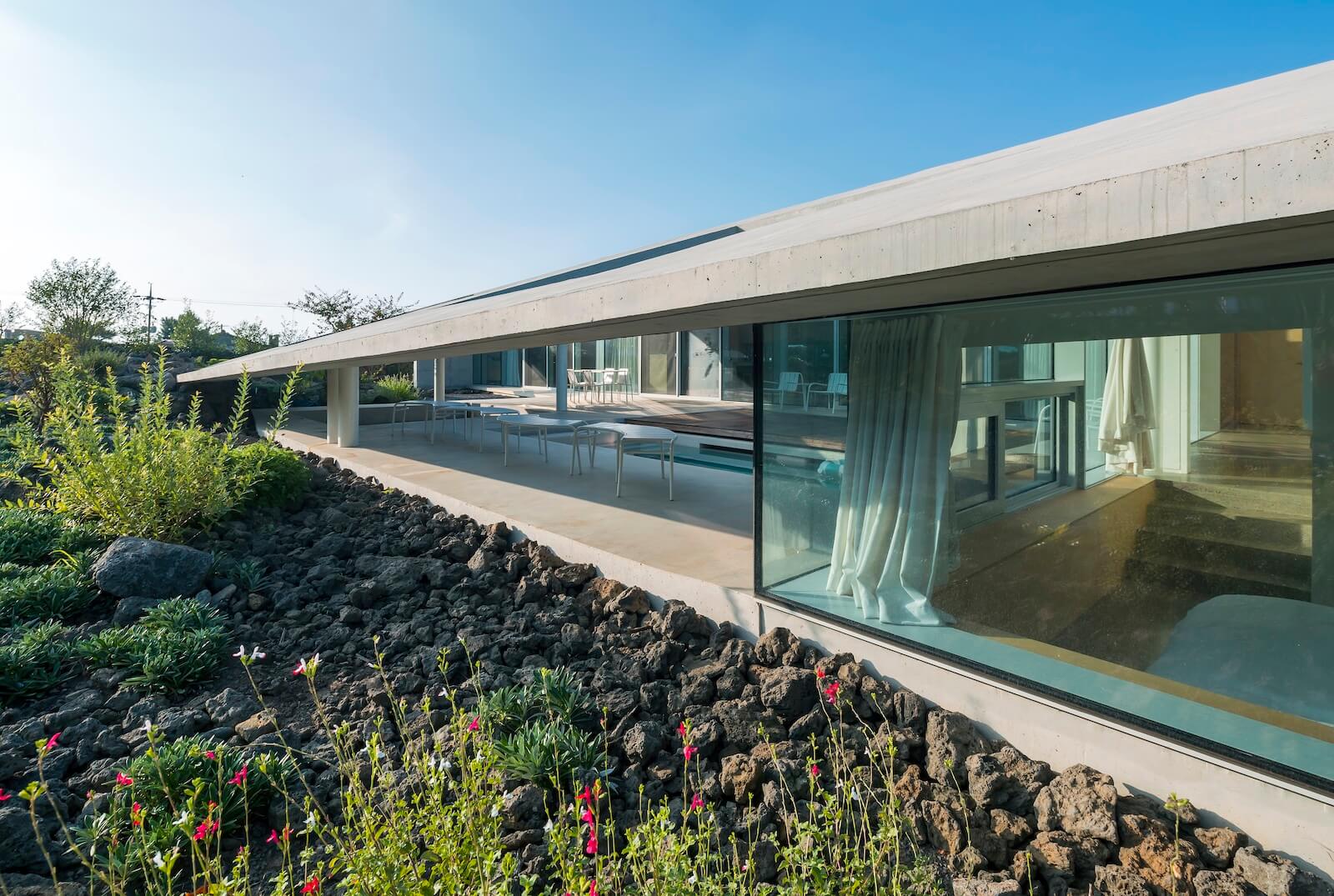
Since completing his Courtyard House of 2004 (ㅁ-Shaped Concrete Box House), Cho has refined a method in which concrete cures to complete its own waterproofing: A gradient of about 20 degrees prevents the concrete from slipping during the pour, eliminating the need for an additional membrane and allowing the volume to remain visually precise. Through repeated on-site testing, Cho has honed this method for ensuring his buildings settle quietly into the land with a restrained expression.
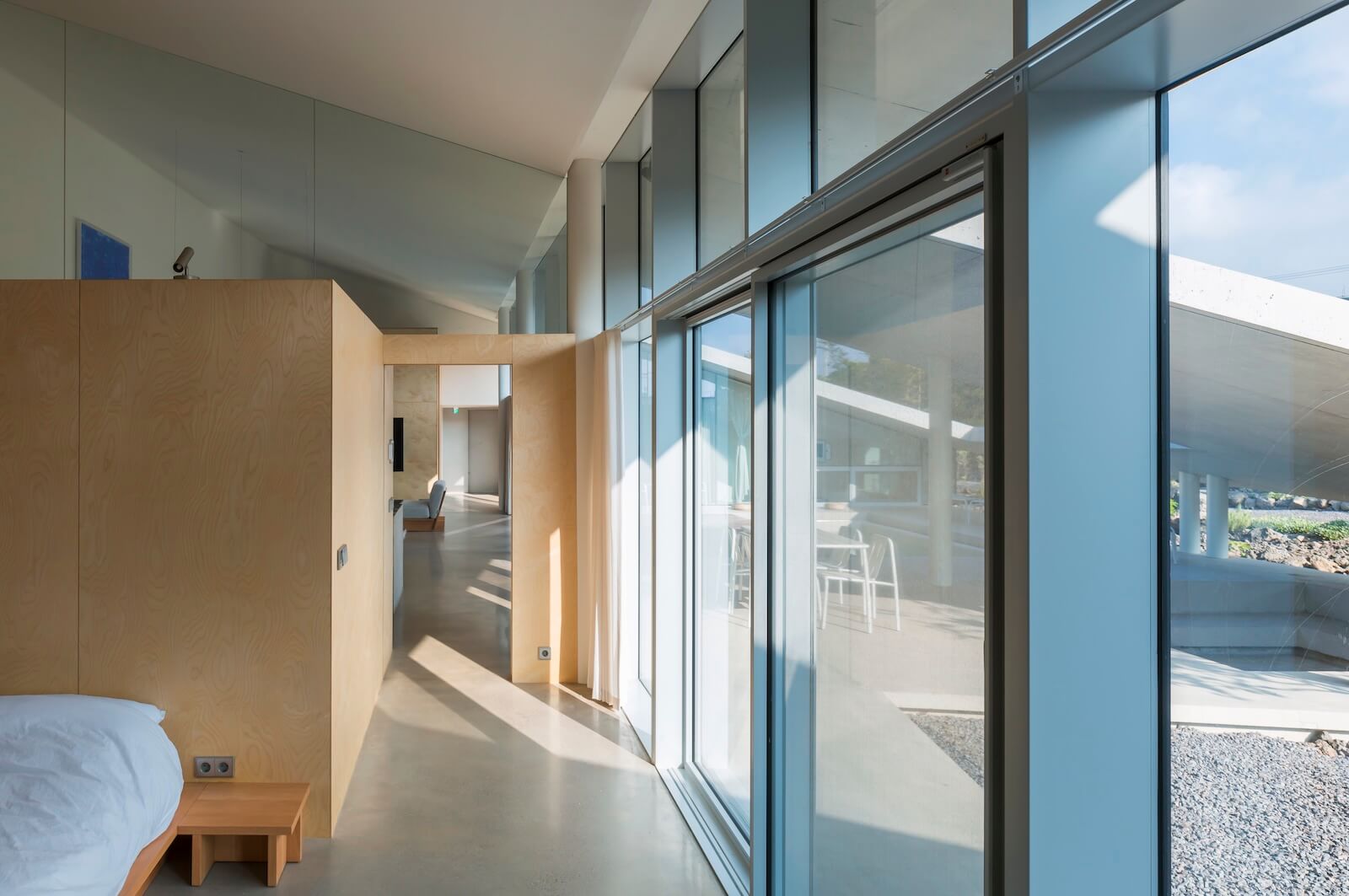
The most challenging question: how to shape the entry. “I think most about how people enter and experience a building,” Cho says. With the open front of the building exposed along the approach, it was crucial to establish a coherent progression of arrival. The roof provides the first layer of shelter, but beneath it, and near the main gate, stacked stones and newly planted trees were added to strengthen the transitional buffer. The main entrance was placed on the east side of the building, so one crosses a modestly sheltered forecourt before reaching the front door.
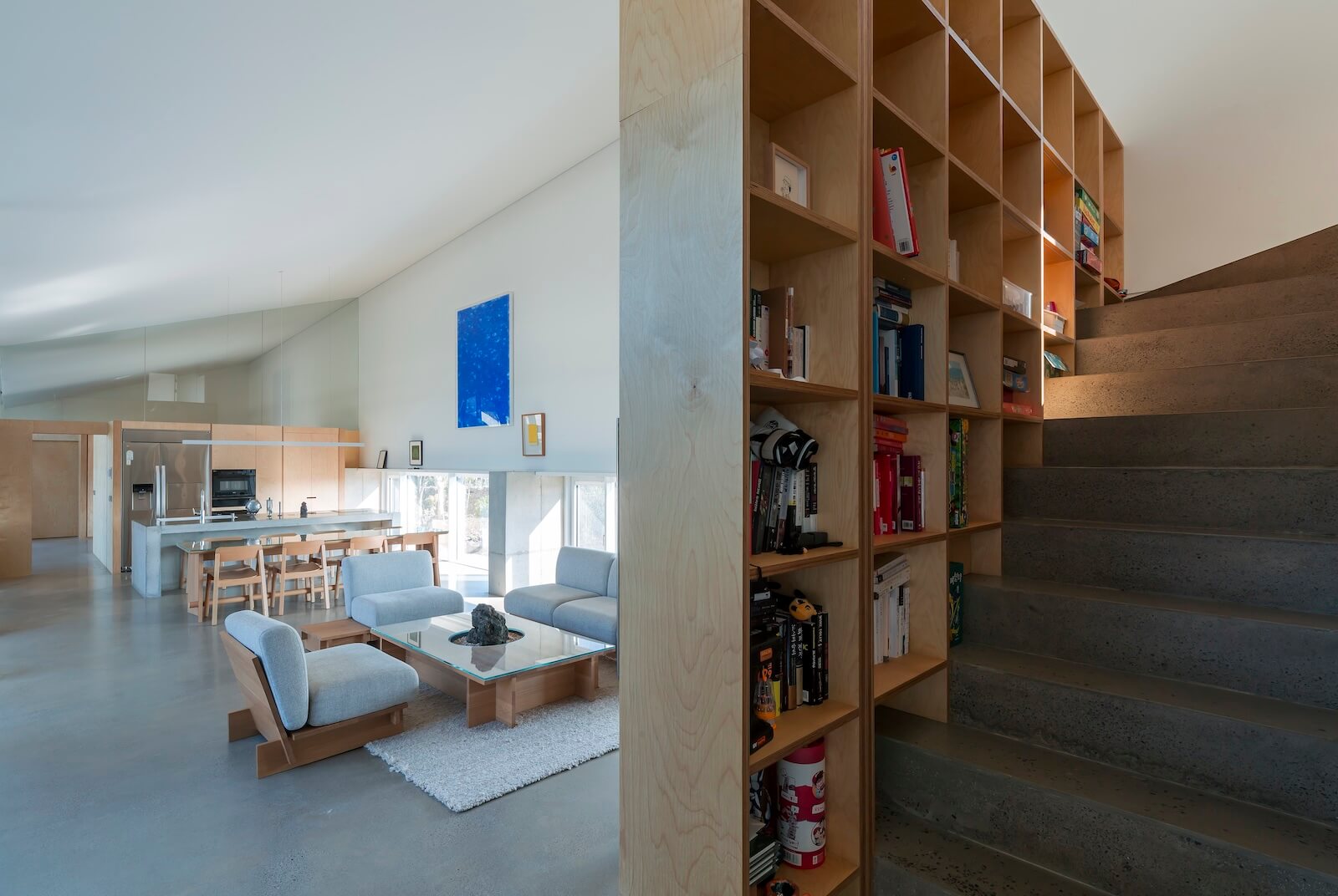
Next, Cho considered the manner in which one moves through the interior. “Korean temples respond to the terrain and create natural sequences, and I also consider what people will see and encounter as they move inward.” The house’s quiet form serves as a backdrop for this unfolding sequence of experiences rather than seeking attention on its own. On the pool side — where your eye level is comparatively lower — the roof was lifted slightly to open up the outward view. This produced rooflines of differing heights and a subtly tilted plane. The raised section also allowed for a small attic space for the children.
Since that early Courtyard House, Cho has created a series of boxlike residences with courtyards open to the sky and in-between spaces that carry light and wind. His interest in the ground has continued to evolve, especially on sites that are damaged or difficult, by reconsidering and refining the experience of arrival. The Tilted Roof House of 2014 used the canopy to resolve the experience of approaching an inclined site and to envision a new kind of yard — and the Sloped Roof House extends this trajectory. Here, the angled formation is not only a visual gesture but also an active element that responds closely to the land, supplements its weaknesses and participates in shaping the terrain itself.
Reading the land and responding to it has always guided Cho’s work. He places the most outstanding value on natural context: topography, wind, water and other physical conditions. Although he believes that land is best left in its original form, his architecture steps in to repair or complement the ground when it has been altered or marred. In that process, building and land become inseparable, forming a continuous whole. The Sloped Roof House, facing Sanbangsan as if it has gently risen from the earth itself, is one such expression of this approach.
Byoung Cho’s Sloped Roof House Meets the Ground — and the Mountain
On Jeju island, with a view of Sanbangsan, Sloped Roof House is the latest and most daring courtyard-typology house by Byoung Cho and his Seoul-based BCHO Architects Associates.