
Montreal is practically synonymous with placemaking. From year-round events that animate the Quartier des Spectacles, North America’s largest cultural district, to pedestrian-first streets and thoughtfully designed public realms, the city has more than earned its designation as a UNESCO City of Design. Yet strong urban design alone is only the starting point. What gives public spaces lasting life is how they’re activated over time, complementing permanent design with evolving experiences that speak to culture and community. For decades, temporary, participatory installations have played a vital role, alongside permanent infrastructure, in bringing energy, joy and social connection to the city. It was within this context that, in 2015, entrepreneur Benoît Lemieux identified an opportunity: to extend Montreal’s expertise in activating public space beyond the city itself, bringing interactive art initiatives to new places while giving local creative talent a broader platform.
Leveraging his experience in project management and public space planning, he founded Creos with the vision to democratize public art, acting as a bridge between cities, host spaces, architects, artists — or really anyone who programs public spaces. A decade later, the company has produced over 500 projects across more than 130 cities, managing the entire end-to-end process from market development to touring logistics and maintenance. In this way, Creos takes on the operational complexity of these endeavours so that artists can do what they do best: make inspiring work that connects with the community. In doing so, the company has developed a unique model for the international circulation of public art, enabling works to travel across borders while preserving artistic integrity and expanding their social impact.
Developed with a roster of artists, Creos’s interactive installations can give new life to underutilized urban spaces, from parking lots to alleyways. Each project is shaped through dialogue, ensuring accessibility, contextual relevance and audience engagement while fully respecting artistic intent. In some cases, works are thoughtfully adapted — to support accessibility requirements or touring logistics — but always in conversation with their creators.
The company works across two complementary models: a touring program that brings existing installations to new cities on a rental basis, and fully commissioned, site-specific projects developed with partner investment. Below, we explore three of the company’s successful collaborations, each introducing an element of surprise into the public realm while making a lasting impression.
The Urban Conga — Oscillation and Optik
Brooklyn-based multidisciplinary studio The Urban Conga first partnered with Creos through Oscillation, an existing installation composed of colourful, crystal-like forms animated by light and movement. Creos supported the international touring of the work, including its presentation at the Edinburgh Science Festival in 2022, helping introduce the installation to new public contexts abroad.
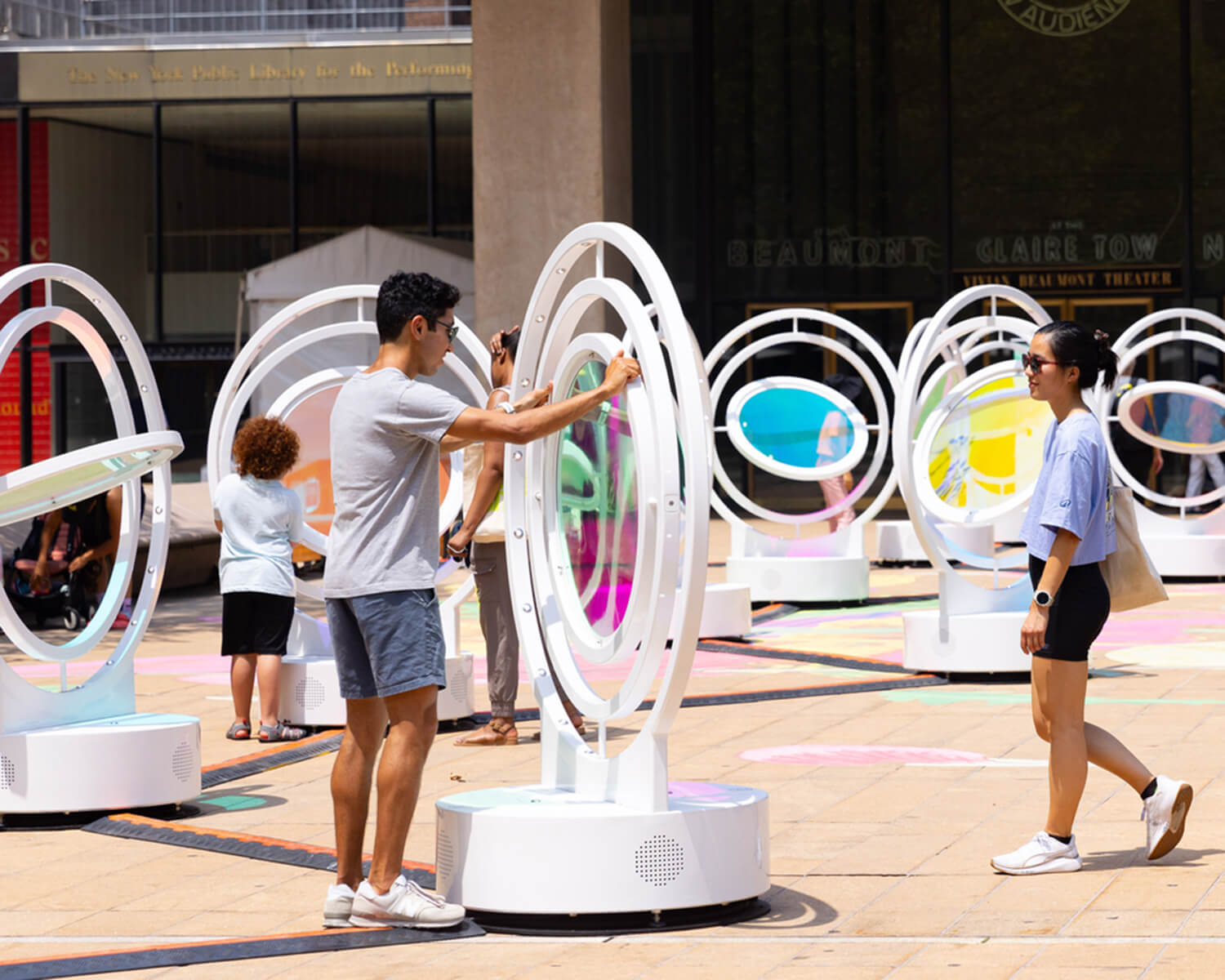
Following that collaboration, the studio returned to the drawing board with Creos to co-develop Optik as an entirely new creation. Building on shared interests in light, sound, and motion, the installation transforms a public square into a multisensory playground. Ten towering gyroscopic forms clad in dichroic film invite visitors to push and spin them, splintering daylight into shifting spectrums by day and glowing from within at dusk. As each unit rotates, movement is translated into musical notes that seem to compose themselves in real time.
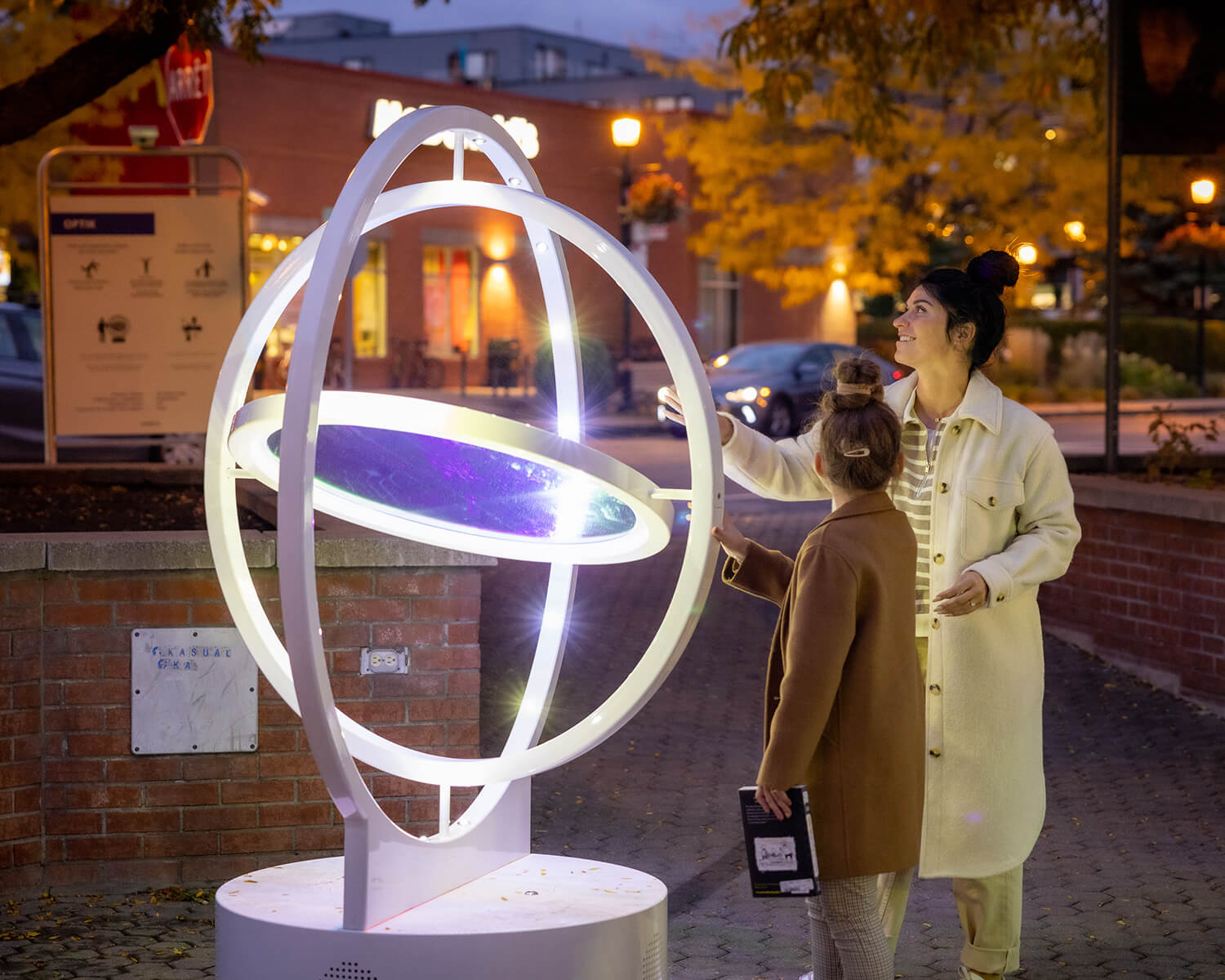
The result is a kind of kinetic choreography: cascades of colour and sound unfold through collective participation, offering ever-changing views of the surrounding streetscape. By placing authorship in the hands of its audience, Optik turns everyday movement into shared experience, and the city’s fabric into a stage for collective
discovery — from New York’s Big Umbrella Festival to Liverpool’s River of Light (2025) and Illuminate Adelaide and Vivid Sydney (2026).
Julie-Christina Picher and Dave Jenniss — Weci | Koninut
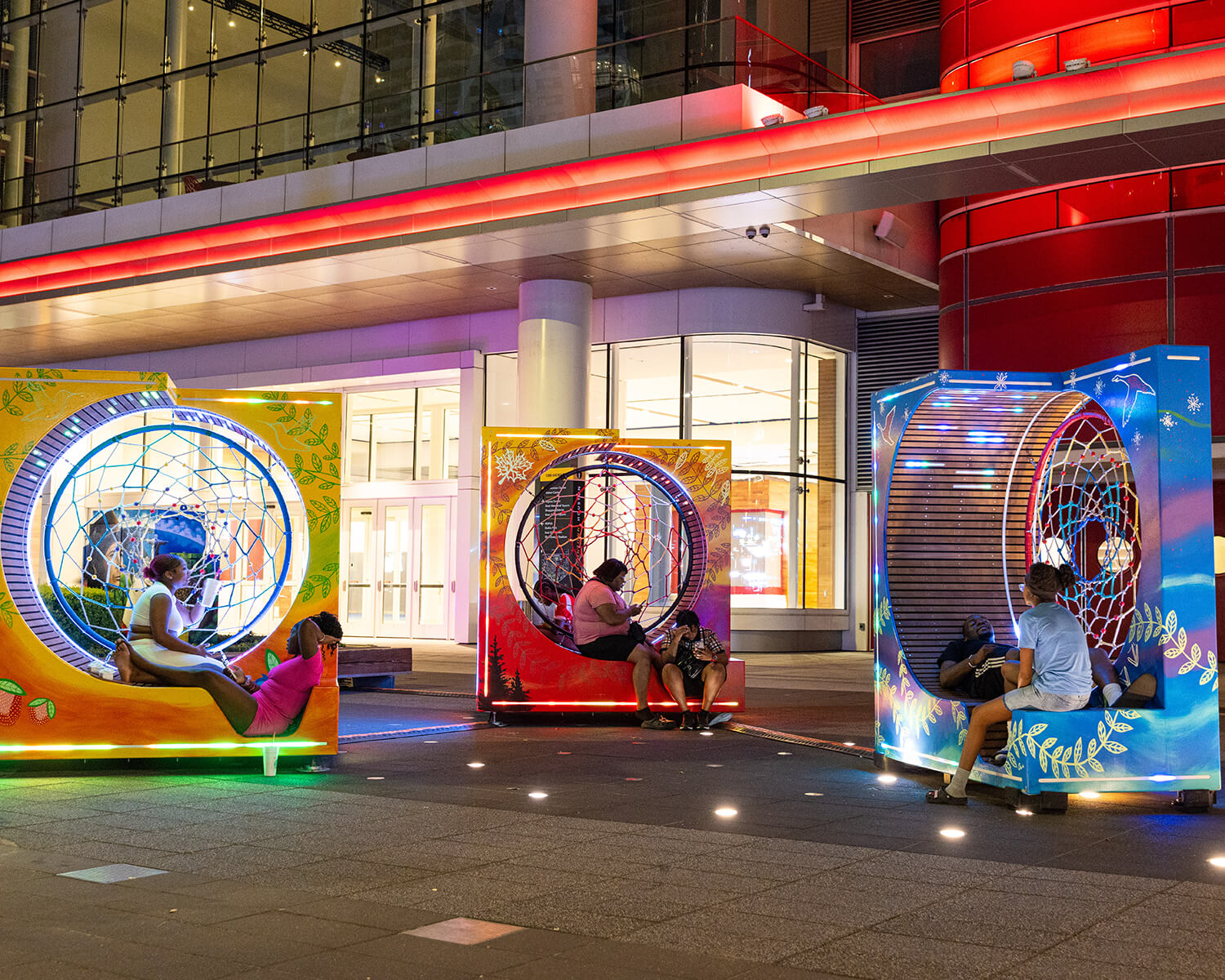
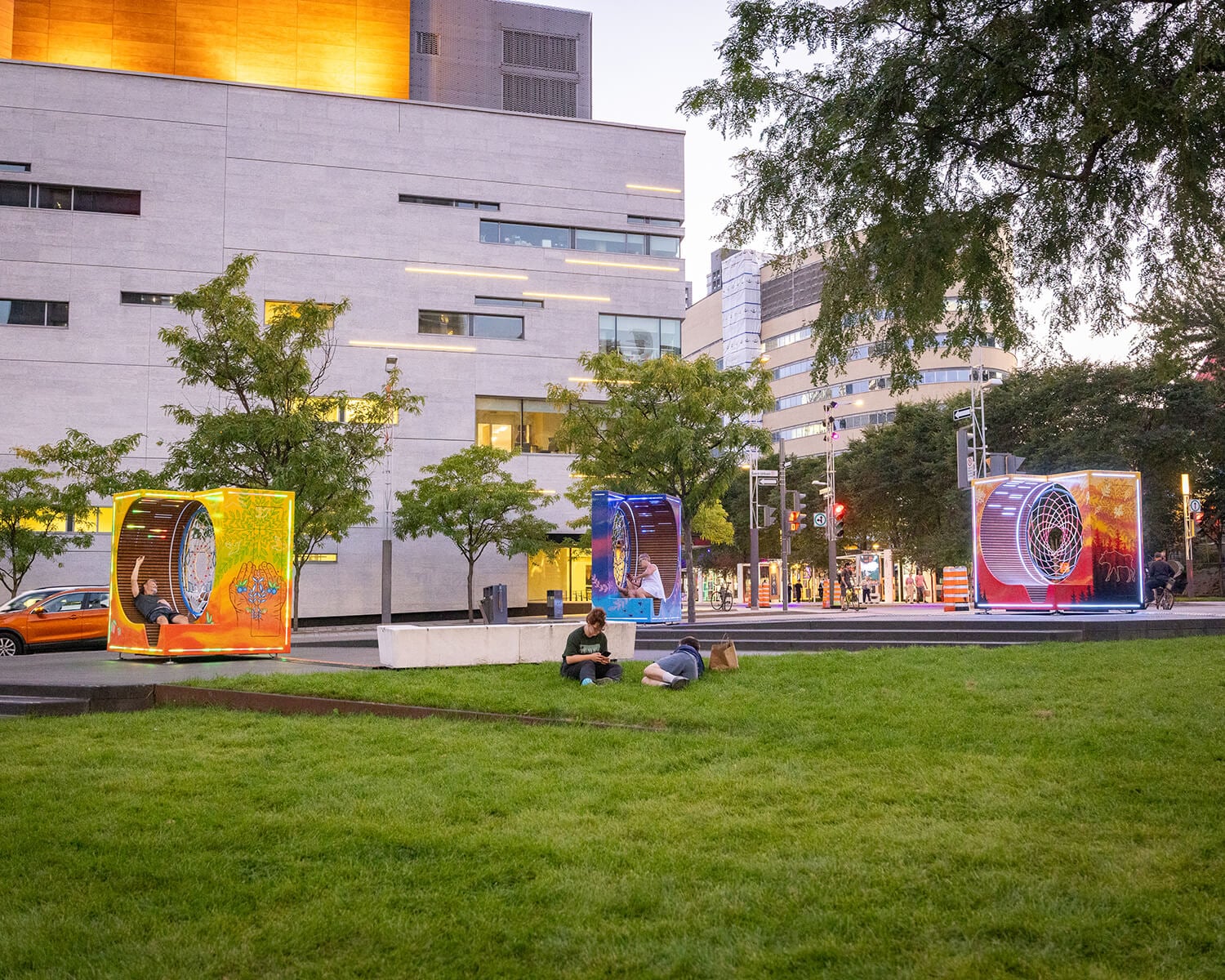
Co-produced with Houston First and designed by Quebec-based Indigenous artists Julie-Christina Picher and Dave Jenniss, Creos’s most recent project is a celebration of Indigenous cultures — and the beauty of the land. Composed of six giant dreamcatchers integrated with light and sound elements as well as seating, Weci | Koninut guides visitors through a “sensory journey through the forest,” inviting them to explore each season from Pitcipipon, the Pre-Winter, to Takwakin, the Autumn. “Creating Weci | Koninut meant stepping outside the traditional framework of theatre to design a living space, a set to inhabit,” explains Picher. “It is a work that literally transports the audience from their urban everyday life into a sensory immersion in the heart of the forest, following the rhythm of the seasons and stories.”
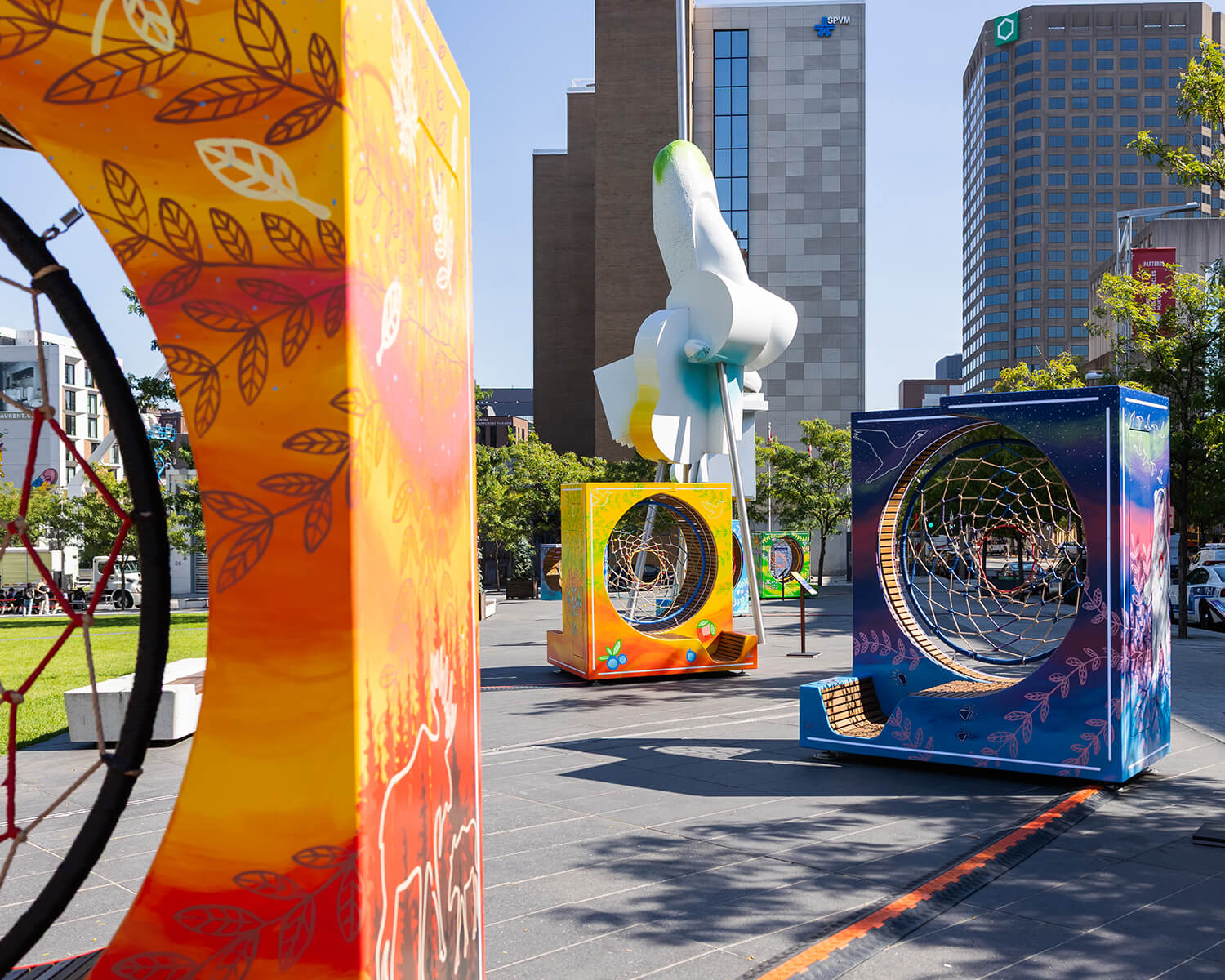
While the artwork is rooted in local Indigenous traditions, it resonates deeply even across borders. “Bringing Weci | Koninut to Houston underscores our efforts to make the city a global destination for culture and innovation,” explains Michael Heckman, President and CEO at Houston First Corporation. “This unique installation offered our community an exciting immersion into the richness of Native traditions, celebrating the importance of art in building bridges between peoples.”
Esrawe + Cadena — Los Trompos and Mi Casa, Your Casa 2.0
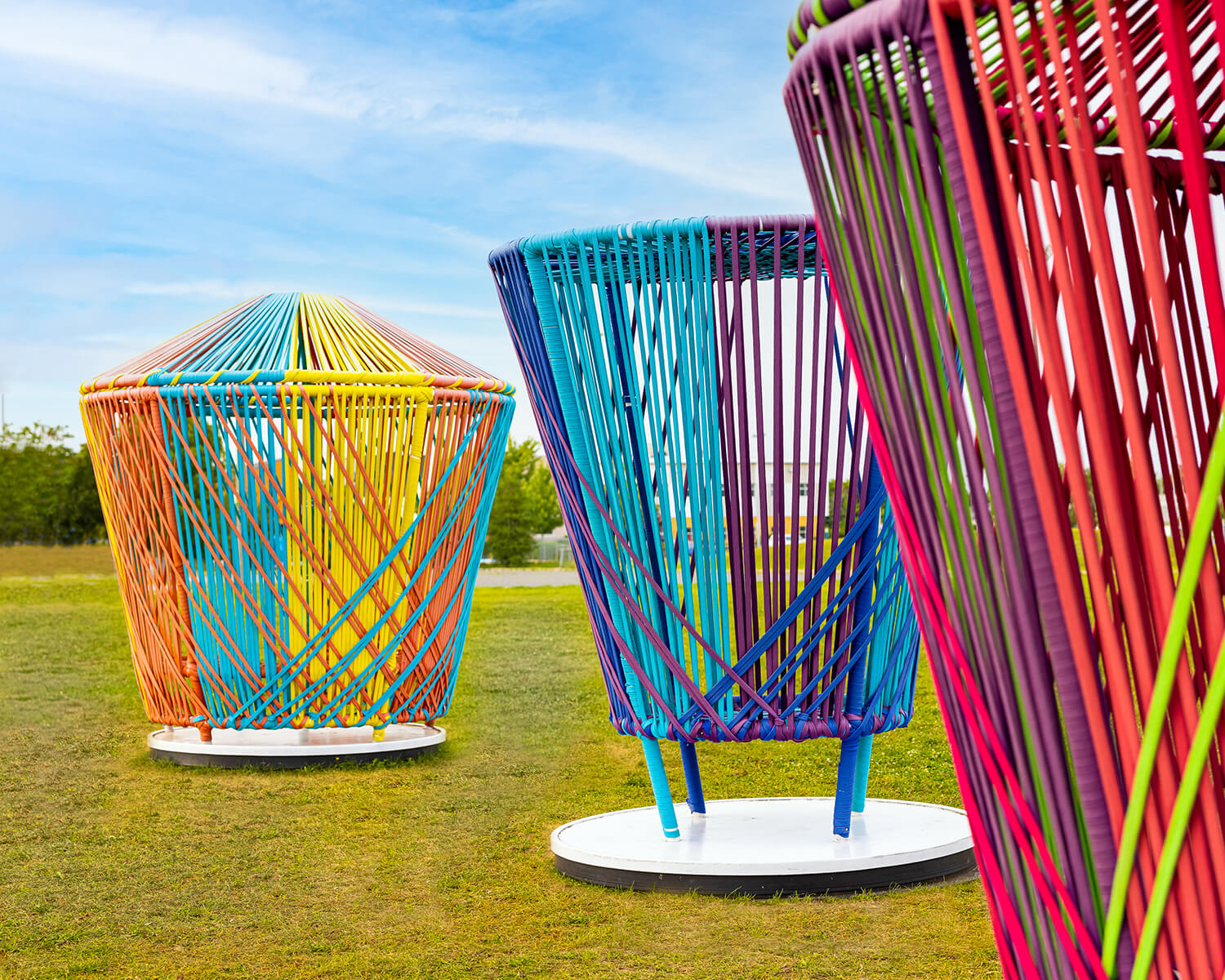
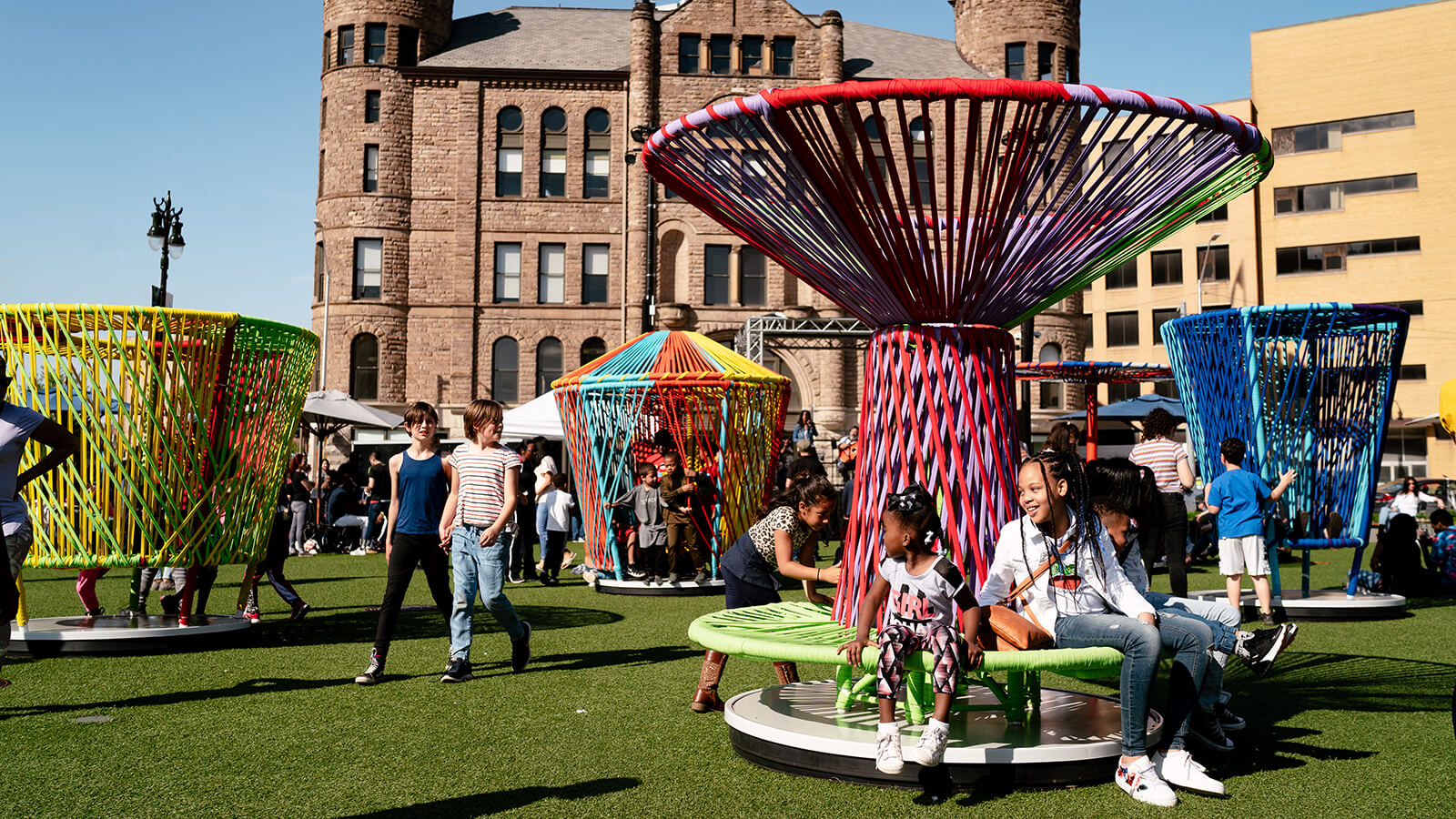
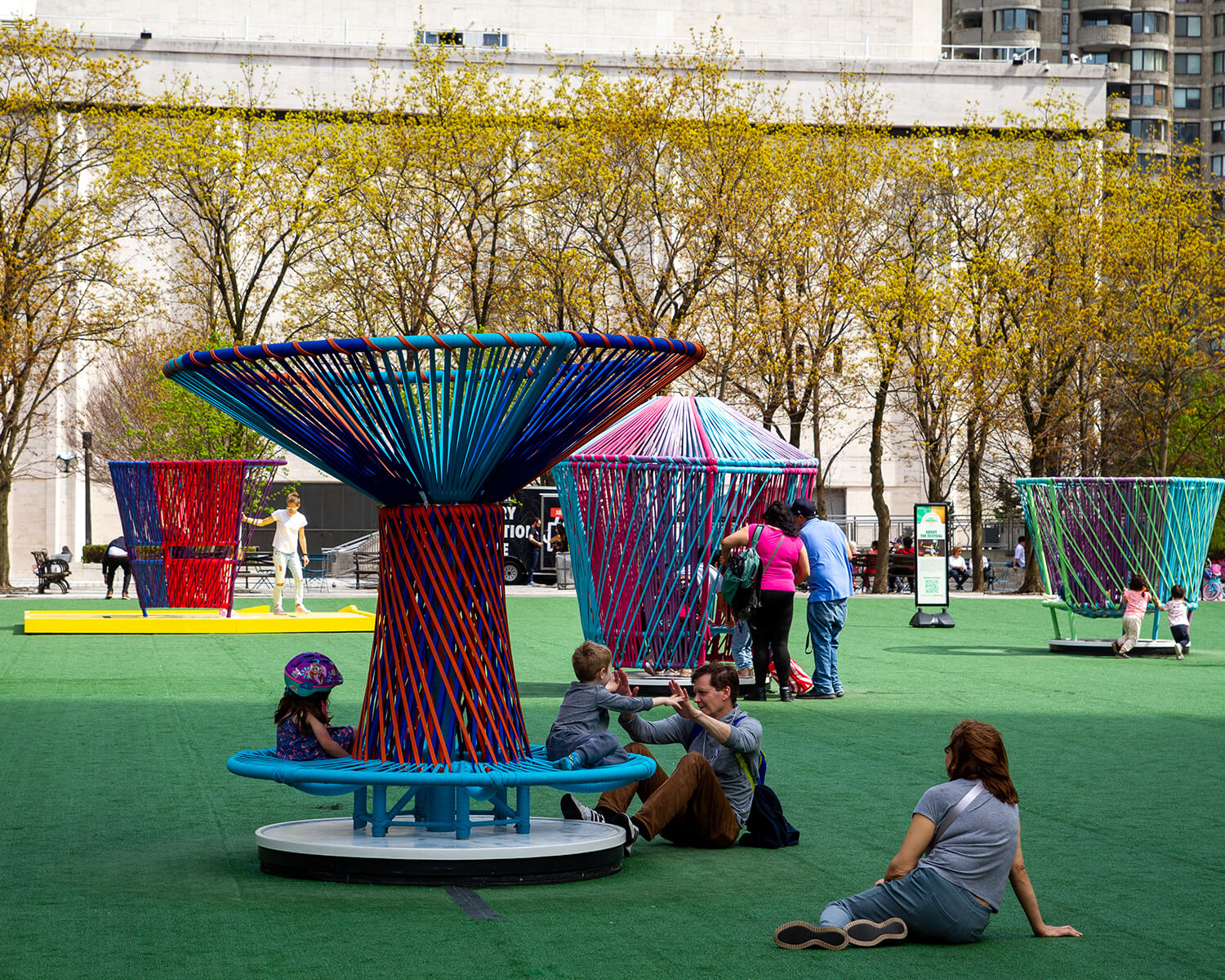
Through their installation designs, Hector Esrawe and Ignacio Cadena draw on their shared Mexican heritage, while still managing to remain universal in their appeal. Los Trompos is a case in point. The project was first commissioned in Atlanta, where it quickly proved its merit. Building on that success, the Downtown Detroit Partnership commissioned a new set of units for installation at Beacon Park. Creos then stepped in to support the installation’s evolution into a travelling edition that brought the work to a major public audience. Featuring larger-than-life spinning tops wrapped in fabric woven in a traditional Mexican style, Los Trompos reimagines a familiar childhood object at an urban scale. The rotating platforms invite collective participation — seating several people at once and requiring shared effort to set them in motion — turning public space into a site of colour, movement and play.
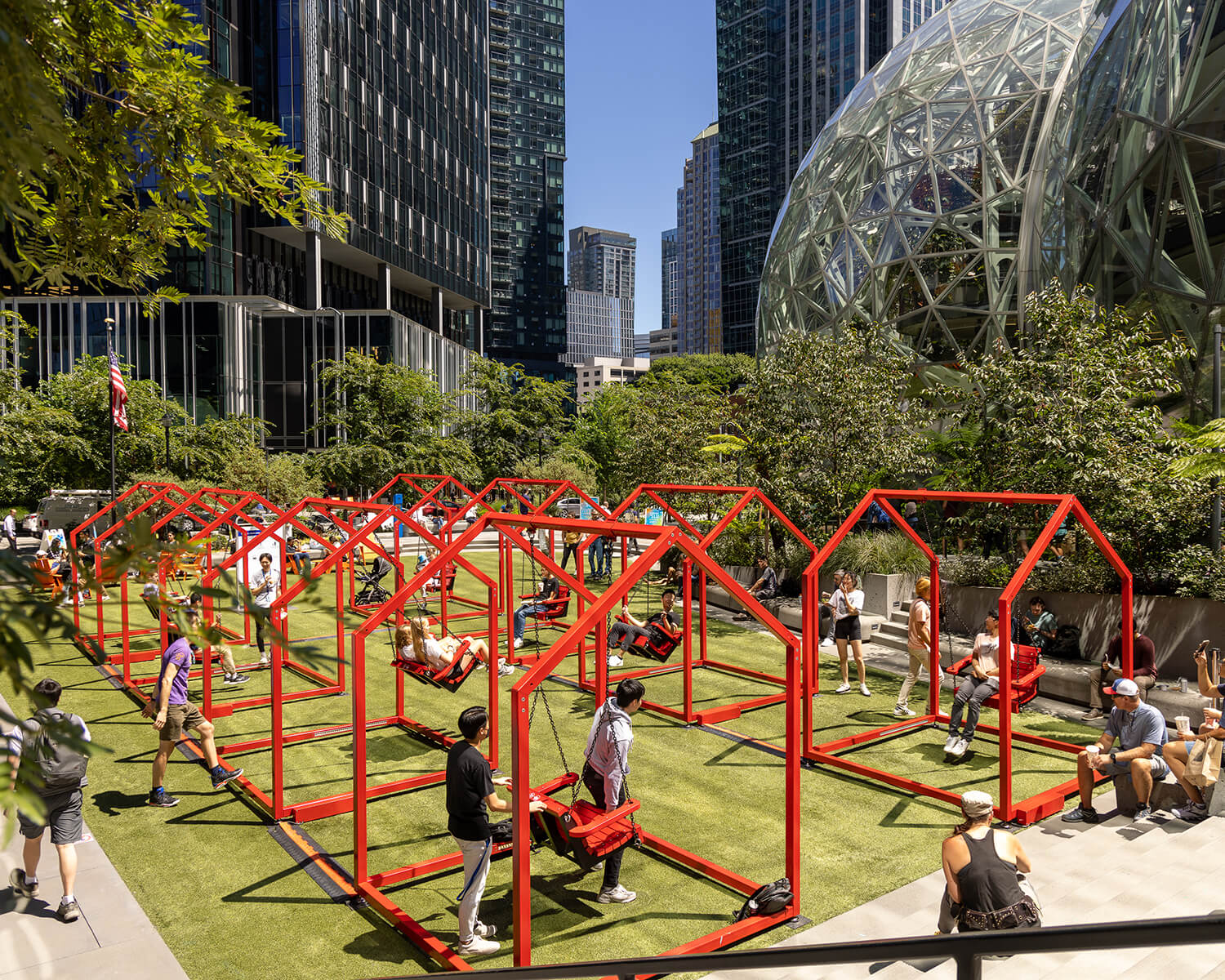
The duo later reunited with Creos to produce Mi Casa, Your Casa 2.0, an evolution of an earlier work inspired by the mercados or street markets of Latin America — informal gathering places rooted in exchange and connection. Working closely with the designers, Creos helped transform the installation into a touring, interactive version capable of travelling internationally. Composed of striking red frames shaped like small houses, each outfitted with a swing, the installation responds to human presence: when a casa is unoccupied, a soft white light invites entry, intensifying once someone is “home.” Welcoming across generations, the project pairs emotional resonance with material consideration; the swings are crafted from urban ash, giving a second life to trees felled in Montreal due to the emerald ash borer.
“CREOS have handled the interactive installations created by Esrawe Studio + Cadena Concepts with the utmost respect and passion, says Rahul Araiza, designer at Esrawe Studio. “Thanks to CREOS, we have been fortunate and proud to share our work with an ever-growing audience, supported by their hard work and exceptional ethos.”
By bringing temporary installations into parks, plazas and streetscapes around the world, Creos creates entry points for cultural connection that reach audiences far beyond traditional galleries or museums. Underpinning this ambition is a depth of operational expertise that is often invisible, but essential. Touring interactive public art across borders demands sensitivity to local contexts, regulatory environments, climate conditions and patterns of public life. Creos’s ability to navigate this complexity, while supporting artists and partners every step of the way, is paramount to its success. The result is a model that makes ambitious public art projects easier to realize, and more accessible to the communities they serve.
This content was published by Azure on behalf of Creos.
Creos Brings Engaging Public Art to the Global Stage
With over a decade of experience — and a roster of top design talent — the company transforms public spaces around the world through impactful travelling art installations.