

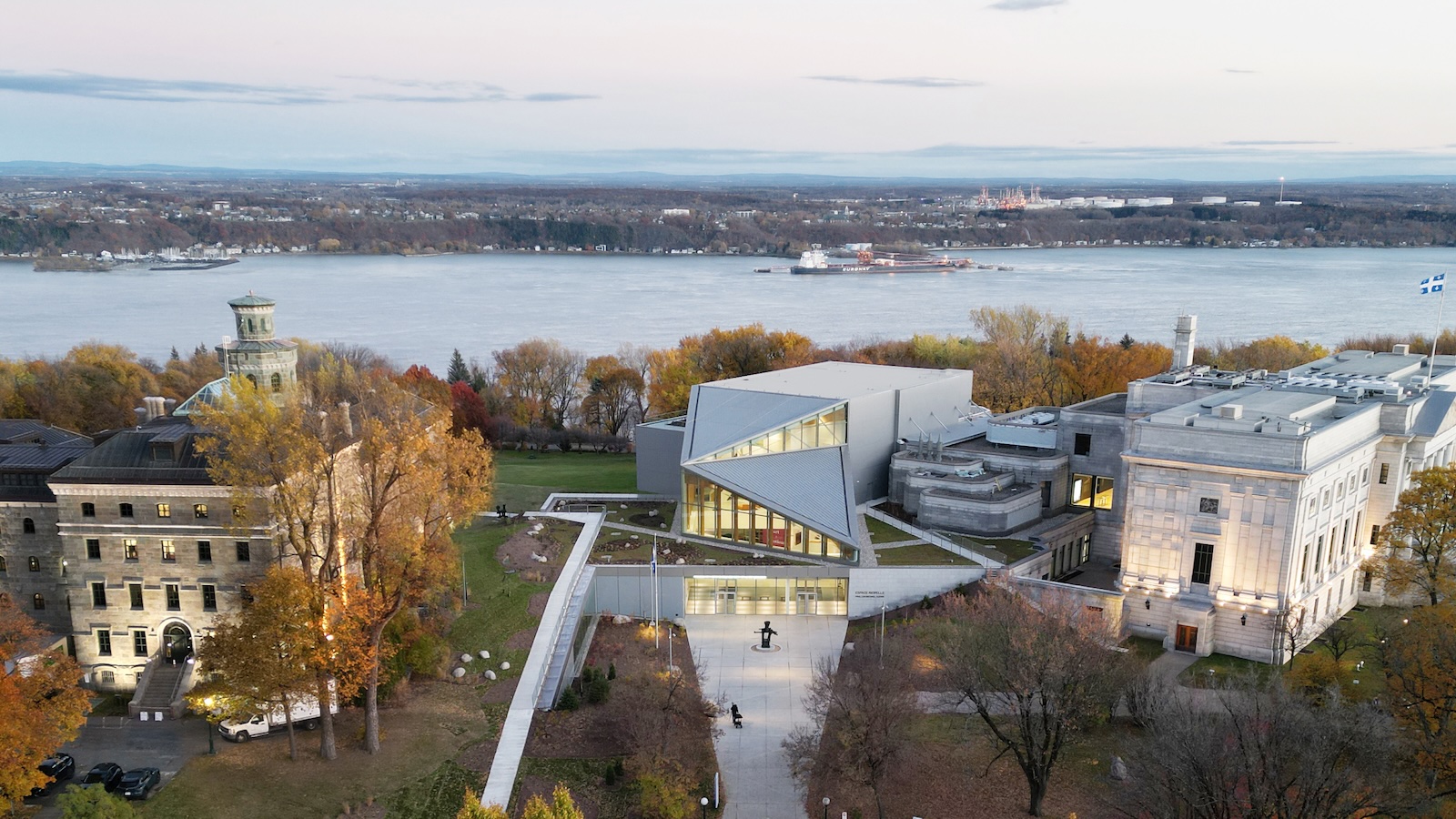
When designing a museum dedicated to a single artist, there is always the danger that it could become a mausoleum. Happily, the newly opened Espace Riopelle Michael Audain Pavilion in Quebec City by FABG is instead a living — and vibrant — shrine to the late, great Jean-Paul Riopelle. Situated on the Musée des Beaux Art du Québec’s (MBAQ) architecturally and historically rich site adjacent the Plains of Abraham Park, Espace Riopelle grounds itself in framed views of the landscape that inspired him, opening up public spaces to the beauty of surrounding greenery and the St. Lawrence River. The $84 million project was funded by Michael Audain (with help from the province and City of Quebec as part of Riopelle’s 2021 centenary) to bring “home” the scattered collection — more than 230 works — by one of Quebec’s, and Canada’s, most renowned painter-sculptors.

The journey to craft this dedicated museum has its own story: As MBAQ director Jean-Luc Murray notes, Riopelle expressed a desire in the 1980s to establish a foundation inside the museum’s Charles-Baillairgé Pavilion, created within a neo-Renaissance prison as an addition to the original, neoclassical Gérard-Morisset Pavilion, built in 1933; he wanted it to be both a showcase for his art and a bridge between creators from all disciplines. Then in 2016, MBAQ opened the strikingly modern Pavillion Lassonde, designed by OMA and Provencher Roy, which displays the collection of mining magnate and philanthropist Pierre Lassonde, including many legendary Riopelle works.
Nearby, the landscape hosts its own juxtapositions: There is the Wolfe Monument to the Battle of the Plains of Abraham (on Espace Riopelle’s opening day, just when the new Parti Quebecois government was being sworn in, a Canadian flag flew outside the national park’s offices — officially federal territory) and more recent works, including Wendat Nation artist Ludovic Boney’s Des perles en mémoire (2024) and 7IDANsuu James Hart’s The Three Watchmen, unveiled two years ago on Canada’s National Day for Truth and Reconciliation.

In its own way, the new Espace Riopelle brings together the historic and the contemporary, as well as the visitor and the artist. It is also a device for mediation between the existing built and natural environments: The 5,600-square-metre building offers continuous framed views of the Quebecois landscape at every turn; its luminous mirrored surface reflects architectural and natural landscapes as well as images of the viewers themselves, at once framed and implicit in the genus loci. Lead architect Eric Gauthier tells Azure, “I’ve been obsessed all my life by Rosalind Krauss’ idea that art is an index pointed towards something that is already there.”
Fittingly for a space dedicated to an artist who defied the conservatism of mid-century Duplessis-era Quebec, there is a sense of liberation in Espace Riopelle. It finds its expression in the site context: The building was erected over an underground storage vault — what was once a tunnel leading to that subterranean space has been transformed into a glass-framed extension with windows that let in light and views and orientate the visitor. This structure extends into a ramp that leads to a green roof covering part of the first of three floors (the first and second floor connect to the Gérard-Morisset Pavilion building), allowing patrons to walk on top of the rectilinear space.

Gauthier explains that the underground vault, and the tricky business of finding the right spot for structural columns, necessitated the idiosyncratic geometries that define Espace Riopelle, whose material palette of glass, zinc, granite and black spruce from Northern Quebec evokes the boreal forest that so inspired the artist. The entrance is covered by two isosceles triangles — sloped zinc clad roof surfaces that also cover the interior atrium. Just inside, a cathedral to nature is revealed, formed by those triangular roofs with triple-height glazing drinking in light and views. The geometrically complex space is both a lobby/entrance way, community gathering and performance area, reflecting the multiple roles of contemporary art museums. A diagonal stairwell leads to the second floor, where visitors are greeted by a giant print of Yousuf Karsh’s portrait of Riopelle and a chronologically unfolding exhibition of his greatest works. While the gallery areas throughout are protected from light, the public areas extend the view outwards.

The third floor is the jewel in the crown. Here, Riopelle’s 1992 masterwork L’hommage a Rosa Luxemburg, which he created in his secluded Ile-aux-Oies studio in the fall of 1992, after the passing of his companion of 20 years, the American painter Joan Mitchell, is given new life. This meditation on creation and mortality, which was inspired by the snow goose migration that Riopelle observed each spring, is displayed for the first time on a circular surface using a novel hanging system. A huge glass wall offers a view of the St. Lawrence River, where birds in the thousands descend every year, as does an outdoor terrace. Gauthier calls it a “temple” to the artist, and indeed there is a sense here of a sacred moment.
While Riopelle’s best work was an abstraction of nature, the new space is a delightful reimagination of his ethos that ultimately surrenders to the power of wilderness. “More than four decades later, [Riopelle’s] dream is taking shape just a few steps away [from Charles-Baillairgé Pavilion],” MBAQ’s Murray says, “an entire building dedicated to honouring his work and placing it in dialogue with pieces by other artists.”
Espace Riopelle Surrenders to the Power of Nature
FABG inaugurates a new pavilion dedicated to the renowned artist Jean-Paul Riopelle at the Musée des Beaux Arts du Quebec.