

Illuminating films, collectible furniture, magical kinetic art and more — our November 2027 events roundup has something for everyone. As we cling to the cool autumn weather while getting psyched for the holiday season, put these energizing cultural appointments on your calendar.
1
ADFF Toronto — TIFF Lightbox

The Architecture and Design Film Festival lands in Toronto with a series of thought-provoking documentaries that dive into the humanist heart of architecture and design. Sure to be a fan favourite, The Tower that Built a City stars Toronto’s CN Tower as a “living character — conceived in ambition, tested in construction, dismissed as kitsch, and ultimately reborn as an icon.” It explores the soaring needle, that main protagonist of the city’s skyline, as a shorthand for Toronto and uncovers the many meanings it holds for the architects, engineers, artists, historians and others featured in the film.

The well-rounded program also includes Bauhaus Forever, where a new museum rises in the shadow of the legendary design school; and Googie, a celebration of the distinctly kooky style of Los Angeles space-age modernism. Not to miss: Out of the Picture explores the “invisibilization” of women in the history of architecture by investigating the “cultural and institutional mechanisms that erased their contributions, while highlighting the solidarities and strategies they develop today to reclaim visibility and legitimacy.” And Barbara Buser — Swiss Pioneer of Sustainability spotlights one woman architect active today whose work we should all be following: She saves buildings from demolition and renovates them using reclaimed building materials.

AZURE will also be moderating two talks for two film showcases on Saturday, November 7. The first is Young Climate Stories, a trio of short films about three winners of The World Around‘s Young Climate Prize: A Garden in the Desert, focused on Mohamed Salem Mohamed Ali’s ingenious thriving garden in an Algerian refugee camp; How To Plant A Lake, about Dayana Blanco Quiroga’s heroic efforts to clean the mining-polluted waters of Bolivia’s Uru Uru Lake (photo above); and The Only Way Forward, which documents Lebanaese entrepreneur Carlos Ayvazian’s mission to turn agricultural waste into fuel. Later that same evening, join us as we moderate a conversation about Five Living Buildings (by Renzo Piano), a deep dive into the Italian master’s projects.
2
Paul R. Williams: Architect for Living — LACMA, Los Angeles

Paul R. Williams was the most prominent Black American architect of his time — an era of socially permissible, overt racism. Williams taught himself how to sketch upside down so that he could communicate his ideas from across the table to white clients who would not sit next to him. At one of his most iconic buildings, the Beverly Hills Hotel (its marquee is in his handwriting), he wasn’t even allowed to walk in through the front door. And yet Williams shaped his native city (and places far beyond) from the 1920s to the 1970s through the thousands of buildings he designed.

Curated by Staci Steinberger and Sarah Locke, LACMA’s exhibition (November 15 to May 31, 2027) is the largest and most comprehensive of three shows (the Getty will launch its own in mid-December) focused on Williams’ vast range of work. His portfolio includes homes he built for the city’s reigning stars (Frank Sinatra and Lucille Ball among them); religious projects like the marvellous First African Methodist Episcopal Church of Los Angeles; and other hospitality projects of renown, including La Concha Motel in Las Vegas. Among its 120 drawings and photographs are many that have never been exhibited before. Designed by Studio Barnes, the Miami firm led by Germane Barnes, the exhibition is supplemented by a dedicated website designed by Folder Studios, which maps Williams’ projects across Southern California.
3 & 4
Lessons in Objectology & Kamiphony – Koffler Arts, Toronto

The New York Times named Toronto sculptor Gord Peteran the “philosopher of furniture.” In Lessons in Objectology, curated by David Liss at Koffler Arts, a one-time classroom in a former school building — now the multi-tenant Youngplace creative hub — is filled with his haunting (and possibly haunted) pieces. One is a wunderkammer housed in a Wurlitzer harp case; the compartments in its velvet upholstery are custom-shaped for the strange assemblages within, which each carry their own additional surprises. Another is a tiny room-within-a-room for a single person to sink into; it recalls the claustrophobic solace of the confession box. Both hidden and laid bare, guns and halos are prominent in many of these pieces that mix humour and darkness, the benign and the sinister, “trash” and craftsmanship.
Peteran is delving into the subliminal and symbolic, reimagining discarded and donated furnishings as something other — or as perfect in their brokenness (one artwork is a chair suspended in a shattered state by an elaborate metal framework). His 3D paintings feature mordant juxtapositions — a tiny print of the Mona Lisa framed within a larger tapestry of tubes, wires, knobs and a horseshoe. His description of his work is almost just as great as the work itself: “Between what the object might have been, and what the object might come to mean, presents a chasm of possible ways to “re-store” the performative nature of every thing. In every home.” Rush to see this show; it closes November 8.

A foil (though an unintentional one) to Peteran’s show is Cybèle Young’s Kamiphony, curated by Zoë Foster and on until December 13. There is lightness here — in the vast array of vibrant, multicoloured artworks made of Japanese paper — but also angst. “Kami” is Japanese for both “paper” and “god”, while “phony” refers to sound. Pass through a double arch inspired by Mexican festivals to arrive at the centre of the exhibition and you’ll find Machine Pantheon, where a series of intricate kinetic paper machines are installed on individual tables, their choreography projected on screens to provide a dual interpretation of each work. The movements have no real purpose, and that’s the point: “uselessness” can also be beautiful. “From Aristotle to Baroque automata, and from Bruno Munari to Jean Tinguely’s anarchic sculptures, philosophers and artists have long returned to this idea,” the artistic statement posits.
The notion of “uselessness” is also deeply personal to Young, who crafted this body of work while experiencing both long-COVID and menopause. The show includes a marvellous wall-mounted piece — almost a complement to Peteran’s 3D paintings — that depicts miniature domestic scenes and objects with a miraculous level of detail. By using shadow play and projecting tiny films onto tiny gemlike surfaces — with brooms, scrunched facial tissues, flora and fauna in seeming free fall — the artwork invites endless discovery.
5
The Mall – Powerhouse Parramatta, Sydney

The Powerhouse Museum celebrates the opening of its new building in Parramatta, West Sydney, with this OMA/AMO—curated show about the evolution of the mall, “one of the most influential urban typologies.” While it is informed by OMA/AMO’s research into 101 malls worldwide, it takes as its main points of departure the nearby Westfield Parramatta, which opened in 1975 as Australia’s largest mall, as well as Western Sydney’s role in “pioneering a global model of large-scale, transport-integrated retail.”
The exhibition is presented in a black box gallery and organized around five thematic nodes: Desire, Arcade, Transaction, Ideal City, and Forum. “Together, these examine both the visible experiences of malls and their hidden systems — spatial, technological, economic, cultural, and social — while questioning the mall’s civic role….The nodes are arranged as a cluster on a continuous ground plane referencing the suburban car park and form a non-linear network that encourages free movement, mirroring how visitors navigate malls.”
6
The Harvest Season — Fondation Cartier, Paris

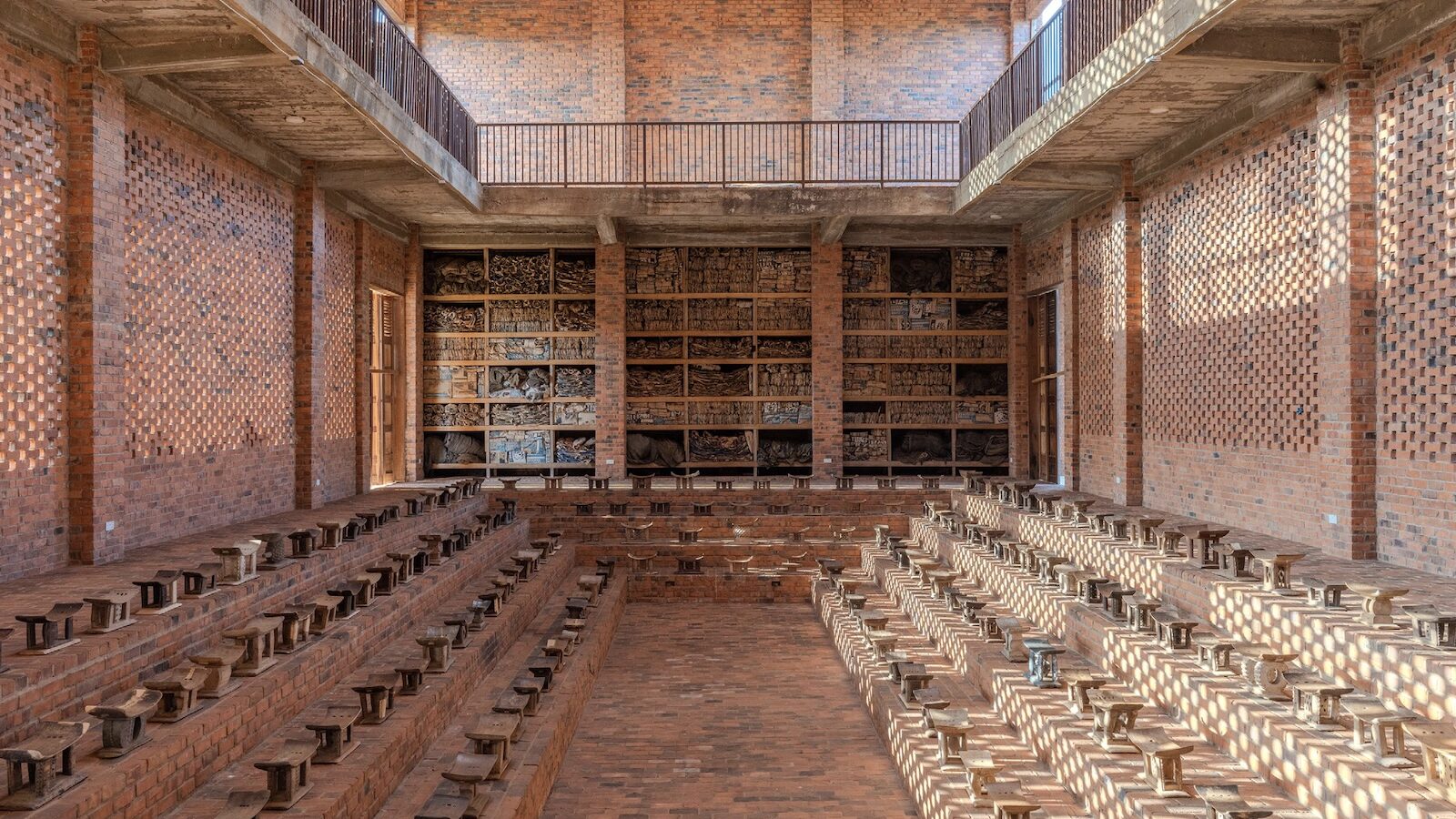
At the Fondation Cartier, Ghanaian artist Ibrahim Mahama serves up works specifically designed for the space, as well as new versions of some of his most iconic installations, including Parliament of Ghosts. First conceived in 2017, Parliament of Ghosts takes the form of a government chamber furnished with traditional Asante wooden stools. Symbolizing “reverse restitution,” by reinserting African craft into a colonial European museum setting, the installation also holds specific cultural meaning. “Emptied of its representatives, this ‘ghost’ parliament also acts as a metaphor for a failed democracy, an allusion to the 1966 coup in Ghana and the dissolution of the government.” Mahama and the Fondation Cartier will reanimate the setting with talks and performances, making it come alive with new life and energy throughout the exhibition’s run from October 22 to February 28, 2027.
Also as part of The Harvest Season, Mahama will present a monumental site-specific architectural feat entitled Things Fall Apart. In recent years, the artist acquired a former Ghanaian glass factory, which opened in 1966 as a major decentralization project by the country’s first president, Kwame Nkrumah; Mahama took it apart, moved its components to Tamale, and reconstructed it for the exhibition, reactivating it “as an artwork and a place of learning, transferring Ghana’s industrial heritage to a narrative of the future.” Finally, Mahama will create a textile installation for the arcades on the Fondation Cartier’s facade; it will be visible from the Place du Palais-Royal.
7
The Light in the Window — Buffalo AKG

The Light in the Window (October 30 to May 9, 2027) digs into Buffalo AKG’s archives to present works by 40 contemporary artists portraying their concepts of home. Curated by Holly E. Hughes, the exhibition in the museum’s new Gundlach Building captures the diversity of the Buffalo AKG’s collection of modern and contemporary art, including several recent acquisitions, while sharpening its focus on the various ways we inhabit “home” as both a notion and a place.

“While we all carry with us a place of origin, many may struggle to find a true home,” the curators note. “The Light in the Window explores this duality by bringing together emerging and mature artists with diverse cultural backgrounds and juxtaposes them to consider the foundations upon which we build our lives and identities.” For instance, Inhabit (2009) by Bahamian artist Janine Antoni explores the complex role of mothering, of being, in Antoni’s words “half–spider, half–hermit crab.” And Do Ho Suh’s Hub-2, Breakfast Corner, 260-7, Sungbook-Dong, Sungboo-Ku, Seoul, Korea (2018) is a polyester fabric and stainless steel installation that plumbs the dual themes of memory and migration.
8
Costantino Nivola. Sculpting the Wind — Triennale Milano

The name Costantino Nivola deserves to be better known — especially in New York, where the mid-20th-century artist contributed sculptural murals to numerous public spaces. A friend and collaborator of Le Corbusier and Eero Saarinen, Sardinian-born Nivola is best known for his sand-casting technique, which he used to craft a 23-metre-long relief for the (now-defunct) Olivetti showroom on Fifth Ave before moving on to bigger civic and institutional commissions, like The Family at Beach Channel High School in Queens. As art historian Michelle Bogart described it, “Nivola was in many ways the municipal civic public sculptor for New York City in the 1960s.”

This exhibition at the Triennale Milano (running from November 11 to February 14, 2027) features over 200 works that trace the main stages of Nivola’s life and artistic research. His architectural commissions, which included the 43 sculptures, reliefs and fountains he designed at Saarinen’s request for the Morse and Ezra Stiles Colleges at Yale University, represent just one focus of his multi-disciplinary studio. Nivola was also a prolific graphic designer and art director for numerous magazines, and envisioned entire urban schemes. In 1953, Nivola dreamt up the idea for “Pergola Village,” which would connect all of the houses in Orani, his native hometown, with umbrellas. That idea never came to fruition but, with frequent collaborator Richard Stein, he did execute the design of many public squares in Italy and the U.S., including Piazza Satta in Nuoro, dedicated to the early-20th-century poet Sebastiano Satta.
9
Striated — 22Muse, Antwerp

Running from October 23 to November 28, Striated brings together works created by Korean-American artist Jae Ko during a pivotal phase of her career “when her sustained engagement with material transformation, process, and the natural world began to define [her] distinctive visual language.” Her sumi ink–saturated recycled-paper sculptures are strikingly evocative of stratified landscapes shaped over time. The intensive process of their making — rolling, compressing, binding and carving — is made visual in the densely layered pieces, which also “address themes of time, memory and impermanence.”


“By elevating discarded paper into monumental sculptural forms, Ko challenges conventional distinctions between permanence and ephemerality, fragility and resilience,” the curators explain. “Her commitment to sustainable materials extends beyond environmental considerations, reflecting an enduring interest in cycles of renewal, accumulation, and change.”
10
Hold Me – Colony, New York

Exhibited as part of Colony Presents (November 16 to 20) at New York’s Colony, Toronto’s Mary Ratcliffe Studio shows off four new works, including its first-ever lighting collection and upholstered piece. The theme of the collection is “Hold Me.” Ratcliffe explains, “Most furniture hides the parts that do the holding: the brace, the joint, the collar that secures a shade. Hold Me brings them forward and finishes them as the focal point of each design.” This is also a deeply personal series. “The collection started from watching my boys grow and realizing how much they still needed to be held, albeit in a less literal sense. The parts that support and hold up each piece are brought forward and celebrated as integral to the design instead of being hidden away.”

Mary Ratcliffe Studio worked with Harnisch Lamps on the lighting: the Strata Hanging Light in oiled walnut with polished aluminum and glass globes, and the Moore Floor Lamp in wire-brushed ash in an “iron oxide” finish with polished aluminum hardware, glass globes and a linen shade. Meanwhile, the oak Jasper Dining Table, with its cylindrical cross-brace in polished aluminum, is paired with the Cinch Dining Chair; for this first-of-its-kind piece for the studio, Mary Ratcliffe collaborated with Toronto-based artist Kelli Kikcio, who created the hand-embroidered chain motif that runs across the chair’s mohair seat and back, a symbol of strength in connectivity.
Design Calendar: Art, Architecture and Design Events Not to Miss This November
Examining mall urbanism, CN Tower symbolism, the many meanings of home, and more, these provocative films, exhibitions and installations around the world should be on your late-fall itinerary.