

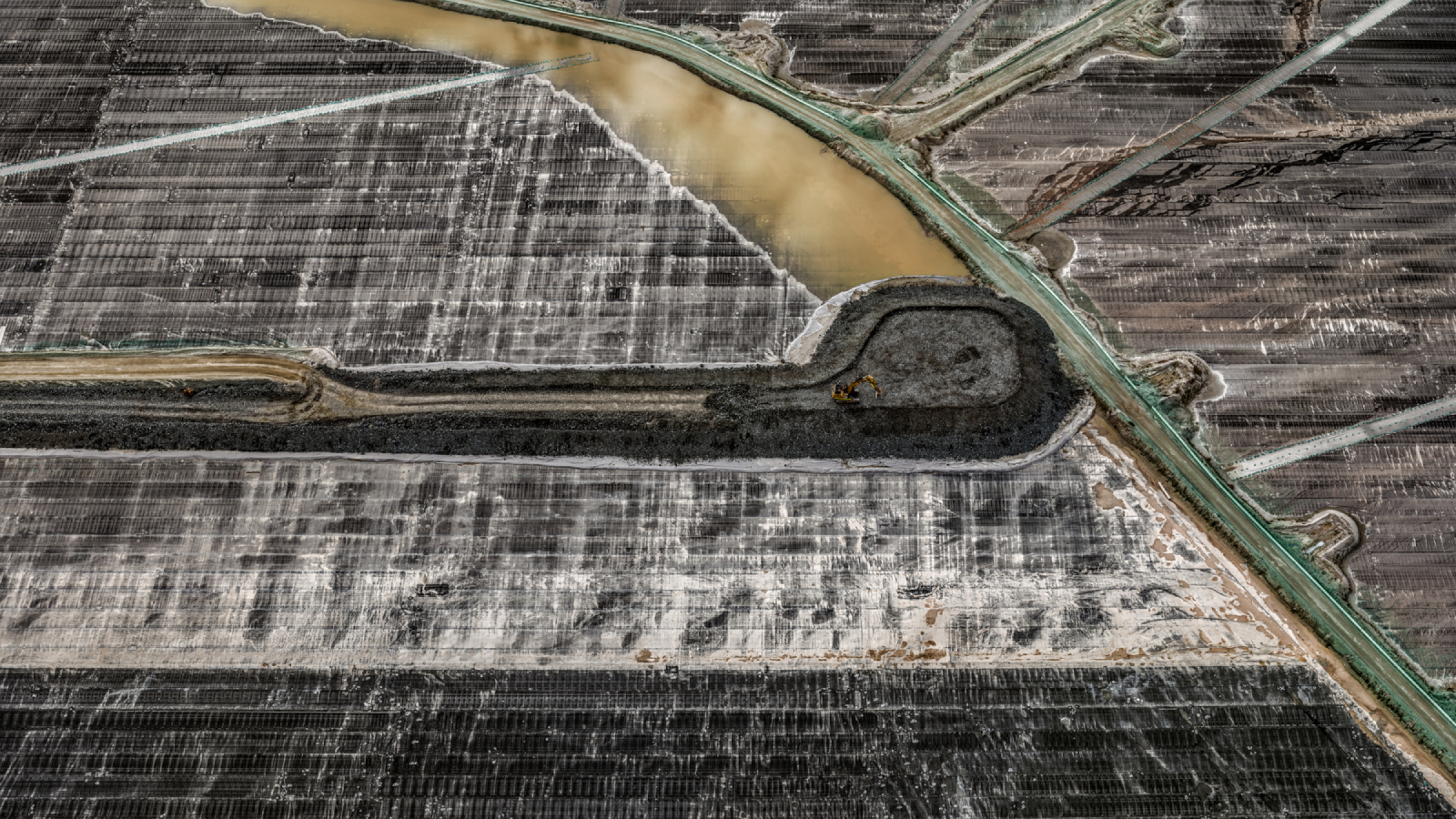
In the midday hours before Art Toronto 2026, Canada’s oldest international art fair, opens its doors, Edward Burtynsky sits down with me to talk about two new photographs debuting with Nicholas Metivier Gallery. In March, the same building hosting Art Toronto — the Metro Toronto Convention Centre in downtown Toronto — was the venue for the world’s largest mining and mineral exploration conference. The booths and temporary walls that advertised the mining sector’s latest trends and challenges now display Burtynsky’s newest additions to his Mining: For the Future series (shown above and below).

The two images, which depict mines in Western Australia, combine the organic lines of fractal patterns with the rectilinear grid of human markings. The intricate pattern that results is rendered in shades of austere blood red and cool mint green, respectively. More than 40 years into his career, Burtynsky reflects on photographing industrial sites, mines, quarries, oil fields, and other transformed landscapes, and on what they mean to the architects who turn extracted materials into the fabric of our cities.

You are premiering two new pieces from your Mining: For the Future series, and you’ve spoken about working in a mine to put yourself through school. What’s it like to come back to the mine as a subject?
- EB
In the last, you know, almost 50 years since I was a miner, it’s advanced. The machinery is way bigger. The scale is much greater. So it is quite remarkable to be in these worlds where everything’s gigantic, and even the tires, for example, are four metres high. It’s three stories to get up to where the driver sits in these trucks.
Mining has been a consistent subject that I come back to time and time again. But to me, mining is a metaphor to some extent for my work, too. In a way, as a photographer, there’s a lot in the world that I don’t actually find interesting as a subject for my camera. So there is this kind of “mining” for the valuable things that you see. I’m always looking in the world, putting my frame around something that challenges the imagination — that has something to say about us as a species, and the things that we need in order to create the worlds that we live in.

Right, you have to be committed to the subject matter for many years, and so it’s not a light decision. Is there a subject you were drawn to, but that didn’t work as a photographic subject in the way you intended?
Sure, I bumped into a lot of that sort of thing. But oftentimes, I’m persistent, like when I first went into photograph factories. I just didn’t find a way to photograph them the way I wanted. But if I’m really interested in the subject, like farming — for a long time, it was like, well, how do you make farming visually interesting?
We all drive by farms all the time. You look out at it, the rows of corn or rows of wheat, or whatever. And it feels like, okay, well, I can take a picture of that, but is it interesting?
And by and large, not really. It’s not telling us anything we don’t know. But at the same time, I also understood that agriculture is the single thing we’ve done as a species that has changed the planet more than anything else. It’s gone beyond urbanizing, beyond industry, beyond mining and beyond quarries. Farming has by far changed the landscape the most.
So, I couldn’t quite find the language, and then only after 20, 30 years of thinking about it, I started finding new ways of using drones and using aircraft, just finding ways to talk about the scale of farming. So, you know, if it’s a subject that I think fits into my kind of overarching narrative, I’ll keep plugging away at it. Even if at first, it doesn’t work. You find your way to get to it.

Your images of mines and quarries trace where the materials architects build with come from, like stone, copper and steel. What do you hope architects and designers take from seeing that origin?
Well, I actually find that architects are often interested in my work because there is a real kind of structural discipline that I try to apply to it and the way I organize my frames formally. And they tend to love my quarry work, because, number one, a lot of architects use stone in the building of things. And to see the kind of residual spaces that have an architectonic sensibility to them — it’s always been something I think architects enjoy in my work.
Knowing where these things come from — our steel, nickel, copper, all these things that are part of the built environment — I think there’s a natural affinity to go look at that work, and understand that all acts of creation are an equal act of destruction. You have to find that material, and get it, and, wrest it out of the landscape, and convert it into material that becomes steel girders or mullions.
So, I’ve very much been interested in going into that place out in nature where those materials come from, that allow our urban centres to exist. And I think a lot of architects understand that they’re engaged in the transformation of material into the buildings that we have on our streets, in the built environment.


Architects work similarly between the aerial site plan and the human scale. There are some critics who might say that the large-scale perspective in your work distances viewers and aestheticizes disaster. What’s your point of view on that?
I’m not looking at that place in the world very much differently than if somebody said, you know, go out and photograph this building — which I have done. I had this architectural photography practice that very few know about, but when I was starting out as an artist, I was doing architectural photography and my own work. I would, of course, look for the point of view that tells the story about the building, you know, certainly try and pick the time when the light was interesting for that building.
And when I go out and photograph where all these things come from, I’m applying the same principle. So I’m trying to find the light, and the structure of the image. The texture, time of day, composition, and all that, to make it something that draws you to the image. Something that makes you want to look at the image.
And whether or not somebody thinks I’m aestheticizing disaster, well, that’s an interesting question, because then I would think you have to then investigate your whole life. When you wake up in the morning, you pick your phone up, shut off your alarm. If you’re connected to the power grid, then there’s a whole nuclear power station… think about all of the copper wires. So you’re probably, you know, at multiple tonnes of materials that get you out of bed. And then you walk over to your sink, and use the stainless steel tap. Turn it on, and there’s a whole pumping station, a filtration plant connected to that action. Minerals in your toothpaste came from a mine. So we’re completely implicated in everything I’m showing, from the moment we get up.
To think that somehow, we can say that’s not part of who we are, is to narrowly look at what is your own reality. So, I mean, I think it’s hard for us to say we are disconnected from these worlds. I just basically say, this is really the yin to the yang of our urban world. ”This” has to exist for “that” to exist. And if that’s a disaster, so is everything here.

To your point about making people want to look at images — you started in large-format film, and now billions of images are made every day with drones, AI, and satellite imagery. How has this changed your practice? And how do you go about making a photograph matter in an abundance of images?
It’s a good question. By sticking to what I do, and doing it as well as I can, and continuing to make, I think, interesting images that make sense to me, and to my 40-plus-year body of work. I don’t react to trends. We have an abundance of images, but I don’t think we have an abundance of images that are really thoughtful.
When I walked into this art fair 10 years ago, almost every booth had some photography. And now, there’s a lot less being represented in this space.
So, I think it’s in transition now, and with AI-generated imagery… I don’t know. I’m not sure. It’s, like, tsunami after tsunami of imagery on us, so it is overwhelming. But I still think that ideas and stories, and vision, and approach, and the individual, and what they do still matter. The Gutenberg press made words available to everyone, but there are still writers and there are still people. You take those words and turn them into something that’s interesting and powerful. And I do the same with imagery or when making a film.
All these things are just tools. To someone who knows the user’s tools, and is able to use them in a way that speaks to people and communicates with people, in ways that engage them, and makes them think, and makes them enjoy the thing they’re looking at, immerses them in the presence of it… it’s all the things that art, film, and all that do for us. It engages. And there are many parts of our world that are interesting, whether it’s a material engagement or a subject matter engagement, a movement of ideas, you know — these are all interesting.
Lead image: Tailings Storage Facility #1, Greenbushes Mine, WA, Australia, 2025. Courtesy of the artist and Nicholas Metivier Gallery.
Q&A: Edward Burtynsky on Documenting Manufactured Landscapes
In an age of abundant digital imagery, what makes an image meaningful? The Canadian artist and photographer, whose work explores sites shaped by extraction and cultivation, reflects on the thought behind image-making and the interpretations his photographs invite.