
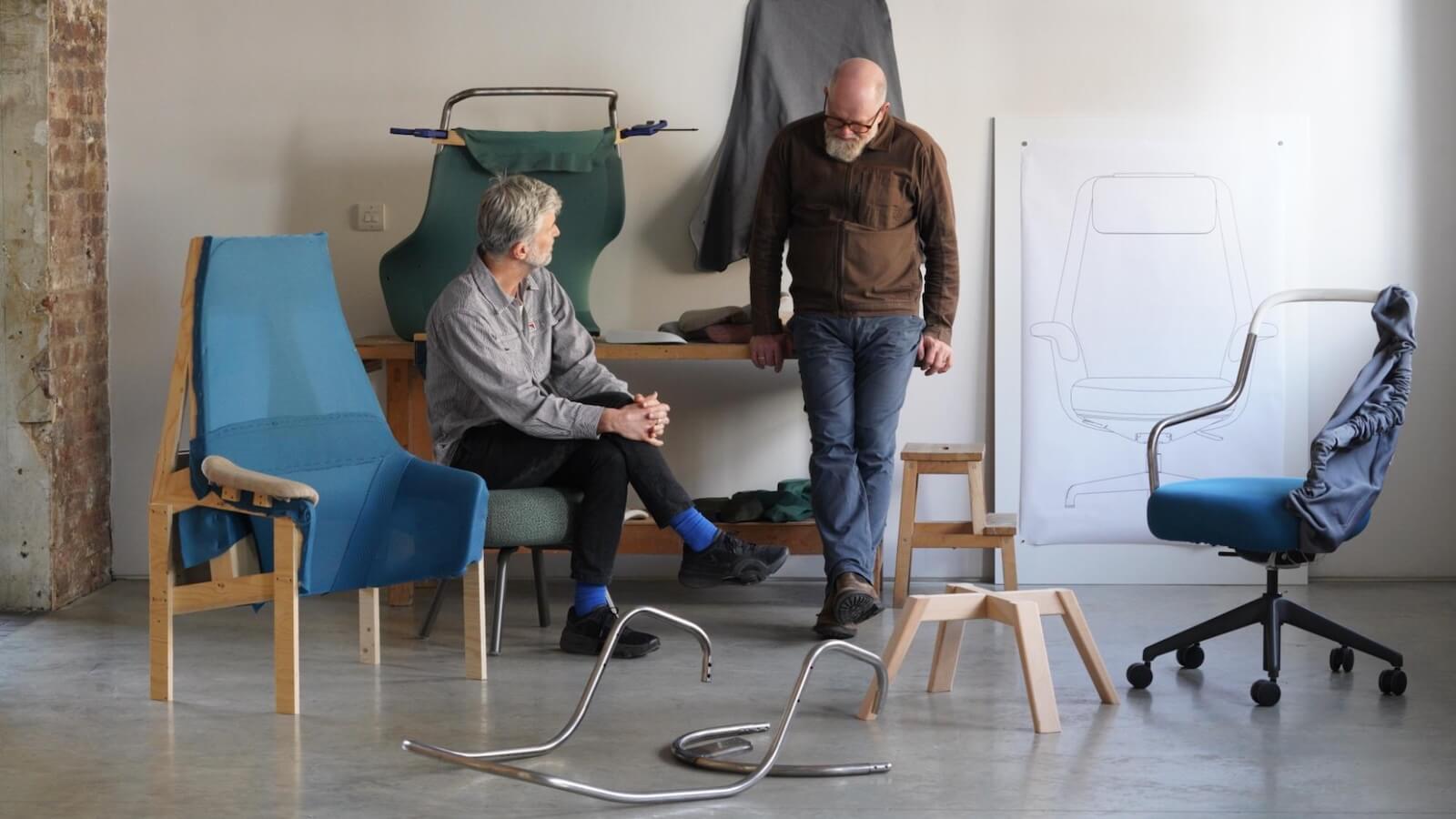
Two years ago, Tom Lloyd and I wrote about the Egg chair. Not to challenge its iconic status but to ask what it represents in today’s context. The Egg, the Womb and the Swan are designs that endure not just because of form, but because of their cultural value. They are repaired, reupholstered and handed down. They last.
The problem lies in the millions of products they inspired. Chairs that borrowed the same materials and methods, but did not inherit the same beauty and emotional durability. Cold-cured foam, glued textiles and inseparable components became a formula that made comfort easy to mass-produce but impossible to recycle. These are the objects now crowding landfills.
That’s what we have been interrogating over the past few years. The way our industry has been designing (particularly the way it uses materials) is no longer viable from an ecological perspective. So the real challenge becomes: how do we continue to meet people’s needs and desires, but do so with radically fewer resources?
We’ve come to see the solution not in new forms, but in a new mindset, which our studio is calling Radical Dematerality. It’s not about designing less, but designing differently. With more care, more foresight and less waste.

We’re working in a new material condition. Today, the brief behind every brief includes resource use, supply chain and impact. Circularity is not a layer we can add at the end, it must be embedded from the start.
At recent furniture fairs, polyurethane foam has been a material under question. Designers and manufacturers are beginning to reckon with the fact that this once-ubiquitous upholstery standard is now a major obstacle to sustainable practice. Hard to recycle, hard to separate, often glued into complex assemblies…foam has become one of the key drivers of waste.
But this isn’t just about foam. It’s about how industrial convenience has shaped design habits, and how those habits now demand rethinking.
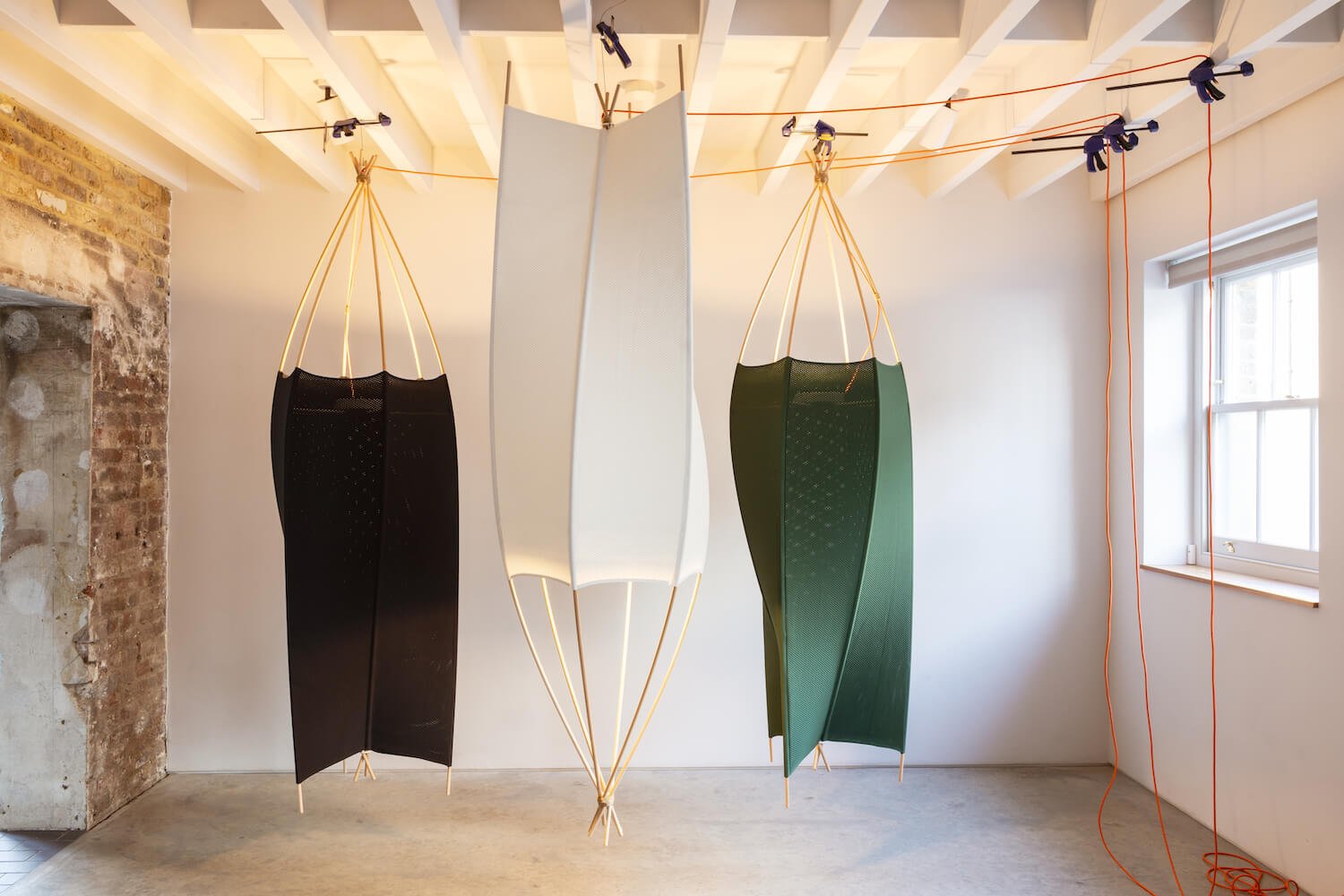
Radical demateriality does not mean doing without. It means removing what’s unnecessary in order to focus on the essentials. In our case, it began with a series of experiments. We were exploring 3D-knitted textiles, a material more common in sportswear and footwear than in furniture, to see how structure and support could emerge from tension and weave rather than bulk.
One early result from this inquiry was Pupa, a playful internal research project that had no specific outcome in mind. It allowed us to learn by making, without expectation. We were not trying to solve a brief. We were trying to learn what new materials and techniques could offer and how we might think differently because of them.
3D knit brought multiple benefits: stretch, support, recyclability and precision. Perhaps most importantly, it eliminates offcuts and waste from the pattern-cutting process. Like 3D printing, it enables material efficiency by using only what’s needed and no more.
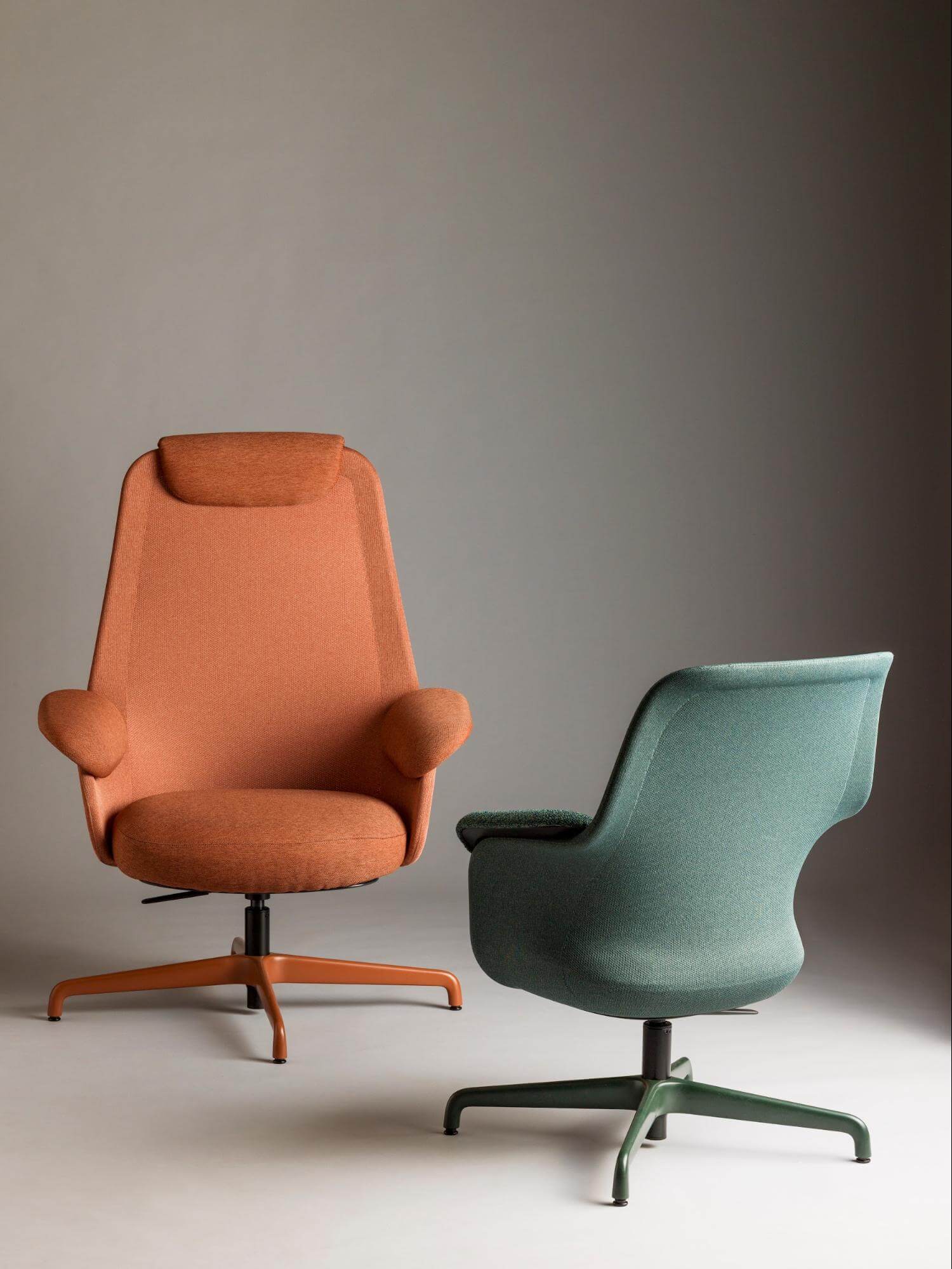
This approach has since influenced how we deliver live projects. Aarea, developed with Teknion, eliminates glued upholstery and foam from the backrest. It uses a single recycled polyester, 3D-knitted surface engineered for both support and comfort. The structure is modular and serviceable, allowing individual parts to be repaired or replaced. At end of life, the components can be disassembled with minimal effort and recycled through existing material streams.
An analogy we often use is the remarkable efficiency of a bicycle. Each part has been carefully optimized to do its job and nothing more. The elegance comes from how the components work together as a system. That clarity became a design language of its own.
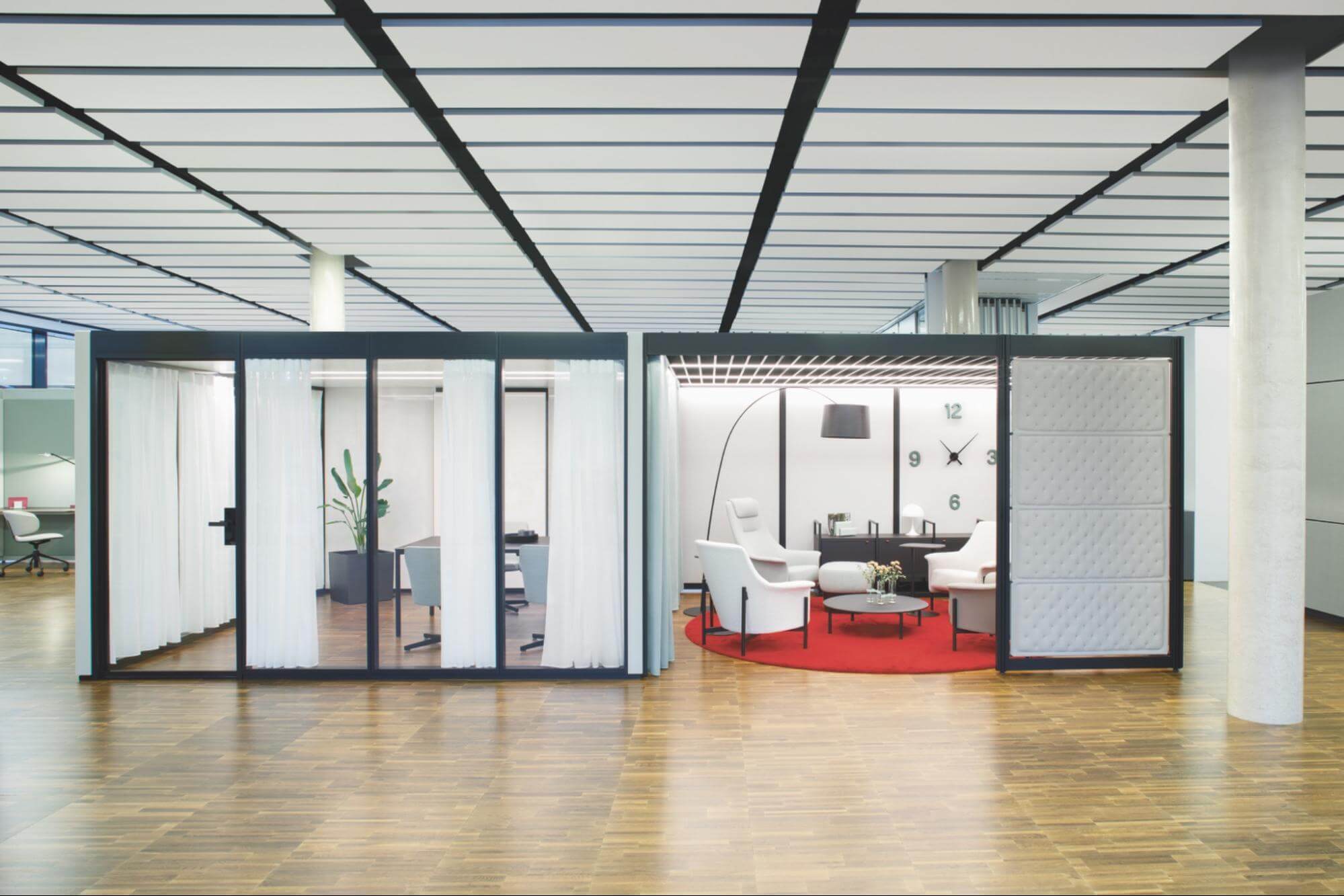
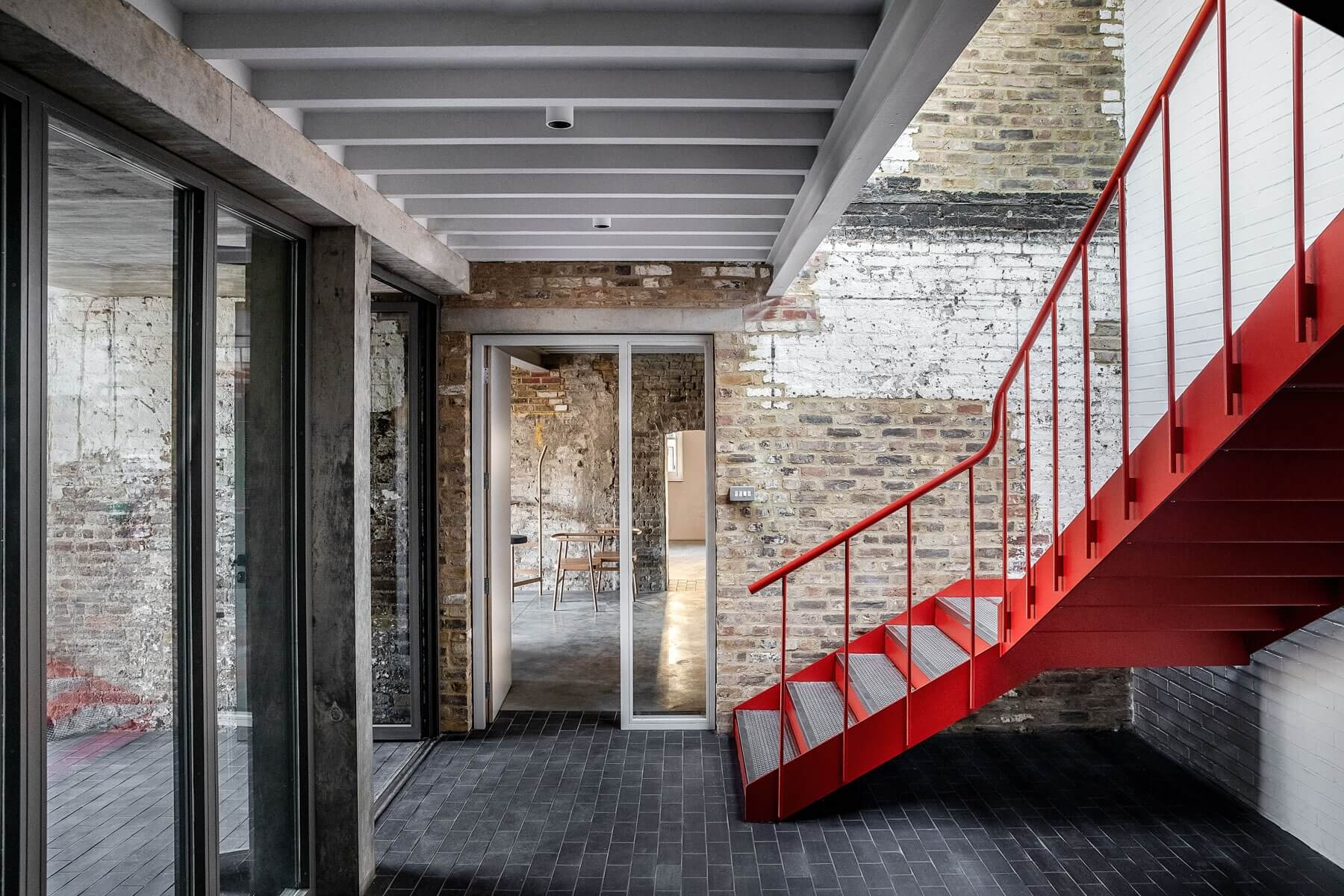
This approach has inspired our work over the last five years at different scales. Revo, a seating system for Profim, applies similar thinking to mono-material design and glue-free construction. Points, a workplace fit-out system for Bene, takes demateriality to the scale of architecture, creating spatial tools that reduce churn and adapt over time. Our own studio building, Yorkton Workshops, embodies these values at a building level. It’s a retrofit project that prioritised reuse over rebuild, and was recognized with the Architects’ Journal inaugural RetroFirst Award.
In other words, radical demateriality is not a design detail. It is a framework that applies at every scale. From the product to the system to the building.
We’re also seeing a wider cultural shift take place. After two generations of irresponsible disposability across nearly every aspect of life, we are now entering a new phase of managing our built environment, where the materials we use can no longer be discarded. Increasingly, we have to treat materials as borrowed for a period of time before being returned to a circular technical waste cycle. This completely rewrites the script for design and manufacturing. We are no longer designing just for users, but for the future conditions in which our work must exist.
Designers must now look beyond the traditional furniture toolbox as many of the most promising solutions lie in adjacent industries where performance materials and innovative techniques are already solving our sector’s problems.
3D knit and 3D print are just two examples of technologies that enable lighter, cleaner and more efficient design. They allow us to produce only what is needed, avoid waste and create new structural and aesthetic outcomes. They also force us to reconsider assembly, service and longevity, which are values that industrial design has often neglected in favour of convenience, speed and cost.
Radical demateriality is not a rejection of technology. It depends on it. It is through innovation and openness that we can meet today’s challenges and reshape what tomorrow’s products can be.
Radical demateriality isn’t about returning to past ideals or stripping back for its own sake. It’s about reimagining the role of design through a new lens, which places materials, systems and consequences on equal footing with aesthetics and performance.
This approach opens new territory. It invites us to develop new archetypes, not just update the familiar. It asks us to find form through material behaviour, not surface impression. And it demands that we look outside our own discipline to industries that have already made the leap, for ideas we can adapt and evolve.
Design has always responded to the conditions of its time. The Egg chair marked a moment when a new process gave rise to a new form, in an expression of post-war futurism, industrial possibility and optimism. In many ways, our context is similar. We too face urgent change. But we now see materials and processes as part of global supply chains and waste streams, rather than as isolated components.
Today’s opportunity lies in developing a new material language that reflects our current values and realities. If we take that challenge seriously, we won’t just reduce impact. We’ll create new possibilities for how things are made, how they’re used and how they endure.
Radical Demateriality: A Mindset for the Future
Pearson Lloyd co-founder Luke Pearson reflects on an emerging paradigm for material efficiency — and sufficiency.