
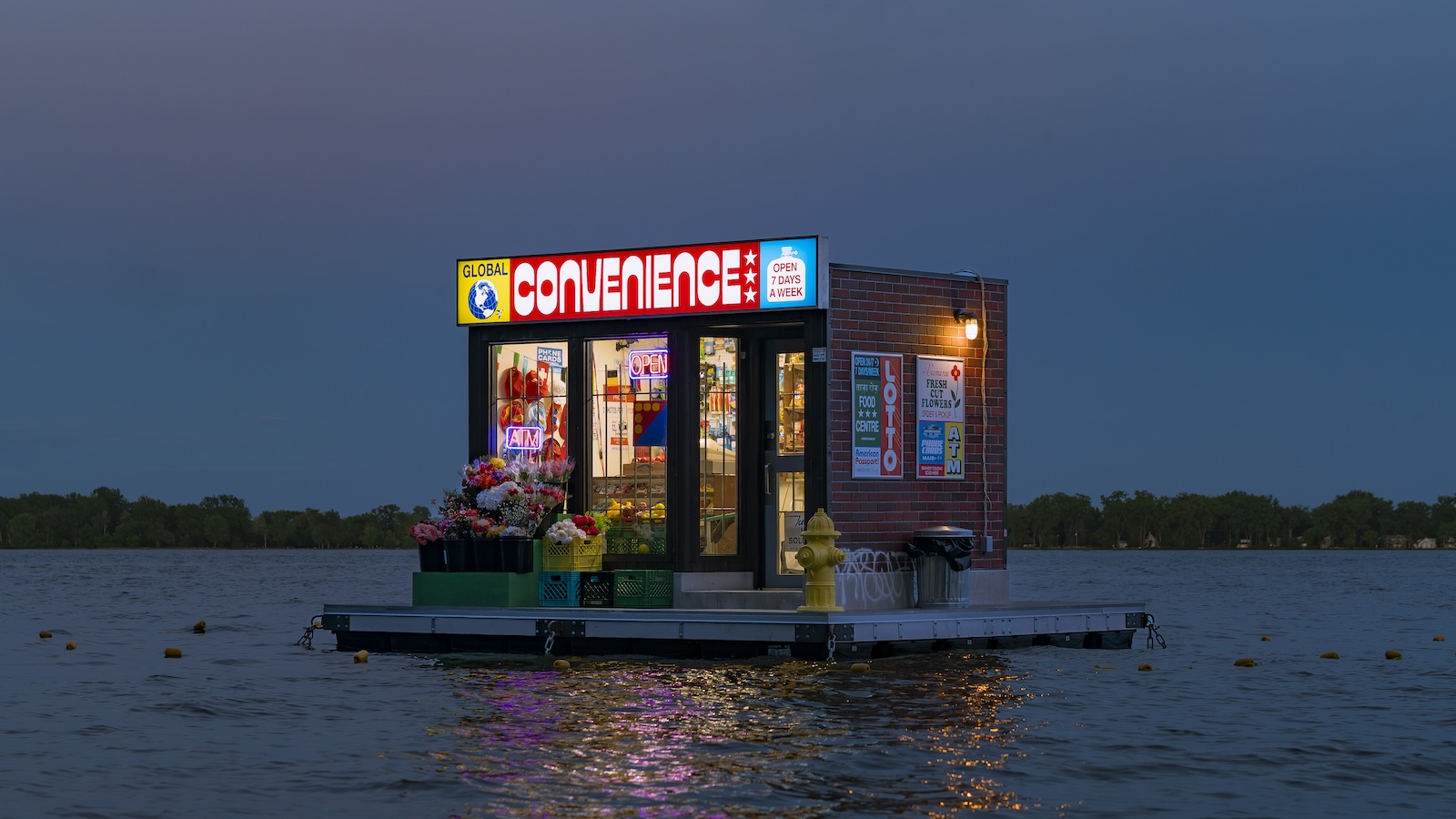
It was bound to happen. A few days back, a man swam out to Global Convenience, the floating artwork near Toronto’s Harbourfront. The true-to-life installation, with its pulsating sign and flower and fruit stand, is as enticing as any bodega. If you could step inside, you would find it fully stocked with chips, candy, toilet paper, everyday tools and sundry household items. But, as the stranded man found out, you can’t: The doors do not open and the goods are not for the taking.
Bobbing on a dock in the water, the faithful representation has struck a chord not just in Toronto — where reviving the presence of corner stores in city neighbourhoods has been an ongoing battle — but around the world. Collaborative artists Trevor Wheatley and Cosmo Dean, who partnered on the Waterfront Toronto commission with arts production company Puncture, led by Rashad Maharaj and Spencer Cathcart, have seen it blow up on social, with Instagram feeds from Designboom to Elle Decor Italia enthusiastically covering it. It’s captured the imagination of people globally, which is no surprise given the many pragmatic uses and symbolic connotations, universally, of the convenience store.

“Rather than relocating a single word or sign, we transplanted an entire urban typology, a convenience store, into an unexpected environment,” the artists explain, in this interview with Waterfront Toronto. “A convenience store is one of the most recognizable and universal spaces in the world. Whether you’re in Toronto, Tokyo, São Paulo, or Lagos, there is a version of this type of business within any given community.”
The idea emerged from Wheatley and Dean’s original desire to create a floating flower store. For Puncture’s Maharaj and Cathcart, this instantly hit home. “Both of our families had convenience stores in Toronto. We both come from immigrant families, and having a store was the only way into the economy for a lot of families,” Cathcart explains. “So we immediately were like, ‘Let’s take your flower store and amplify it.’ Convenience stores are such a community space, a representation of how diverse the city is.” Timed with the FIFA World Cup 2026, with soccer fans from nations around the world converging on Toronto, the project has special resonance. “It just seemed like the perfect metaphor, especially with the World Cup in town.”

What makes the building pop is its signage, which glows like a beacon that signals the store’s uncanny presence in the middle of the water. As I was walking away from Harbour Square Basin after admiring the piece for some time on a boardwalk full of equally delighted folks, I encountered a stream of tourists heading to the artwork, pointing at it, “Yes, it’s there. I see it!”
The “Global Convenience” banner was designed to evoke familiar store signs, in a 1970s font called Zipper. “There’s a store in Parkdale called Best Convenience, and it’s the typeface there,” says Cathcart, a graphic design grad who also worked with the other members of the art team on a series of posters for the project, including one advertising a key-cutting service. The milk jug announcing “Open 7 days a week” is also a mainstay of the typology. So too, one might say, is the brick cladding and graffiti. Wheatley and Dean built the entire structure and made its peripherals — the ice cream box outside and the fire hydrant — mainly out of wood, foam and vinyl in their Geary Avenue workshop.

As a hyperrealistic simulacrum of a modern urban archetype, Global Convenience has precedents, notably in Elmgreen & Dragset’s Prada Marfa. That artwork was promptly broken into upon its unveiling in 2005. Thankfully, visitors who’ve ventured into the water to get closer to Global Convenience, which include a kayaker, haven’t tried to force their way in (or succeeded in so doing). “I don’t know if I we thought it would be a problem, but we went so hard on the detail,” says Cathcart. “We were down there the other night, and I heard somebody go, ‘That’s ridiculous! Like, how am I gonna get out there?’ I was surprised — I guess we thought it would be obvious that it’s art.”
The Allure of “Global Convenience,” the Viral Artwork on Toronto’s Harbourfront
The floating installation by Trevor Wheatley and Cosmo Dean, in collaboration with arts production company Puncture, has captured the world’s imagination.