
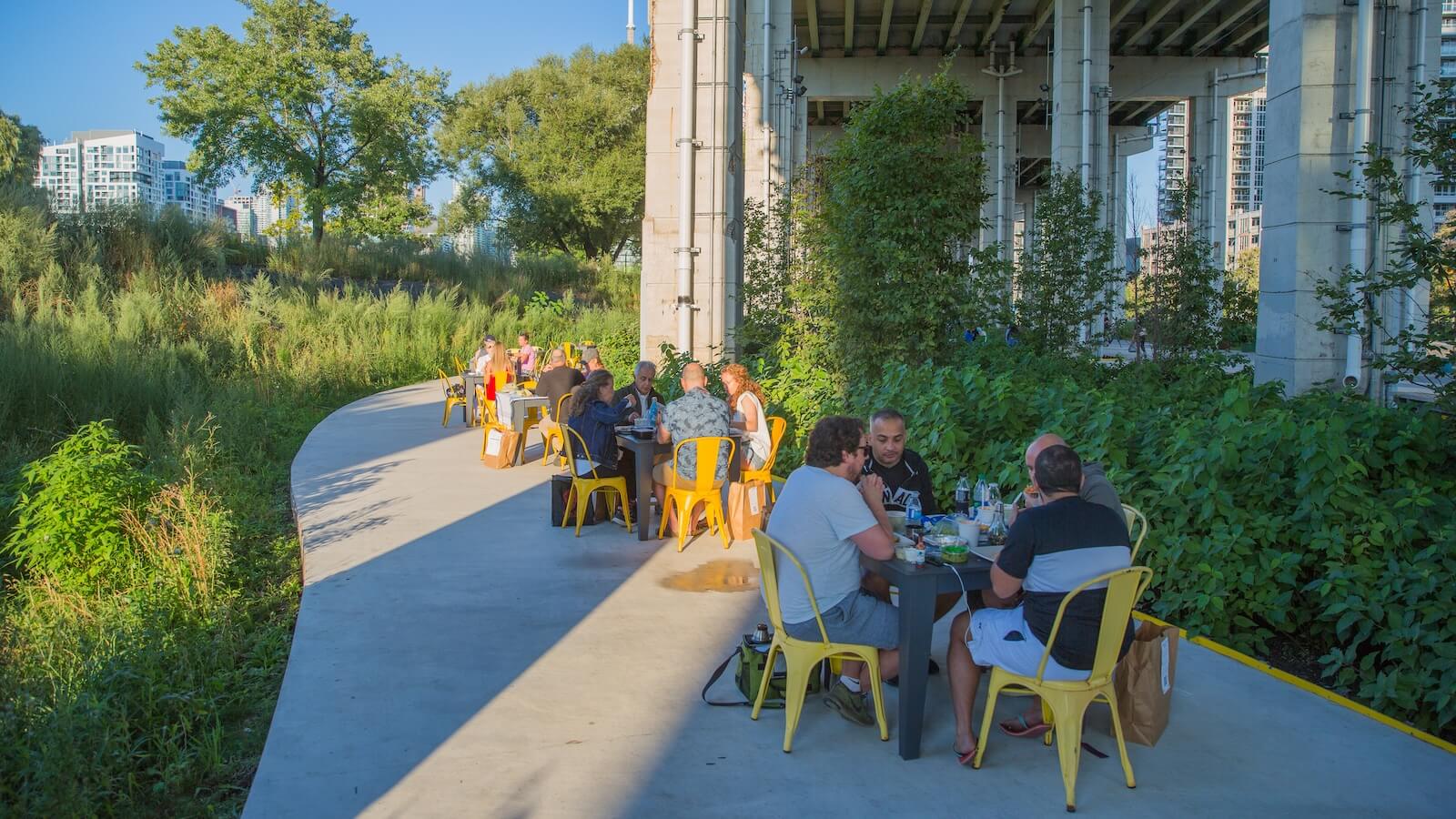
In a city where shade is still a contentious urban planning issue, The Bentway has been a serendipitous salve. The public arts space below Toronto’s Gardiner Expressway not only repurposes the negative space beneath a hulk of hard infrastructure but it also embraces the virtues of its shaded site along Lake Ontario, especially during the summer months. And its just-released latest annual report, Cool by Design, cements The Bentway’s thinking on why, where and how shade can be created throughout the urban realm — and enjoyed by everyone.
But it’s not only planning officials who need to change how they think about shade. It’s the rest of us, too. “Shade, cooling infrastructure, and natural landscapes are vital, but so too are the cultural and behavioural shifts that influence how we think, program, operate, and inhabit public space,” the report notes. “The spaces once seen as recreational and social amenities must now be recognized as frontline strategies for safeguarding community health and wellbeing in a warming world.” Cool by Design encourages us to reframe shade as a tool to help us better navigate, inhabit and make the most of our city throughout the day. The soft infrastructure of shade in its myriad forms — from tree canopy to designed elements, from repurposed infrastructure to reimagined public spaces — can be a powerful climate-adaptation device and approach. It’s a simple idea, but one that could be transformational.
Like The Bentway’s previous publications, Cool by Design corrals learnings from both the organization’s programming and its research, with input from artists, designers and policymakers. The last report, Rx for Social Connection, drew from the summer of 2024’s “Softer City” exhibitions, which emphasized the ways in which we can make public spaces — including those under hefty urban infrastructure — more inviting and convivial. It included Dominoes, a public performance that saw hundreds of volunteers arrange 8,000 giant domino blocks along a 2.5-kilometre path that snaked through and beyond The Bentway site. Along this same route, 21,000 attendees gathered to witness the massive tumbling spectacle. Through this event and many just as playful, “Softer City” constituted a compelling case for how volunteers — and a volunteer-ism spirit — could form the beating heart of collective art experiences in the city.
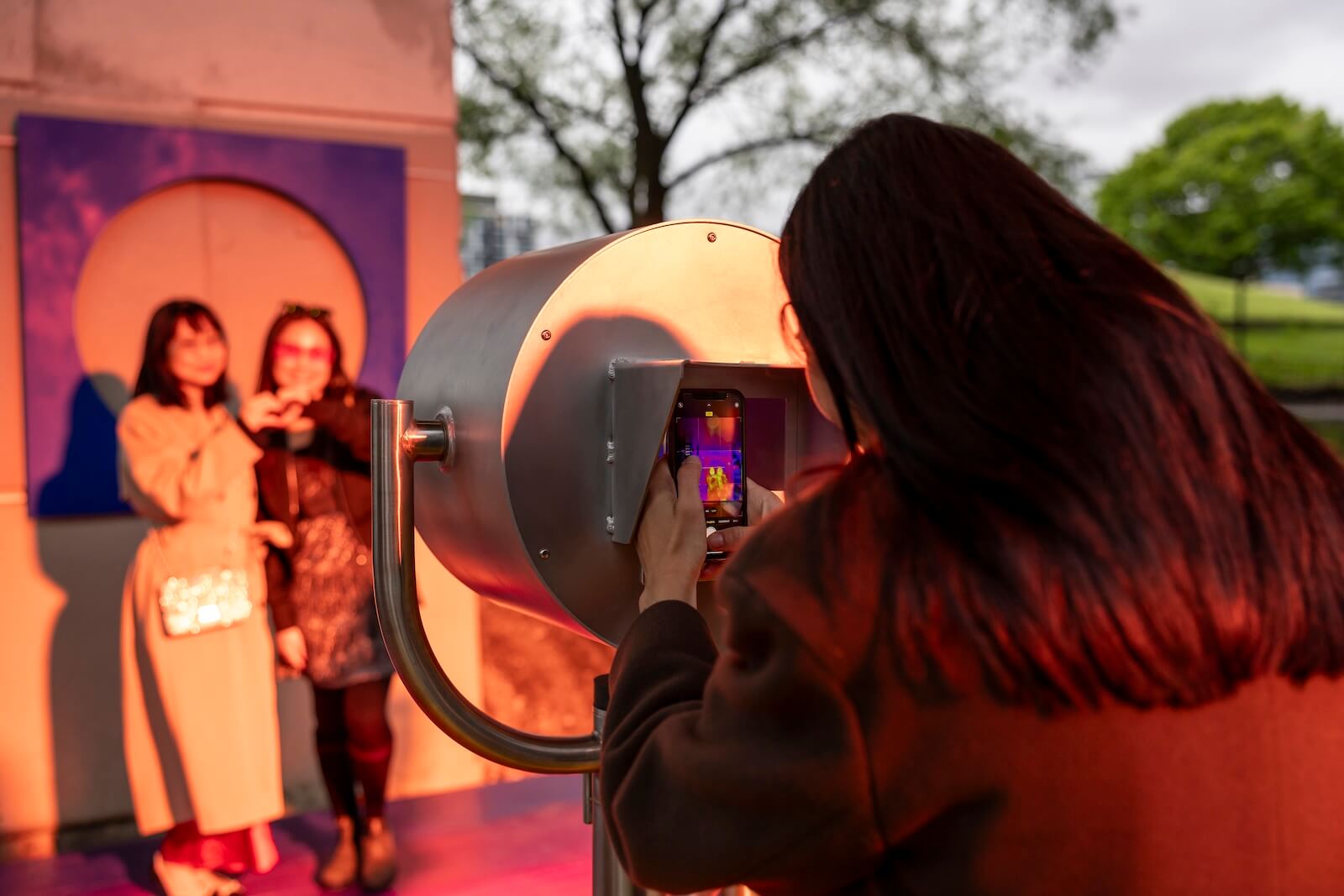
Cool by Design, then, leans on 2025’s “Sun/Shade” programming, which included October’s mesmerizing SOLAR light installation, “explored how new thinking about sun and shade can help cities adapt to rising temperatures and create more comfortable urban spaces.” It also builds on the City of Toronto’s Thermal Comfort Guidelines “to demonstrate that adaptive design and programming can create public spaces that are not only cooler, but also stronger, more equitable, and more socially connected.”
The report bolsters recent research into the benefits of “cool” public spaces in cities that are getting hotter every year — with forecasts of 60 days above 30ºC by 2050 — and also points to the disparity of their distribution along socio-economic lines. This is borne out in the work of Dorsa Jalalian of Dialog and Fadi Masoud, an associate professor in landscape architecture and urbanism at the University of Toronto’s Daniels Faculty of Architecture, Landscape and Design, which has shown that Toronto’s more affluent neighbourhoods have more mature trees and shaded streets, while lower-income areas are exposed to more direct sun because they have fewer shade-making amenities, a phenomenon referred to as “heat vulnerability.” The report states, “Extreme heat is more than a matter of comfort — it is a serious and growing public health crisis.” One need only look to heat-related deaths in recent years to see that not everyone has access to air-conditioned interior spaces. On a broader scale, we need to implement and endorse urban design solutions that form an alternative to staying inside and cranking the AC.

Cool by Design also presents findings from its own independent research, which included an interactive mapping exercise: The Bentway invited members of the public to pinpoint places across Toronto that they use “to avoid extreme heat exposure.” The result was a publicly available resource for “beating the heat,” with its own insights into what makes a site attractive beyond its provision of shade. (Hint: things to do and see!)
Most helpfully, the report concludes with a list of recommendations. Not only are these ways to introduce more respite in cities away from the sun’s glare, but they are also new modes of thinking about shade, and our relationship with the city throughout the day. One of them, “Look to other cultures,” encourages us to take notes from cities like Austin, Paris, Milan, Miami and Melbourne. For instance, Paris’s Oasis program, launched after deadly heatwaves, has introduced permeable shaded public spaces into closed schoolyards. “During heat emergencies these shaded public schoolyards are open around-the-clock for everyone in the neighbourhood,” the report states. The Bentway’s summer of 2025’s program proffered its own ideas: Artists Edra Soto and Celeste, for example, reinterpreted the vernacular residential and market typologies of Puerto Rico and Mexico to devise enchanting shaded structures that imbue the city with both the wisdom and charm of warmer cultures.

Another recommendation, “Adopt a 24-hour relationship with the sun,” urges us to plan outdoor activities around cooler times, which means that cities must also program the evening and make public spaces more accessible long after dusk. “Cities should leave their shaded public spaces open as long as possible to foster 24-hour use, encourage socializing, and avoid over-dependence on air-conditioned indoor spaces.”
We must also “Embrace shade as a life force.” Here, The Bentway points to its installation Declaration of the Understory by Tania Willard, who was inspired by the Carolinian forests in southern Ontario, “where pockets of shade and sunlight shape unique ecosystems below.” Her artwork “activated the architecture of the highway as an imagined re-wilding of public space, proposing a renewing of relations with the lands, urban ecologies, and Indigenous communities.” An earlier installation, from summer of 2024, also serves as a useful demonstration: Staging Grounds funnelled rainwater runoff from the highway above down to flowering species in vibrant blue planters below.

The report also directs us to “Focus on flexibility:” Shade can be created in numerous ways, and our previously single-purpose infrastructure “can be rethought to solve multiple issues — an elevated highway built to move cars can double as the city’s longest continuous canopy,” it notes, with a wink to The Bentway. And, finally, it encourages us to “Stop design devolution,” a process by which our designed spaces, especially air-conditioned interiors, alienate us from the natural world. Here, Cool by Design references The City of Toronto’s Thermal Comfort Guidelines and its call for us to protect “all living things” as we also recognize that we, too, are part of nature and need to be connected to it for our wellbeing, mental and physical.
For almost 10 years, The Bentway has served as a collective downtown porch — or a backyard for everyone to enjoy year-round in a condo-dense milieu. Its programming has made the most of its position along the lake and under an elevated expressway. And now Cool by Design brings this wisdom to the rest of city, presenting shade as a soft infrastructure that can be re-engineered into the urban realm as a form of climate change adaptation. Together with the City of Toronto’s own Thermal Comfort Guidelines, there might just be change in the air.
The Bentway’s Lessons for Basking in the Shade – For Toronto and Beyond
As any weather forecast will tell you, it’s cooler by the lake. And with its latest report, Cool by Design, the Toronto public art venue The Bentway is capitalizing on its shaded site to share its learnings for urban centres that are getting hotter every year.