

After his groundbreaking Guggenheim Bilbao — a shimmering sculpture of a museum that ushered in a new formal lexicon and the coinages of both Bilbao Effect and Gehry-esque — the legendary Frank O. Gehry went on to ever more dazzling projects. In 2003, AZURE contributor Adele Freedman caught up with him in Los Angeles, when he had just completed the Walt Disney Concert Hall. Here, we publish that story for the first time online upon hearing of the maestro’s death at the age of 96.
***
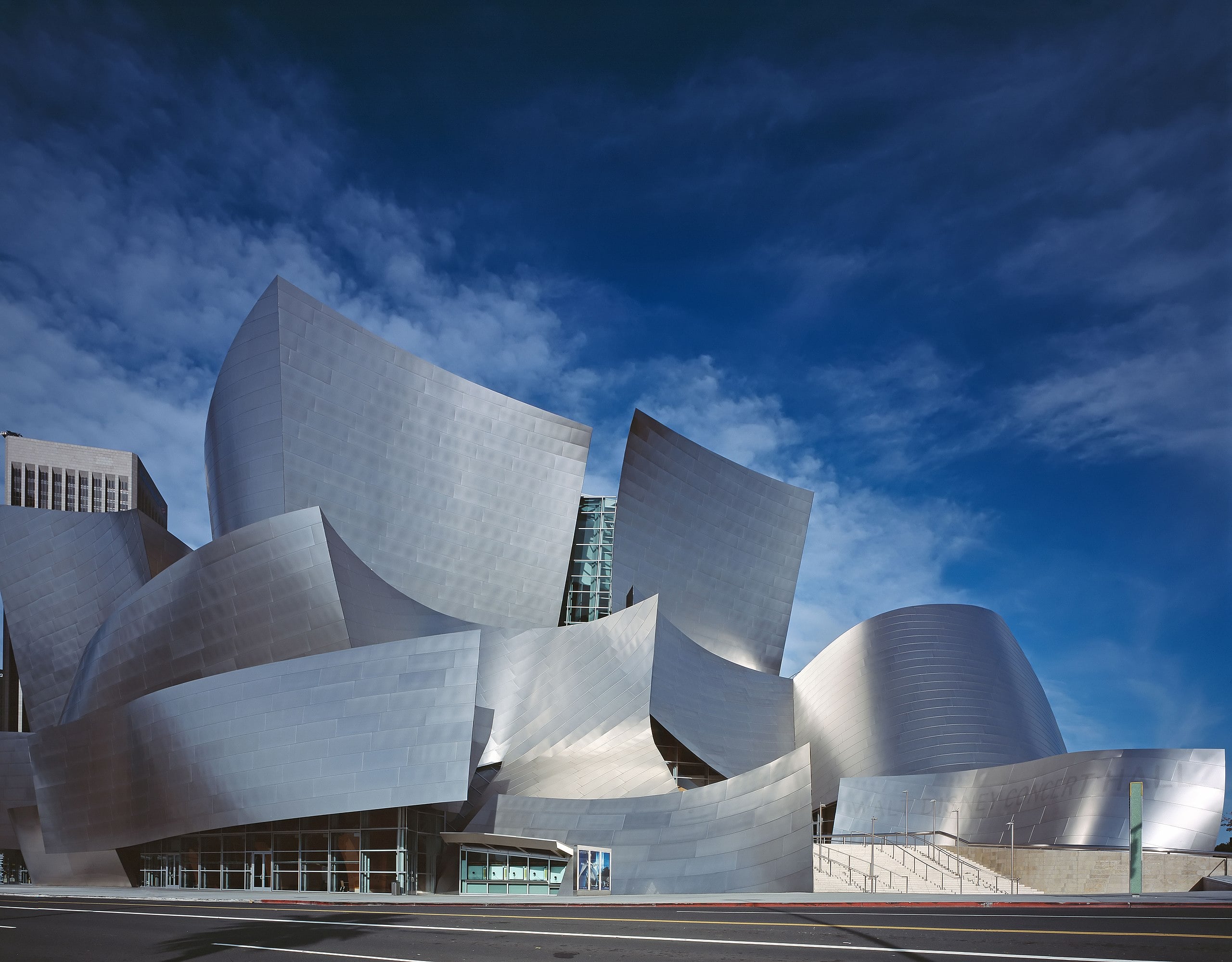
With his Guggenheim Bilbao, Frank Gehry created an architectural wonder that inspired a phenomenon. The Bilbao Effect, as it’s being called, describes the power of a single building, provided it’s a work of genius, to transform the urban equivalent of a mangy chicken into a goose that lays golden eggs. Suddenly every barnyard on the planet wants to be a Bilbao, even Toronto, Gehry’s birthplace, where the Art Gallery of Ontario is hoping to be on the receiving end of some of his handiwork. But it’s his adopted city of Los Angeles that has landed a Gehry masterpiece the equal, and then some, of the shimmering pride of Basque country – Walt Disney Concert Hall, a real-life Magic Kingdom the Los Angeles Philharmonic is lucky enough to call home.
The building was 15 roller-coaster years in the making, and if it weren’t for the Bilbao effect it might never have seen the light of a California day. In 1997, when the museum in Spain opened to the raves that actually made Frank Gehry a household word, Disney Hall was still waiting for its prince to come. Though the design competition took place in 1988, the only sign of the winner a decade later was an underground parking garage. As the old story goes, it needed the validation of outsiders to convince the local high and mighty to rally round a project that had been maligned from the start and eventually left for dead.
“We’re going where we always go — to the building with all the steel on it,” said Gehry to his driver, in the middle of another long day of interviews, site inspections and social dos leading up to Disney Hall’s inaugurating galas. Already being hailed as the saviour of downtown Los Angeles, but by his own admission “not quite ready to assume that mantle,” he was looking on the exhausted side of his nearly 75 years, in a youthful combination of T-shirt and chinos. From time to time, he checked his wristwatch, his own design, consisting of hand-drawn numerals circling his signature, manufactured for sale by Fossil. En route to the concert hall, he revealed a taste for Victorian fiction.
“I love Anthony Trollope,” he said. “I’ve read so much Trollope, the Trollope Society asked me to give a lecture.” Soon he was ensconced in the auditorium at the heart Disney Hall, a pitch-perfect expression of the here and now where he really lives.
You wouldn’t know you were inside a flared concrete box massive enough to keep vehicular rumblings from coming in and Beethoven from seeping out. Yasuhisa Toyota’s acoustical requirements were a given. Gehry shaped them into a 2,265-seat concert venue specifically designed for unamplified sound that sets standards for architectural innovation, even coming from him, an original. In the twentieth century by comparison to the nineteenth, the heyday of the plush European concert hall, “fire codes have made rooms bigger, aisles wider, stairs wider – everything that would make a room less intimate,” he observed. ”Codes do that. Architects accept that. In Disney Hall we fought back.”
Back when Gehry was developing his design, he was juggling a handful of artists in his mind. One was Michelangelo, “who had the greatest interest in folds,” according to the man who keeps a stack of colour Xeroxes of Michelangelo sculptures beside his work table. Michelangelo’s folds reappear in the restlessly undulating stainless steel exterior of Disney Hall, for reasons beyond mere photogenic appeal. “Folds are compelling because there’s a primitiveness about them,” said Gehry. “It’s like when you’re born…your mother…there’s a comforting feeling about it. For me, it’s a comforting form of decoration.”
In seventeenth century Dutch paintings of ships under sail and in the Elgin Marbles he found models for visualizing the pulsing energy and spiritual uplift intrinsic to music. From experience he knew what it was like to perform before an audience: “You give a speech and feel they’re with you. The feedback makes me relax, roll a bit better.” Aiming for contact and immediacy, Gehry wrapped the seating around the stage in sharply banked terraces – “vineyard formation,” he called it. “We squeezed in the seats, that was the big deal,” he said. “We kept squeezing tighter and tighter, and tilting the rake as steep as we could without pissing everyone off.”
He squeezed in a lot of poetry besides, mostly of the sea-going kind. Behind low keel-shaped walls of Douglas fir, some chairs seem to be aboard ship. A billowing, light-studded ceiling of basket-woven Douglas fir panels tells of sails, clouds and anchors aweigh. Though every piece of wood in the place is reinforced with concrete for correct distribution of sound – advance reports on the acoustics were two thumbs up – the room looks the picture of soaring anticipation, as if about to steam out of port.
There has never been an organ like the one Gehry sculpted for Disney Hall. It’s as radical as cardboard furniture and fish lamps made from smashed Formica, preludes to architectural invention. Breaking with centuries of tradition, whereby wooden pipes are hidden behind the metal kind, he fashioned dozens of working wooden pipes and planted them forward of the 6,100-pipe instrument, replacing a mathematical ordering with a lyrical evocation of trees and branches.
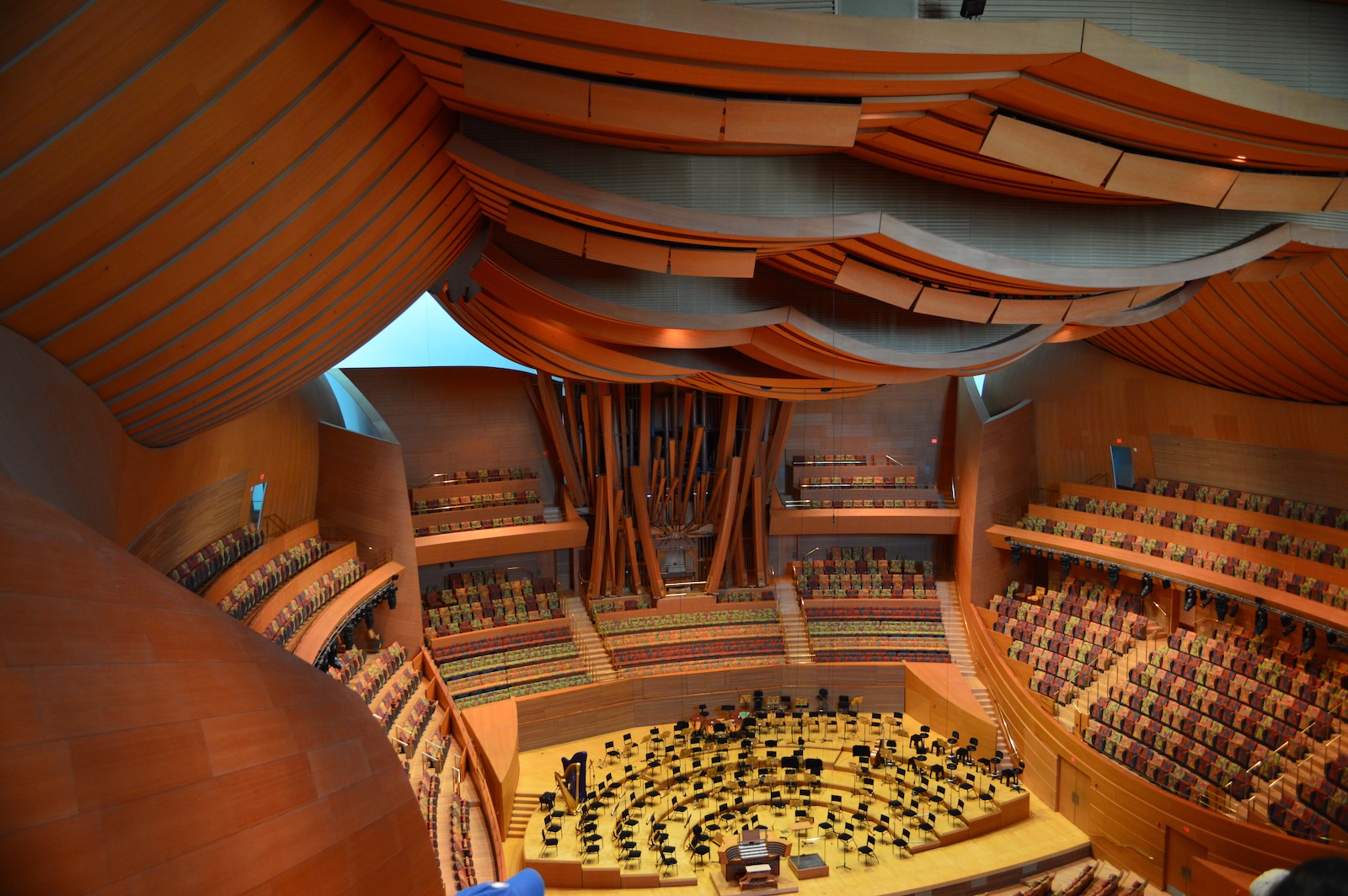
Been in an orchestral venue with natural light lately? The back wall of Disney Hall frames a large north-facing window. “Usually when you sit up there for a concert, you get a blank wall – that’s why I did that,” Gehry offered. Four skylights, one at each corner of the room, contribute a mysterious glow. Gehry even made occasions of the 1.2-metre-wide sound locks buffering the entrances to the auditorium. Declaring them “sound-and-light boxes,” he gave to each its own irregular shape, angled views and intricate cross-hatchings of light and shadow.
Disney Hall contains echoes of every hunch, obsession and breakthrough that came before, amplified to a refined extreme. Chain-link and plywood may have given way to Douglas fir, travertine and stainless steel, but Gehry still utilizes materials to pose questions about how we perceive the world. “The spaces we live in – their character – contribute to our well-being, our sadness, our happiness,” he maintains, speaking like a modernist.
“Buildings have a persona and contribute to our emotions. It’s important to understand you’re playing with a volatile commodity when you’re making a building. It has an impact on the city, on life.”

With its come-hither movie-star looks and staircase spilling down to meet the street, the concert hall can’t help but put a welcoming face on an otherwise chilly cultural precinct that includes the Dorothy Chandler Pavilion, site of countless Academy Awards ceremonies. As the material resolution of his personal vision of the way things are, or should be, the hall is the mask of its maker. While a skeptic might doubt a swirling structure could fit into an orthogonal urban context, Disney Hall does just that, without sacrificing its individuality or robbing the Chandler, next door, of its iconic status.
“It was important to me not to trash it,” said Gehry. “It’s the Golden Rule, do unto others, the neighbour thing. I always thought the traditional contextual moves – you copy the building next to you – deprecating. A lot of theorists are hung up on nineteenth-century city organization: it’s neater, more orderly. Living out here, I realized that was never going to happen. I grew to value the freedom of democracy, architecturally. It meant a lot of stuff could happen. It created collisions of thought, like in modern politics, that freed us to do things.”
Freedom notwithstanding, there are limits to the damage a single building can wreak: “You can’t do much in one individual building that can destroy the world. I’m using that as license to try things. So that’s what I’ve done.”
You need a ticket to attend a concert at Disney Hall, but the building is remarkably accessible for a security-conscious town in insecure times. The staircase is for people to hang on. During the day, the ground-floor lobbies with their Douglas fir tree-columns are open to the public: Facilities include a café and bookshop. And the hall has its own elevated park, which can be reached from the street.
Disney Hall’s persona has a fearlessly sentimental aspect. Lillian Disney initiated the construction of the hall with a $50-million gift in honour of Walt, her late husband. Gehry got to know her well enough, before her death in 1997, to twig to her love of flowers and Delft china. For the woollen carpeting and upholstery fabrics that enliven the hall, he devised abstract floral patterns in shades of green, red and purple. In the park, a village-like arrangement of one-room buildings and serpentine planting beds, he set a 12-metre-high Founders Room with a domed ceiling shaped like an inverted tulip. The sweetest tribute of all is a fountain titled A Rose for Lilly, each curling petal a mosaic of blue-and-white tesserae cut from Delft vases.
Starting on the exhibition design of his retrospective at the Guggenheim Museum in New York, Gehry instructed his team: “Pretend I’m dead.” Now he’s talking about one last crack at a “miracle” along the lines of Bilbao and Disney before “the final chapter,” Meanwhile he doesn’t mind being world-famous. “It’s very nice, the feeling of being appreciated,” he said. “For years, the people have been making fun of me. ‘Quirky’ – that’s a word that’s been used a lot – seems to be going away.”
Gehry’s final word on Disney Hall: “I put my heart and soul into it.”
Lead image by John O’Neil.
The Virtuoso: When Gehry Completed the Walt Disney Concert Hall
Legendary architect Frank Gehry has passed away at the age of 96. In tribute, we revisit a 2003 profile by Adele Freedman.