
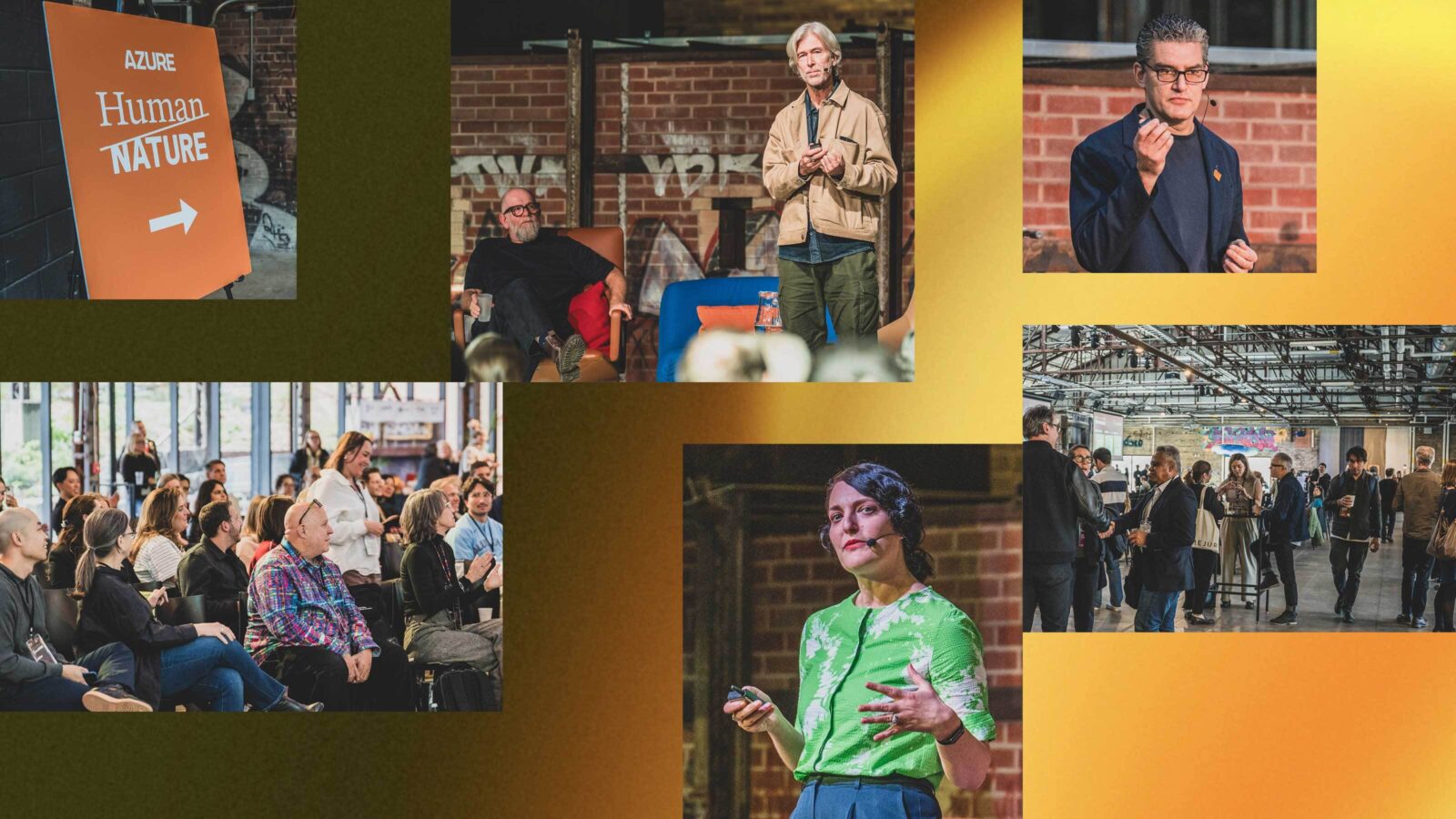
Last month, Toronto’s Evergreen Brick Works became a global hub of sustainable design thinking. From architects and urban planners to industrial designers, activists, fabricators and civic leaders, AZURE’s second annual Human/Nature conference brought together a wealth of thinkers and innovators, sharing proven approaches to nurturing more resilient — and more equitable — planetary life. And like last year’s inaugural edition, the conference yielded a wealth of inspiration. Below, we round up 11 first impressions that are already shaping our thinking for 2026 and beyond.
1
Design with Epistemological Awareness — and Humility
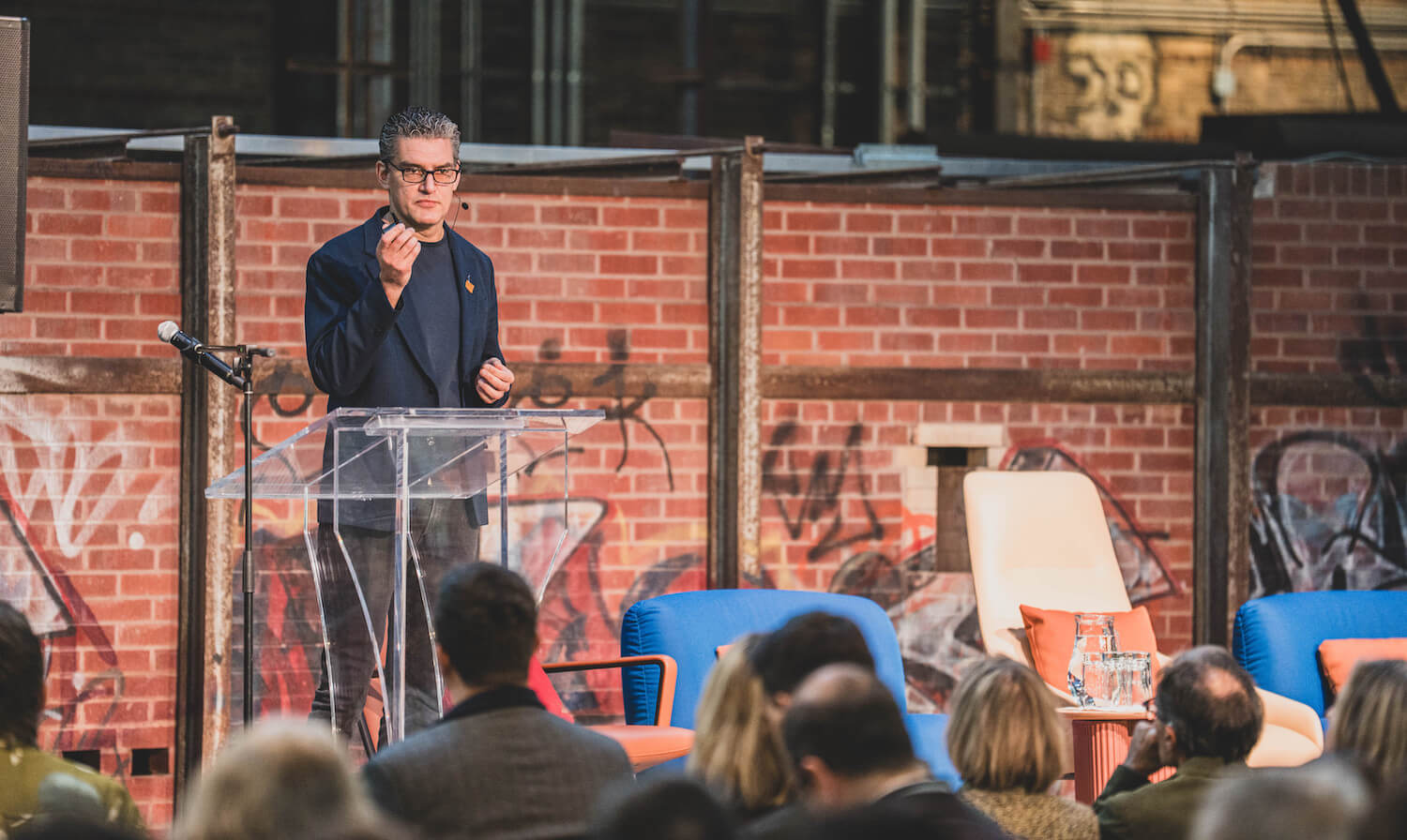
Our opening speaker, David Fortin, set the stage for two days of ideas to come. An architect, theorist and professor at the University of Waterloo’s School of Architecture and a citizen of the Metis Nation of Ontario, Fortin’s keynote, “Design as Kin,” contextualized contemporary architecture through an understanding of the rich web of human and non-human relations that shape our lives.
What makes a design sustainable? What makes an aesthetic appealing? What makes a building “good?” For Fortin, it’s rooted in a holistic understanding of culture, economy, geography and nature — a point illustrated via a reflection on housing in Indigenous reserves. “At a certain point, I realized it doesn’t really matter what the house looks like, what form or style it’s designed in,” Fortin told us. Instead, suburban lifestyles were never successfully replicated on reserves, in part because such settings lacked the requisite access to cheap gas, electricity and consumer goods. For architects — in both Indigenous and settler communities — it means understanding how design meets systems of production and political economies. Put another way, it’s about the web of relations and relationships that shape our lives.
It is a humbling revelation, one that shakes a designer’s sense of agency. Yet humility is its own reward. Fortin invoked the practice of beading as both a locus of design inspiration and a respite from digital life, embracing a lexicon of textiles and crafts that increasingly that increasingly shapes our design vocabulary. It is not a language conjuring or controlling, but of weaving, knitting and mending. As keynote speakers Tom Lloyd and Luke Pearson later put it, there’s a lot to learn from darning a pair of socks…
2
Furniture Repair Starts With Sock Darning
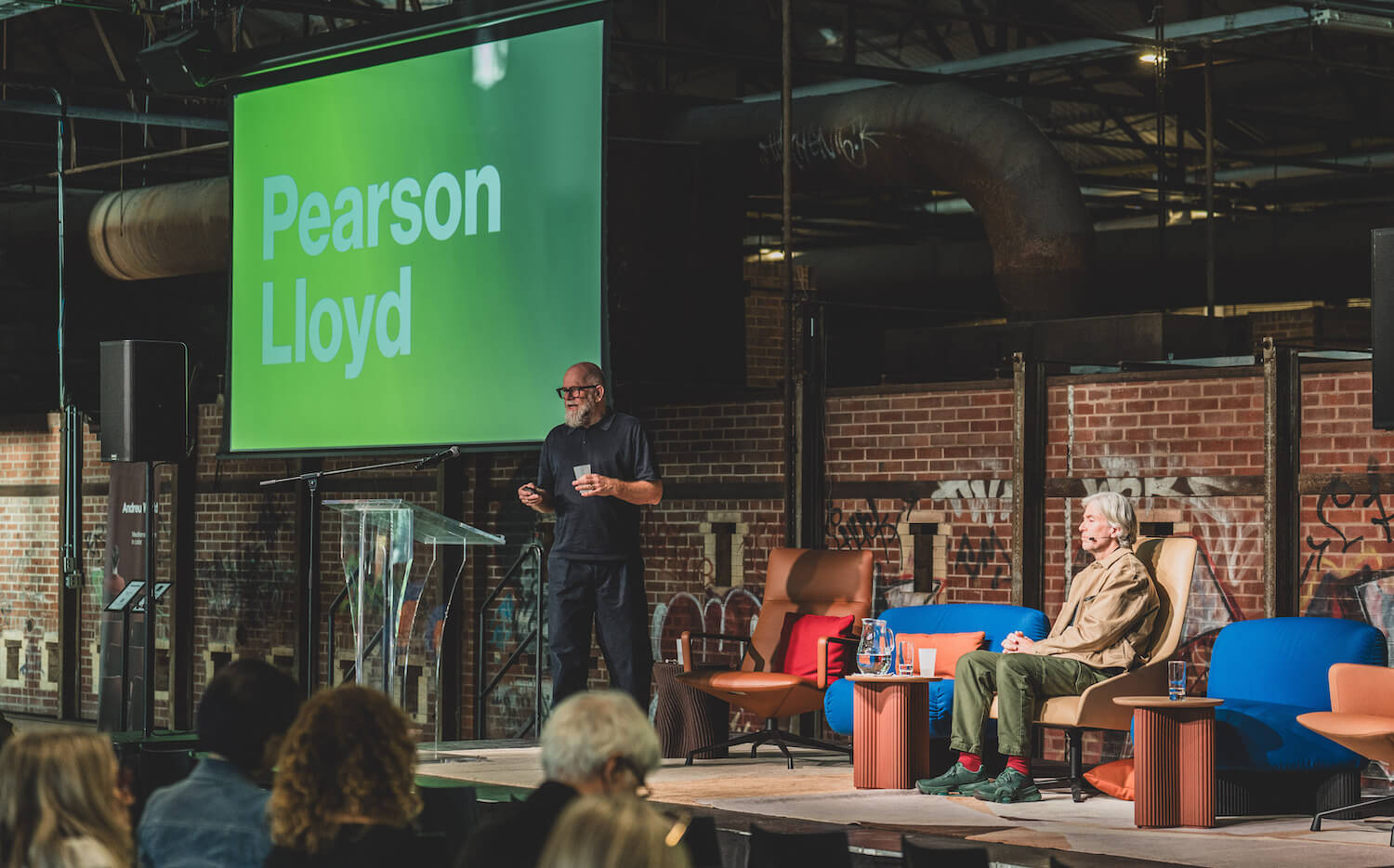
After originally planning a more extensive renovation of their Yorkton workshop, Pearson Lloyd noted that they instead opted for an adaptive reuse approach that “knits and weaves together existing materials with new elements.” This philosophy has carried over to their furniture design, too — by visiting junkyards, they study the areas where furniture wears out the fastest. In the case of a sofa, for instance, an upholstered armrest degrades much faster than the frame. How then, can these furniture components be designed to support easy repair? Mind you, the ultimate success of these initiatives requires a bigger cultural shift that sees society embrace the practice of repair writ large. On this point, Luke Pearson noted that he was encouraged to see his son being taught about sock darning in school. Pearson Lloyd also noted the importance of establishing more local operations dedicated to repair, since having to ship a chair back to a manufacturer in another part of the world defeats some of the environmental benefits of being able to fix it.
3
Client Buy-in Starts with the Bottom Line — But it Shouldn’t End There
How do we build business models that are both economically viable and environmentally responsible? For Pearson Lloyd, this might look like renting and sharing what we need, repairing the things we already have — and ultimately, getting comfortable with owning less stuff. The reality is that net-new sustainable products cost a lot to make, which can be harder to justify to the end user. Educating your customer to understand the value of green materials and craftsmanship is key, a theme that resounded in the Product Design panel.
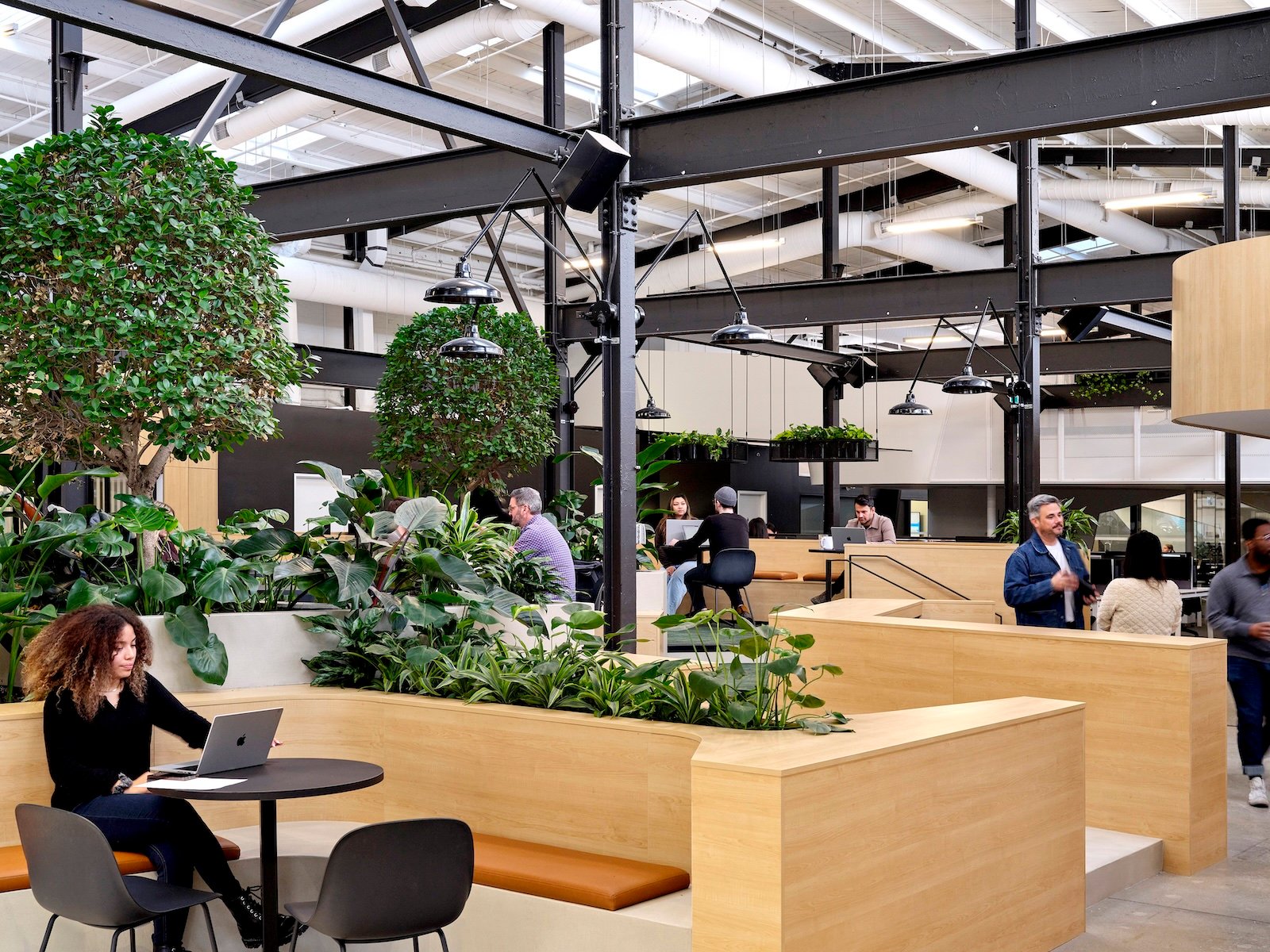
The same tension surfaced at the interiors scale, where sustainability often sits behind other client priorities. “If you asked the client, they’d never present this as a sustainable case study,” said Natasha Lebel of Plus Company’s new Toronto campus, who unpacked her surgical approach to the renovation of the Liberty Village office in a workshop on resilience in interiors. The project was a success in their eyes, not because it is an example of eco-conscious design, but because it delivered exactly the kind of workspace that supported the company culture — on time, and most importantly, on budget. The reality is that clients rarely ask to implement sustainable strategies — but that doesn’t mean it’s not worth doing. Lebel’s approach underscored a broader point echoed across the conference: sustainability often advances only when designers push for it. “Building codes represent the worst we can do,” echoed hcma’s Melissa Higgs in the Climate Intersections panel. “We need to push our clients to be better.”
4
“Preventative Care” Isn’t Just for the Medical Industry
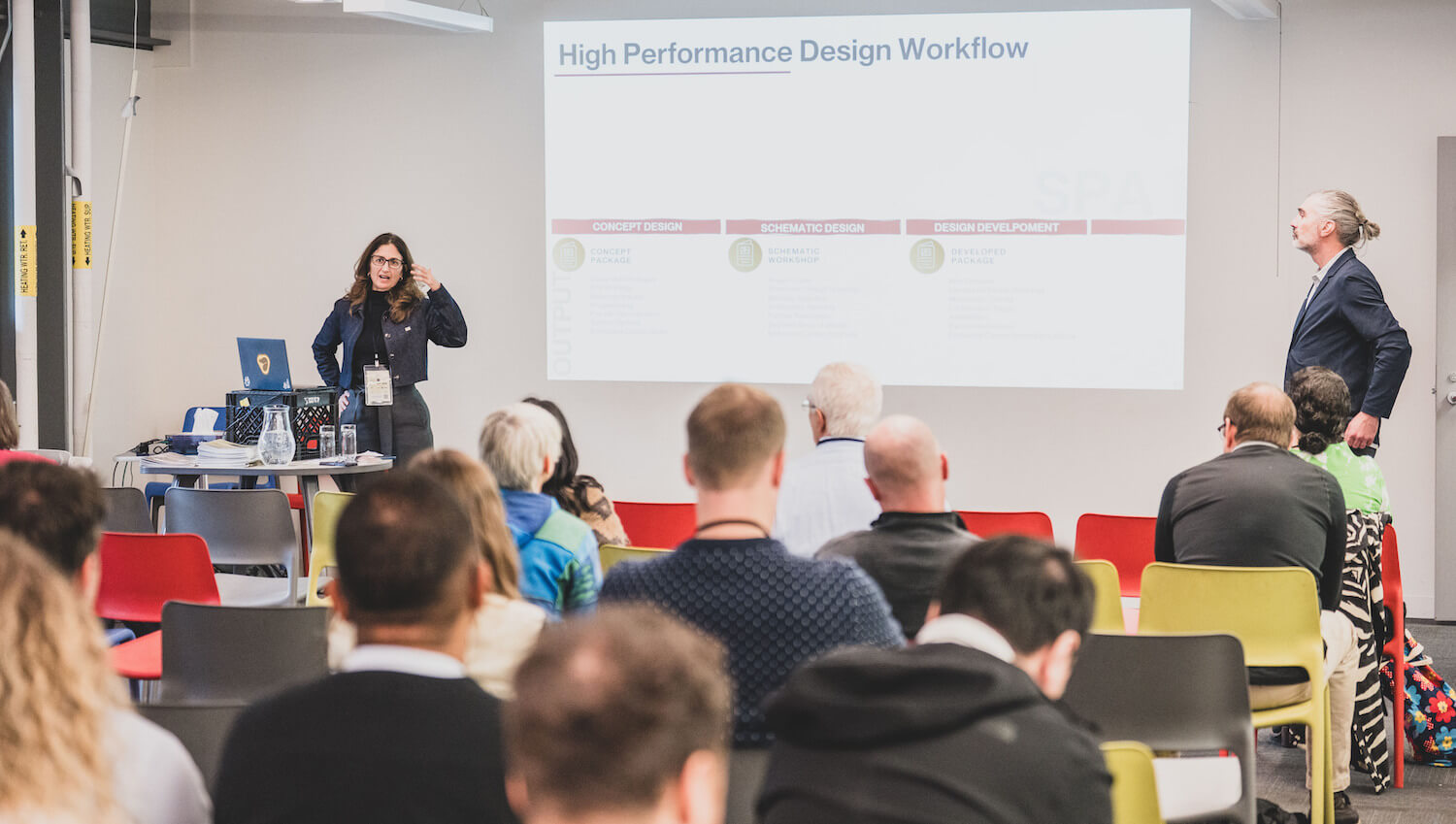
During “From Insight to Impact: Technical Tools for Climate-Resilient Design,” a workshop led by BDP Quadrangle’s Michelle Xuereb and ClimateFirst’s Mike Williams, the pair presented a climate risk audit that they had completed for 80 Atlantic, Ontario’s first mass-timber office building, located in Toronto’s Liberty Village. Back when the building was originally designed, the project team’s main emphasis was on decarbonization, but the presenters noted that, in hindsight, sustainable design now needs to place just as much priority on climate resilience. In turn, the insights from their follow-up audit anticipated the greatest current and future climate threats posed to the building. For instance, the number of extreme heat days in Toronto is estimated to increase from seven in 2025 to 31 in 2050, which will impact everything from outdoor landscaping to sealants, which have a lower life span at high temperatures.
In turn, Xuereb and Williams proceeded to detail the building’s most at-risk components and present recommendations about how to safeguard them — either immediately in the case of low-cost interventions, or for larger investments, as part of scheduled maintenance and repair down the road. In the audience discussion that followed, Field Operations partner (and Human/Nature keynote speaker) Lisa Switkin noted that she pitches clients on these resiliency efforts by comparing them to preventative medicine. “That way, they’re not constantly operating in the emergency room,” she said.

5
Embodied Carbon Isn’t the Only Elephant in the Room
Behind the main stage, a striking installation stretched through the long corridor of the building’s former kiln. Designed by Giaimo, Houses Worth is a study of local development projects that aim to replace tall, densely populated 20th-century towers with even larger new housing. Scale models of threatened buildings are paired with hundreds of single-family homes, illustrating the cost of demolition by translating each imperilled high-rise into an equivalent carbon value of houses.
But carbon is just one part of the story. Alongside the houses and towers, photos by Doublespace Photography present intimate glimpses into the daily lives of apartment residents at risk of displacement through demolition. Developed in collaboration with housing advocate Monica Hutton and tenant collective No Demovictions, these intimate snapshots humanize the stakes. Buildings are vessels of culture and community; they are places where myriad lives and livelihoods unfold. There’s a lot more in the walls than CO2.
6
Great Architecture Often Requires Activism
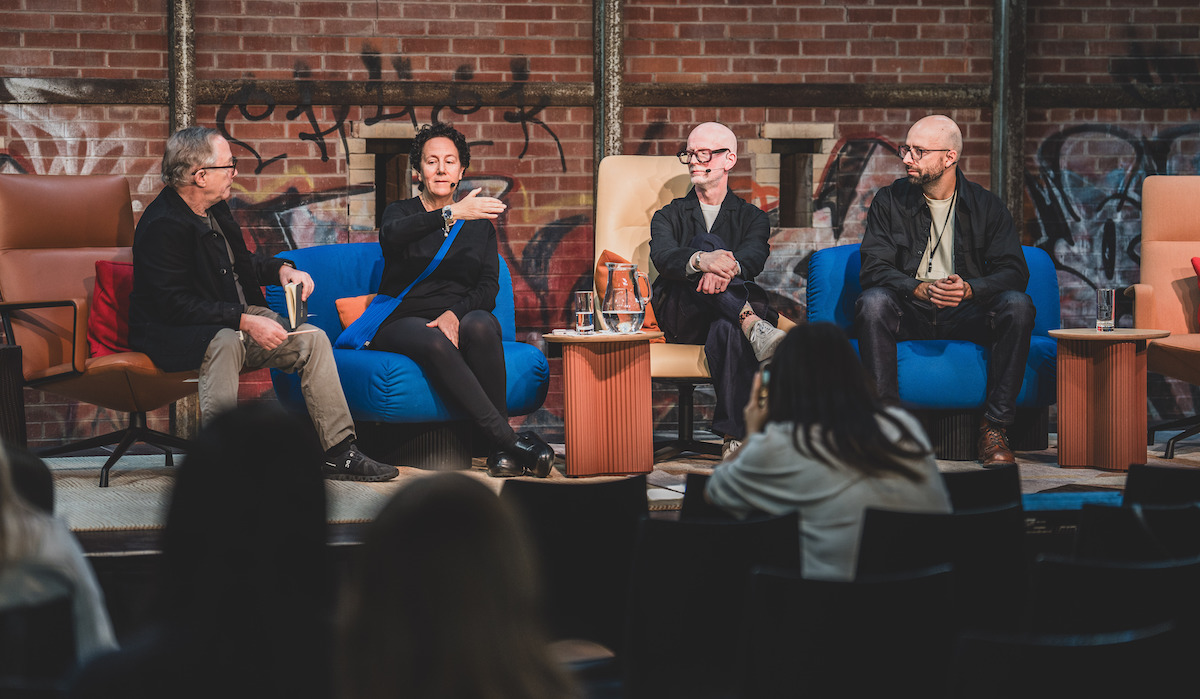
The question “Who matters?” was also central to Melissa Higgs’ presentation during the Climate Intersections panel, which looked at how sustainable design goes hand in hand in meeting such societal needs as housing, education and recreation. “Who should this building serve and how should it serve them now and into the future?,” she asked. The principal architect at Vancouver firm hcma went on to explain, “We design for a complex, nuanced, amazing group of humans, and there can’t be a one size fits all in our work. Climate change may be the most fundamental problem we face collectively, but it is interwoven with many others: inequity, poverty, lack of respect for diversity, market instability, social justice, isolation. We believe that social ties developed through time spent together, in person, in the buildings we design, is needed and contributes to social resilience.”
What matters is often governed by out-of-date and often downright wrongheaded building codes. Just like the tactical urbanism espoused by the mobility panelists, Higgs and her co-panelists — Janna Levitt of Toronto’s LGA Architectural Partners, Lawrence Scarpa of Los Angeles firm Brooks + Scarpa and Montreal architect Pierre Thibault — showcased both their marvellous projects and the extensive efforts they undertook to realize them. And much of that effort went towards challenging the status quo.
In Toronto, LGA has led with such projects as ReHousing, the Single-Stair Alternative Solutions project and Canada’s Housing Design Catalogue; and in Los Angeles, Brooks+Scarpa have initiated programs like Livable Places and the Affordable Housing Design Leadership Institute. Both have had to move the needle on boosting housing density by going up against existing zoning bylaws – and then shaping new ones. Thibault, who established Lab École, an incubator for reimagining elementary schools as inspiring, sustainable and nurturing places for children, also had to convince the province of Quebec to support the project, where building designs were selected through competitions rather than procurement. This spirit of activism must also apply to energy codes going forward. As Higgs told us, “hcma often starts with the fact that meeting building code requirements is not enough. They are actually the worst we can do. By their nature, they represent the past.” The call to action: “Let’s go beyond the code.”
7
Sustainable Strategies Require Both Nature and Nurture
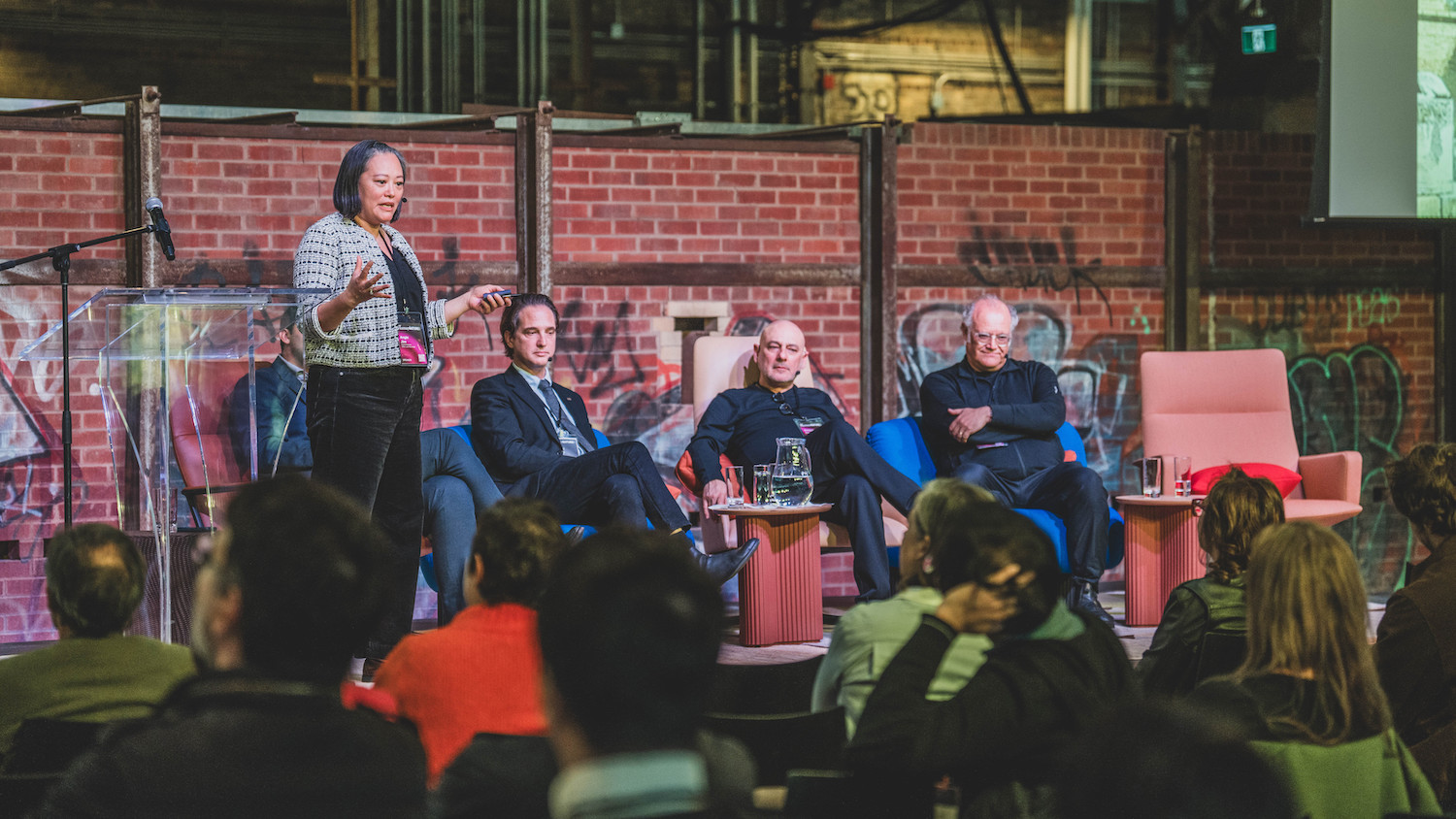
“We’ve gotten too good at human-centred design,” David Fortin proclaimed in his keynote, “and we’ve destroyed the planet in the process.” To dig ourselves out of this mess, he explains, humans need to start recognizing ourselves as part of nature, rather than separate from it. He describes this shift as one from patriarchy to matriarchy: “In Indigenous teachings, mother earth is not a metaphor. A mother carries and sustains life.” While the idea of nurture as central to sustainable design may seem at odds with the scale of Toronto’s mega developments, this sentiment was echoed by Angie Jim Osman of Allies and Morrison, who wants to see these projects rebranded as Mama Developments — green, accessible, mixed-use neighbourhoods that are full of character and space for the community to gather. After all, isn’t designing spaces where people actually want to live the most sustainable thing we can do?
If Fortin and Osman focused on the values shift needed to rethink our relationship with the built environment, Lisa Switkin showed what that ethos looks like in practice. As she illustrated in her closing keynote, design for humans and wildlife doesn’t need to be mutually exclusive. The idea that cities can be dynamic, nature-based systems runs through all of Field Operations’s projects, but is perhaps most apparent in its reimagining of the Seattle waterfront, which, in creating a vibrant pedestrian promenade, also restored a salmon migration corridor. It came down to a simple material change: replacing a solid deck with glass panels that allowed light to reach the water below. Not every environmental challenge can be resolved through purely natural means; sometimes the fix is a move that enables natural processes to resume. James Corner says it best: “Even though landscape invokes nature and engages natural processes over time, it is first a cultural construct, a product of the imagination.”

8
Rethink the Corporate Retreat
During her keynote, Switkin detailed the “Positions” exercise that her firm leads each year, in which every employee is invited to write their own personal definitions of nature, cities and resilience. The replies served as rich prompts for deeper discussion — some people framed nature as fragile, while others defined it as a myth. Similarly, Pearson Lloyd discussed “Well Made,” an exhibition in which they invited a group of collaborators (including designers, historians, journalists and even children) to nominate a single product that they considered well made and contribute 50 words explaining why. Submissions (which were initially showcased during London Design Festival 2024; a subsequent follow-up was held this year during 3 Days of Design) ranged from a hammer to a menstrual cup.
Meanwhile, during his team retreats, David Fortin gathers colleagues to honour the Indigenous tradition of beadwork, creating small objects as gifts for someone. “This is how buildings could be,” he said. “You’re gifting something to the community by bringing these components together.” Sure enough, this practice has informed his design work, too. Inspired by the concept of a “spirit bead” — a bead that intentionally diverges from the look of the others to act as a symbol of humility — he introduced a “spirit panel” onto his design for Otipemisiwak Centre in Kamloops. Evidently, when framed around the right activity, team retreats can be a powerful source of inspiration.
9
The Curb is Malleable
The enduring myth that streets are primarily for cars must be debunked once and for all if we’re to truly combat climate change. And that battle begins with questioning the very division between the curb and the road. During the workshop “Where Mobility Meets the Curb,” speakers Brent Raymond of DTAH, Vincent Clarizio of PXP and Claire Weisz of WXY showed how the curb is, and has always been, malleable – from Toronto to Montreal to New York. Raymond drove this home by sharing vintage photos of Toronto when Yonge street was a thoroughfare shared by automobiles, trams pedestrians and cyclists. Our streets were made for flexibility and inclusivity where the curb seemed almost imperceptible – can we fully embrace that climate-friendly version of coexistence and conviviality going forward?
Weisz presented her firm’s work on a linear park in Jackson Heights, an “essential worker neighbourhood” in Queens that previously held only two square feet of park space per person as opposed to 140 in more affluent parts of New York. To envision Paseo Park, WXY and the community had to challenge the borough’s priorities. For instance, instead of holding onto a handful of parking spaces, why not quadruple the amount of park space along 34th street by linking 26 blocks into one super-block where cars are restricted? “By taking it off the conventional street network, you’re going to get 7.5 acres of new parkland,” as Weisz put it to elected officials. To get there, her team practiced tactical urbanism, an approach all familiar to Clarizio, whose firm has used colourful, flexible and moveable street furniture as pedestrianization trials across Montreal, in places like the Quartier Latin. “We’re building this flexible infrastructure as a civic stage so it can be used for people, for different events. We learn from it, we modulate it: How can we improve it?”
That the curb, and the street, can have many permutations – that it can be for everyone equally and safely – is still a point of contention in many cities. In the conversation led by Lloyd Alter that followed the presentations, the panel discussed the preventable death of DTAH founding partner Roger du Toit, who in 2015 was hit by a car while riding his bike. Ultimately, the question came down to, “Who matters? What matters?
10
The Best Furniture Has Broader Impact
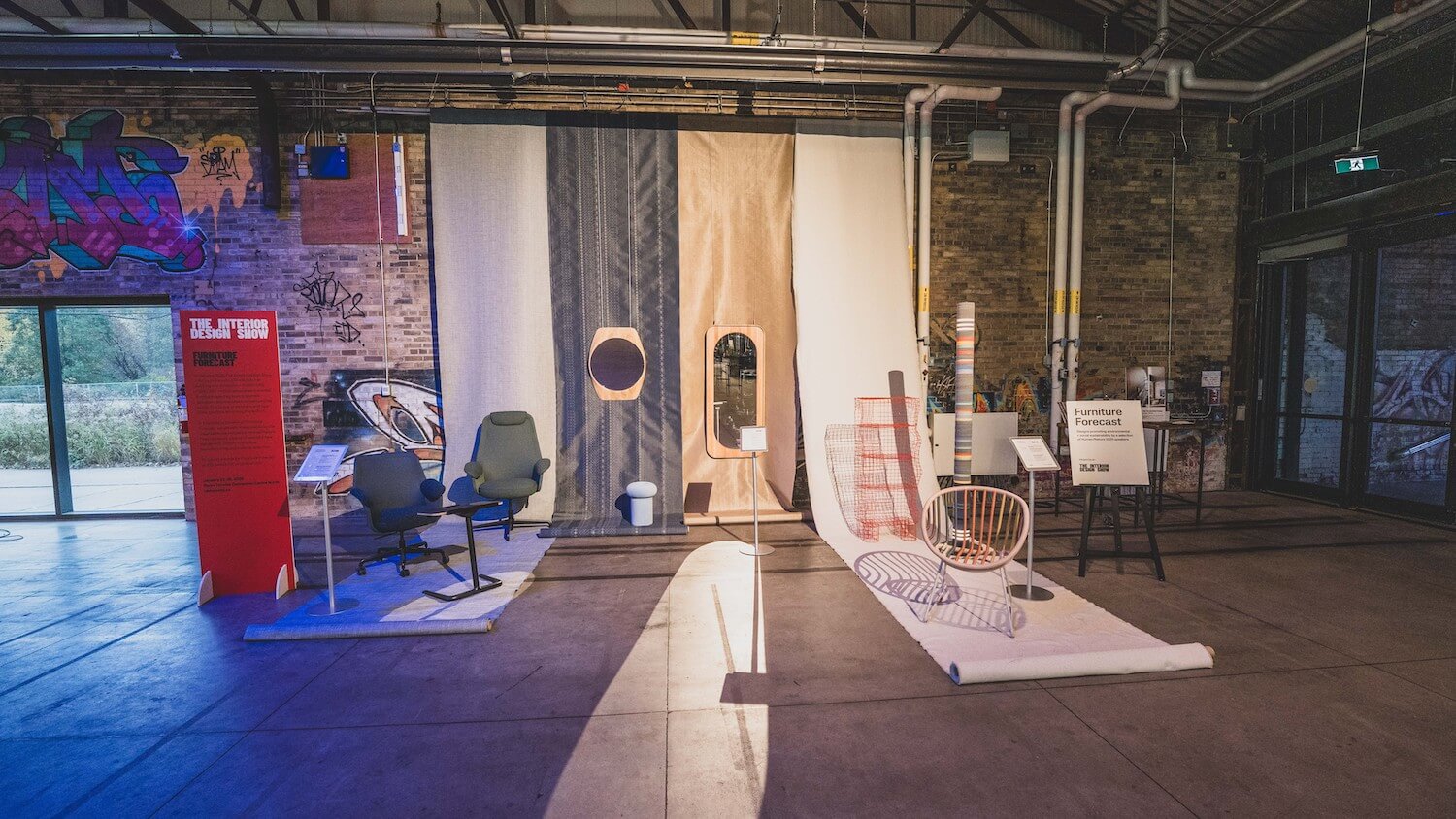
Next to Human/Nature’s main stage, the Interior Design Show Toronto presented Furniture Forecast, an installation showcasing designs envisioned by our 2025 speakers to address environmental and social sustainability. Against a backdrop of Carnegie’s bio-based Xorel fabric manufactured from renewable sugarcane, a trio of colourful statement pieces demonstrated compelling ways to redefine the value of waste. Pearson Lloyd’s Aarea chairs for Teknion feature a mélange knit back fabricated from recovered ocean plastic, while Stackabl and Benoist F. Drust’s Night City Scape floor lamp layers LED discs between textile offcuts sourced from the waste streams of top manufacturers. And in a true feat of ingenuity, Lauren Goodman turned derelict lobster traps salvaged off the coast of New England into her Fresh Catch cabinet.
Other pieces highlighted the role that design can play in supporting community. Dedon’s Kida chair designed by Stephen Burks, for instance, is a fixture at this year’s Venice Biennale U.S. Pavilion, which explores the importance of social gathering spaces. Meanwhile, Toronto designer Jake Oliveira offered an early preview of Ourse, a new furniture brand launching at January’s IDS Toronto that pairs Canadian designers with Canadian manufacturers. On display was the Soufflé stool by Montreal’s smallmediumlarge, as well as the Tortue mirror (which references a shape common in watchmaking) and Farfalle mirror (featuring pinched corners inspired by bow-tie pasta), both designed by Oliveira himself and both featuring made-in-Montreal hardwood frames.

11
Don’t Think of Infrastructure as Ugly
Dan Wood and Amale Andraos are no strangers to beauty. As the co-founders of New York’s WORKac, the pair are responsible for groundbreaking projects the world over — from the Intercorp banking headquarters in Lima, Peru to the Marea housing complex in Lebanon. Yet, the architects’ work is also shaped by a playfully unconventional embrace of infrastructural elements as aesthetic showpieces. In Colorado, the sloping roof form of the North Boulder Library transforms the building’s solar panels — typically considered an eyesore — into a proud and prominent expression. At San Francisco’s Mission Rock Building B, meanwhile, a blackwater recycling system is celebrated as if it was a luxury retailer, with ground floor windows inviting passerby to peer at the pipes and cisterns. Why? Wood had a simple answer: “We don’t think of it as ugly.”
11 Things We Learned at Human/Nature 2025
From darning a pair of socks to reviving a distressed landscape, AZURE’s second Human/Nature conference was a locus of inspiration for a more sustainable planet.