

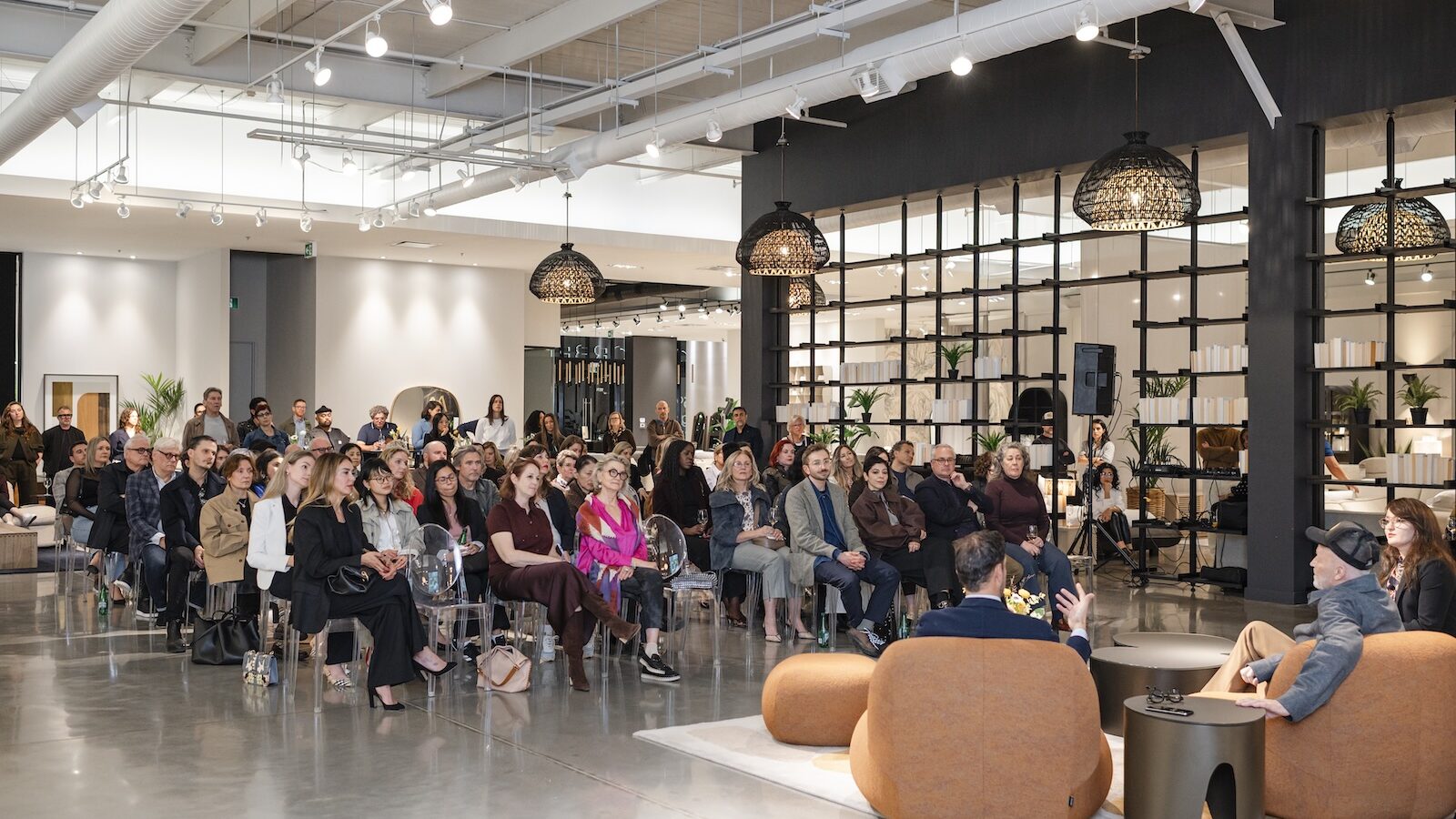
Last month, AZURE hosted a talk between Antoine Roset and Glenn Pushelberg at MUST Société in Toronto. Roset is the co-CEO of Ligne Roset with his cousin Olivier Roset. Together, they represent the fifth generation of the founding family behind the globally celebrated French furniture brand. With over 165 years in business, Ligne Roset is synonymous with elegant modernism. While the company is also reissuing classics by such mid-century icons as Pierre Guariche, which show its dedication to preserving French patrimony, its successes include decade-defining pieces like the Togo sofa from 1973, the Ploum from 2011 and the Pukka — by Yabu Pushelberg — from 2021. Under Antoine and Olivier’s direction, the company is embracing a slower tempo, releasing fewer collections of lasting relevance, rather than seizing on come-and-go trends. And they are aiming for carbon neutrality across the entire design, manufacturing and delivery process.
Glen Pushelberg is one half of Yabu Pushelberg, the world-renowned studio he founded with his business and life partner, George Yabu, in 1980. They started out with great interior design projects, first in Toronto — with their now-legendary schemes for Club Monaco and Monsoon — then in New York and now across the globe. They are creating beautifully tailored spaces for the world’s most prestigious restaurant and hotel brands, including Edition hotels, Four Seasons Toronto, Park Hyatt in various cities, and Le Samaritaine department store in Paris. Several years ago, George and Glenn also began designing furniture for the world’s top manufacturers, including, of course, Ligne Roset.
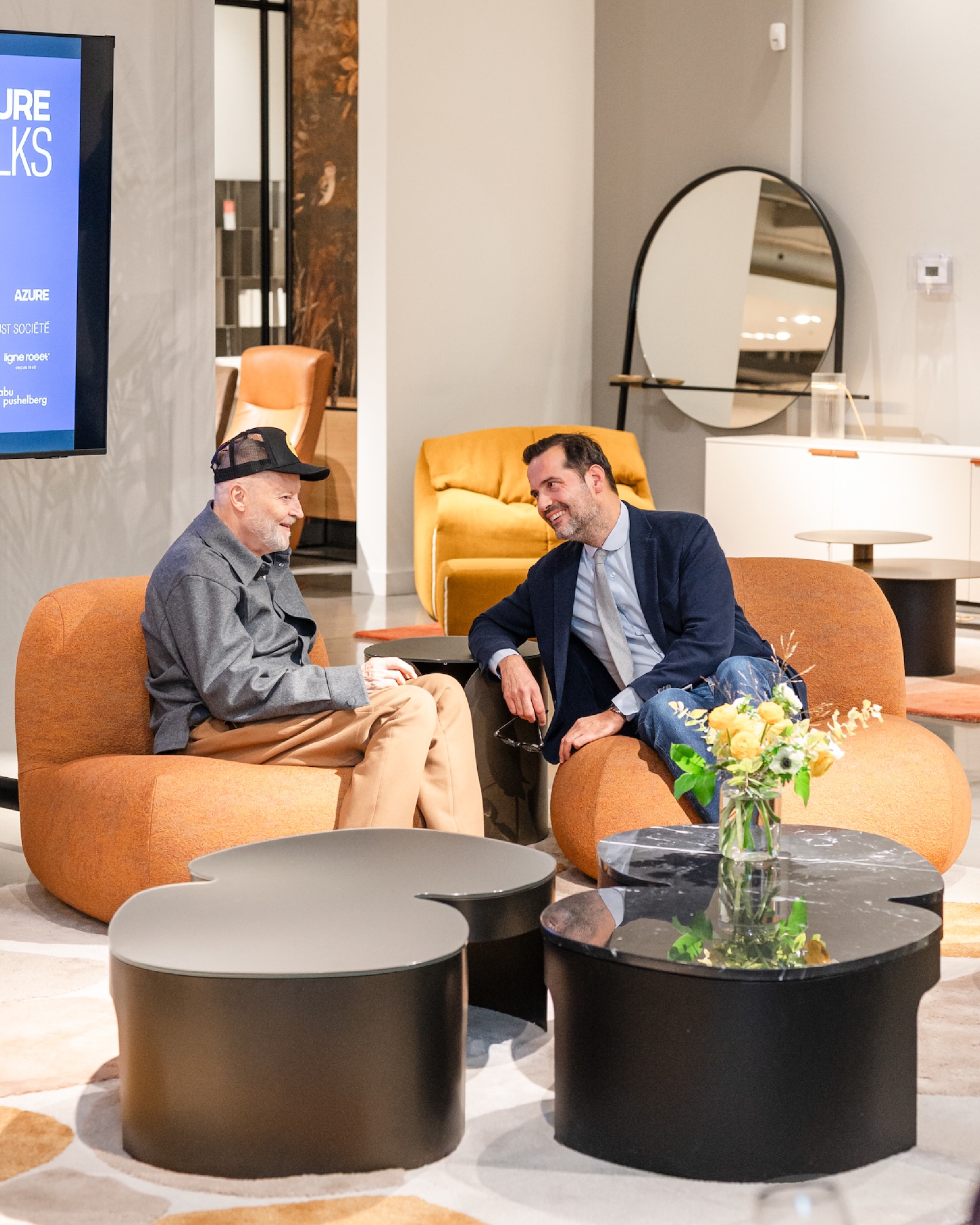
Here are some insights from their conversation, moderated by AZURE Editor in Chief Elizabeth Pagliacolo (and gently edited for clarity):
Chemistry in Collaboration
Antoine Roset: ”When we work with a designer, we have to be sure that we match well with them. So, we have to meet, we have to discuss, and it’s like the French way around the table — we can speak for hours around the meal. That’s very important. We have a back and forth. George and Glenn [of Yabu Pushelberg] came to us with different ideas, and we said, “It’s Pukka. We want Pukka. This is the one we’re gonna do.” And then we have a process for the prototype: The guys at the factory make different prototypes at the same time — for hotels, for example — that we develop. So depending of the volume, it can take slightly longer to develop. Then there’s the difficulty of the product. I don’t see how we can be faster than a year. Two years, I would say, is a good average. We have another product with Yabu Pushelberg coming out this year. And that one has taken three years to develop.”
What Makes a Design Endure?
AR: “If I have a beautiful seat that is not comfortable, or beautiful but not strong and durable, it’s not good design. They’re two different worlds: artistic creation and design, which has a function.”
Glenn Pushelberg: “You have to start with really good work. You have to be self-critical, because that way you can make your work better. It doesn’t matter what design that you’re doing. We have debates in the studio: Is this chair derivative? We’re doing a chair right now for Zanotta. After the first concept, which I call The Worm, we found a similar chair from the ’60s. We said, “No, we can’t do this,” and then we changed it into something else.
If you make something that is thoughtful and complete, and you hone your craft, the more that people can feel some sense of emotion to it. You know, for us, it’s not one thing, one idea that makes a whole. It’s all the ideas making the whole. It’s the scale and proportion of space. It’s the materiality. It’s the lighting. It’s the art.
We were in Amsterdam, talking to somebody who wants to build a restaurant, and she was apologizing because they’re all three broken up little spaces. But it reminded us of the Windsor Arms Hotel, a million years ago, when we were young, and its restaurant Three Small Rooms; they were these beautiful little rooms, and a courtyard cafe. We thought of these iconic Toronto spaces, these restaurants that people continuously went to because of all of the parts for making the whole work, and of course, interior design is only a manifestation of an experience, because it’s the service, the food, and all of those things. And it’s the same with a piece of furniture. It can be fanciful, it can be sweet and happy, it can be serious — but it has to be thoughtful.”

French Evolution:
AR: “From designing umbrellas to dining chairs, Ligne Roset has evolved since 1860. We have the heritage. We are inheriting something, so we can’t — even if we are French — do a revolution. But the evolution is to say, what are we going to give for the next generation?
We decided to keep this company 100 per cent family — and so my shareholders are my sister, my brother, my colleagues. So, I have to deal with that, but it’s a lot of fun.”
GP: “It’s really interesting working for these European furniture businesses that are family businesses. As you get to know the families, you see how much they are part of the DNA, how in sync they are, how in-depth their knowledge is and how dedicated they are. And how clear they are about what they’re making. When companies go into private equity, you lose freedom, and you lose that kind of immediate decision making between designers and makers.”

Fast Fashion vs. Quality
GP: “The truth is there’s too much furniture. And now the luxury fashion companies have much more capital than the traditional furniture companies involved in furniture. And the furniture companies, some of them are focusing on branding more so than product. So they’re becoming overexposed. It’s interesting to understand the issues around it and then work through it because all of these things provide opportunities for change.”
AR: “We don’t say we are luxury. We say we are premium. We manufacture 83 per cent of our production in France. The cost of craftsmanship is expensive. Then, we are using premium materials. You can buy many different qualities of foam — if you want a product that lasts two years, you won’t pay a lot. But if you want a product that lasts 20 years, it’s much more expensive. So, based on the designs we have and the name we are working with, we are premium. And we try to have a decent, reasonable price for the premium quality that we are giving.”

Inspiration
GP: “The adventure of life is about continual change. I was reading an article about brain patterns, and, you know, if you have a daily routine and then you go on a trip, your brain gets disrupted because it doesn’t follow the pattern. So when you’re coming back from the trip to your daily routine, there’s always some stress in your mind. But the more you travel and the more you see, the more your brain adapts to change and creativity. For us, too, the more we get to travel, the more opportunities that come our way. Life should never be dull. We never want to be dull. We want to continue to move. We don’t want to do the same thing all the time. But we want to remember things work, and we want to do it with grace and joy, and once you put your mind to that, life is wonderful.”
Visioning vs. Marketing
AR: “The vision we are giving is the vision of our brand. We don’t adapt to the market. If we start adapting the product to market, we lose our DNA because it’s not the vision of the designer anymore. To be honest, I have some people, some financial guys, with me today, and they wouldn’t answer the same way. But the truth is, we don’t care. We have the chance to give to every one of you a vision of design. You’re not obliged to accept it and to like it. But at least it’s our vision, and we share it with the entire world, everywhere, the same.”
A Conversation with Yabu Pushelberg and Ligne Roset
Glenn Pushelberg and Antoine Roset share insights on collaboration, inspiration, and making design that lasts.