


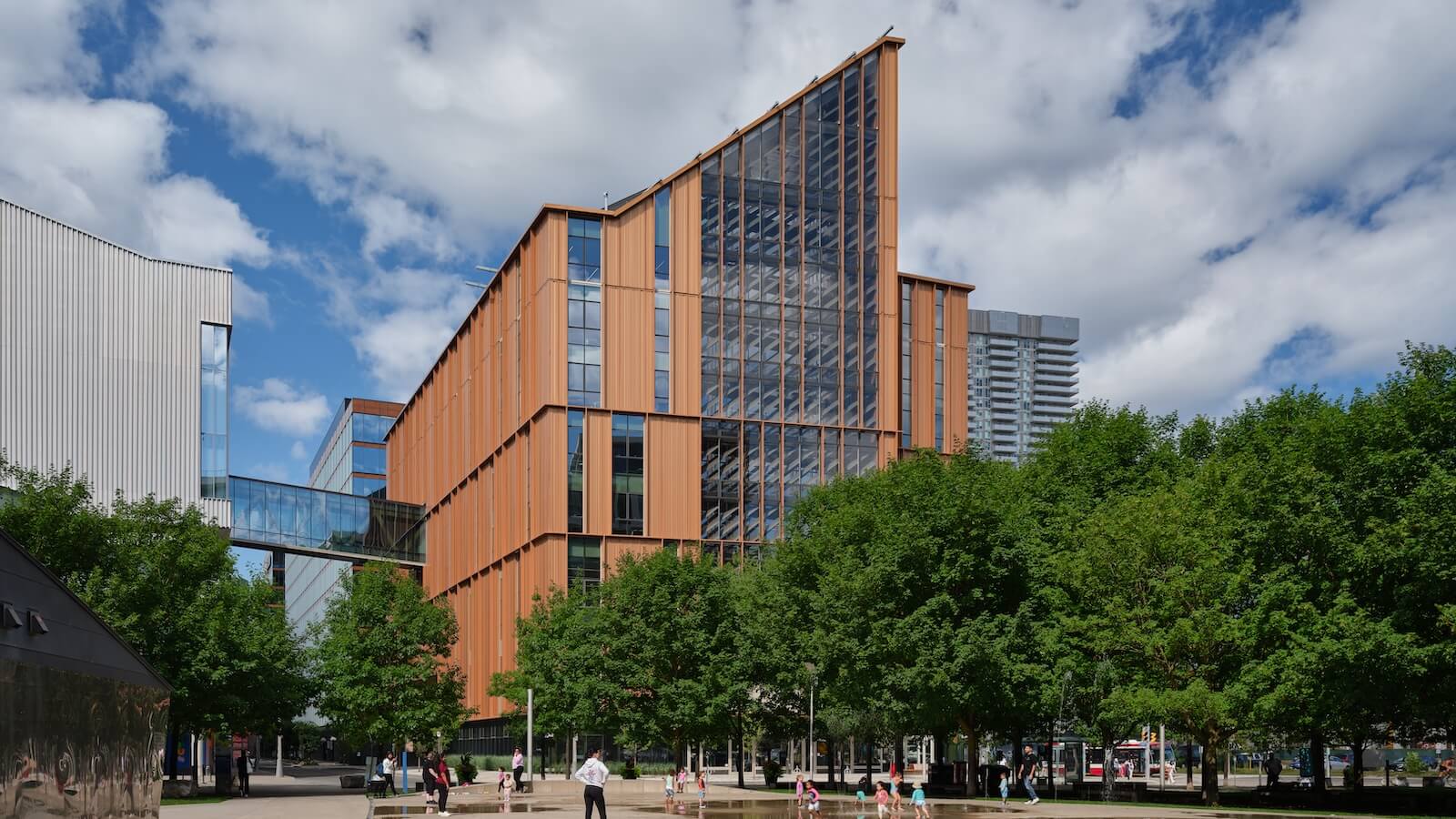
There are few projects in Toronto that have been more highly anticipated than Limberlost Place. Nearly a decade in the making, the academic building — which opened this fall on the waterfront campus of Toronto’s George Brown College to house the school’s architectural studies program — marked a major milestone as the city’s first mass timber institution. Its design, by Moriyama Teshima Architects (MTA) in partnership with Vancouver studio Acton Ostry Architects, had been lauded with accolades well before the project even broke ground.
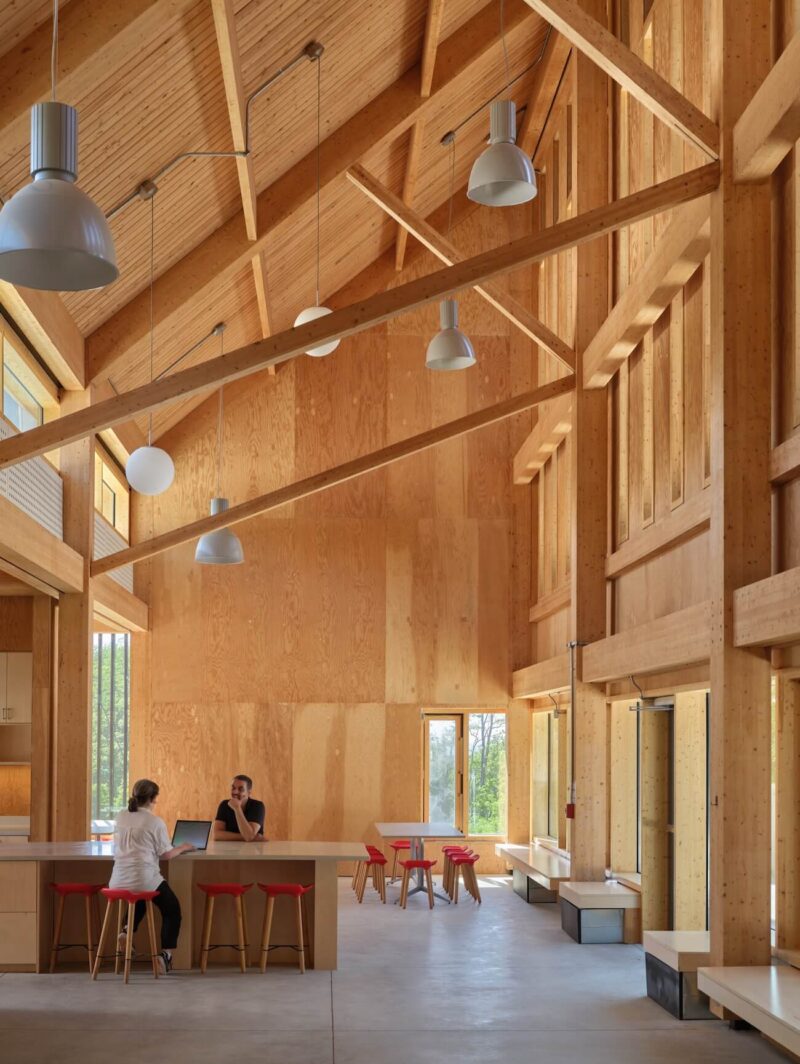
When I first visited the building on a hard-hat tour in September 2024, the buzz was palpable as contractors put the finishing touches on the interior. As I stepped off the street and into the soaring, 16-metre-tall Learning Landscape, it was easy to imagine hordes of students gathered on the bleacher steps (a now-quintessential component of many educational facilities) that lead up to the second floor, even amidst the scaffolding. Conceived to emulate a clearing in the forest, the massive glulam columns are on full display, emphasizing the verticality of the space and adding to the sense of wonder. The smell of wood was immediately grounding: The structure, made of black spruce sourced from Quebec by Nordic Structures, is replete with knots and checks, adding to the interior’s uniquely “Canadiana” character. Another stunning celebration of timber comes in the form of a massive three-storey CLT stair that snakes through the building’s core (and what better incentive to take the stairs rather than the elevator?).

But the pièce de résistance was stepping inside one of its two solar chimneys — the first and perhaps last time I would have that opportunity — as it was being sealed off. “It feels perfectly comfortable in here, even without the mechanical systems on, because of the natural ventilation,” explained Phil Silverstein, the Moriyama Teshima principal leading me through. As I climbed into the shaft, my knees shaking a little as I peered down from the 10th floor, I could feel both that breeze and the project’s sky-high ambitions. But more on that later.
For Carol Phillips, the MTA partner who led the project, the process of building Limberlost Place was akin to landing a person on the moon. When the college launched an international design competition for the project back in 2017, their ask was for a mass timber, net-zero carbon, future-proofed and smart building. At the time, there was no precedent for a mass timber institutional project in the city. In other words, the architects would be navigating uncharted regulatory territory.

The brief from George Brown, just in terms of the program, was a tall order: It included classrooms to accommodate 3,400 students, a gym, a daycare, offices and communal spaces. And because colleges are training the workforce, they had to be nimble enough to adapt to the needs of their community, meaning the programmatic requirements could change at any time — and they did (the space was originally intended to be used for computer studies, a program that grew exponentially over the course of construction). “This project required us to deeply listen and look at these criteria not as challenges but as real opportunities,” Phillips explains. “I think the reason we ended up emerging as the winners is because we did not run away from the constraints; we ran towards them.”

One of those constraints was to create between 40 and 60 classrooms with clear sightlines (meaning, no columns within them). The architects devised a nine-metre grid that could accommodate classrooms of that size, but design- ing a mass timber structure that could span this distance while maintaining all the required programming within the building’s 30-metre height restriction was no easy feat: There was limited knowledge available about timber–concrete composite systems at the time. So the team — which included the structural engineers at Fast + Epp — pursued a research grant from Natural Resources Canada to bridge the gap.
Fast + Epp found inspiration in an unlikely place: parking garages. With similarly restrictive height requirements, these concrete buildings often use a wide and shallow drop panel, which increases the slab’s strength around the columns. Knowing that CLT behaves similarly to concrete due to its laminated layers, which run in alternating orientations, Fast + Epp devised an innovative slab band system that could span the full nine metres and measures just 40 centimetres in depth — less than half that of a typical post-and-beam structure. This move gave back an extra floor of programmable space. It was an instant game-changer, enabling the architects to use less material and reduce costs.


The slab band system was initially conceived to be all-wood, but the engineers discovered that, despite being structurally sound, the slab bands were too light and therefore allowed too much vibration. This would impact acoustics and the general comfort of the spaces. To dampen the vibration, they added a thin layer of concrete on top, effectively creating a composite structure.

The building’s sustainability mandate extends far beyond its timber construction, however. Perhaps its most impressive features are those two solar chimneys, which flank the building to the east and west (and were developed by sustainability consultants Transsolar). They draw air from the open windows up and through, using the stack effect. “In the summertime, when you’re cooling the building, you want this area to be cool. So we open the windows at the bottom and the top and just allow air to circulate through here,” Silverstein explains. “In the wintertime, when you’re heating the building, you want it to be hot in here. So we button all those windows down, and the heat shelves will warm the space up. It will be like a nice warm blanket on two ends of the building.” To perform properly, the chimneys must rise two storeys above the floor they seek to cool, and this was a key driver of the building’s pitched-roof form. Its purpose is twofold: The roof also tilts southward at the optimal angle to capture solar energy.
The inclusion of these passive design strategies is just the first step. It was also critical to ensure that the building’s occupants would understand how best to use them. To that end, George Brown is developing an app that connects to both the building’s automation system and the weather station, indicating to staff if it’s a good day to open the windows. Sensors can detect when enough windows are open and, in response, shut off the ERVs on each floor. In this way, architects have given the users almost complete control over their own comfort in the space. Instead of adjusting the thermostat, students can open a window or turn on a fan. If there is plenty of sun, they can turn off the lights.

Giving students a sense of agency was also a guiding principle for the interior design, which places more public programs around the perimeter to animate the street front while also offering quieter moments of reprieve for those who need them. “We’ve done a lot of vertical campuses, and the life usually dies by level three. Once you go above that, it’s a ghost town unless students are in classes. We’re hoping that students will gravitate to these spaces, bringing the energy up through the whole height of the building,” says Silverstein. Throughout, the building brims with magic moments begging for discovery. In the upper levels, abundant natural light reflects off the structure, evoking the coziness of a wood cabin on a summer morning; a skylight perfectly frames the Toronto Islands hovering on the horizon.
Such an ambitious project could not have been realized without a truly collaborative approach. From the initial kickoff meeting including everyone from the fire engineers to the code consultants and larger overseeing building authorities (and, of course, the client), Limberlost Place exemplified the rare occasion where every stakeholder saw the project’s potential to change the industry and was deeply committed to seeing SECTIONS the vision through. Realizing it needed external support to better understand the project, the City of Toronto asked George Brown to hire peer reviewers who could examine the design and approach to the code, checking in at regular intervals and weighing in as decisions were made.

Phillips credits this teamwork for the project’s success: “If the mass timber industry is on a larger trajectory, we’re at a nascent part of it right now. We need to work collaboratively in order to realize all those possibilities and see where the industry leads us. My hope is that the project will influence how we work together as much as what we build,” she tells me.
To mitigate fire risk, the architects were told they would have to encapsulate the entirety of the wood in drywall. For all the effort that went into the structure, it would be a shame to cover it all up. By changing the sprinklers from light to high- hazard, they were able to leave as much of it exposed as possible (50 per cent), an educational tool for the architecture students who would soon walk the halls. “We wanted the building to be didactic,” says Phillips. “We wanted it to be a living lab.”
Limberlost Place is already an important precedent for practitioners today. Insights from the project have influenced revisions to the National Building Code, all the structural research conducted by Fast + Epp has been made open-source, and the building’s life cycle analysis by MTA (currently underway) will also be publicly available. Vibration monitors embedded within the building will allow it to be a resource for continued learning. “We have not held our cards close to the chest,” explains Phillips. “We wanted to try and change culture and to create a trans- ferable system that others would be excited by. We don’t make a sustainable world by making buildings that are only demonstrative, but by showing what is possible for every building.”
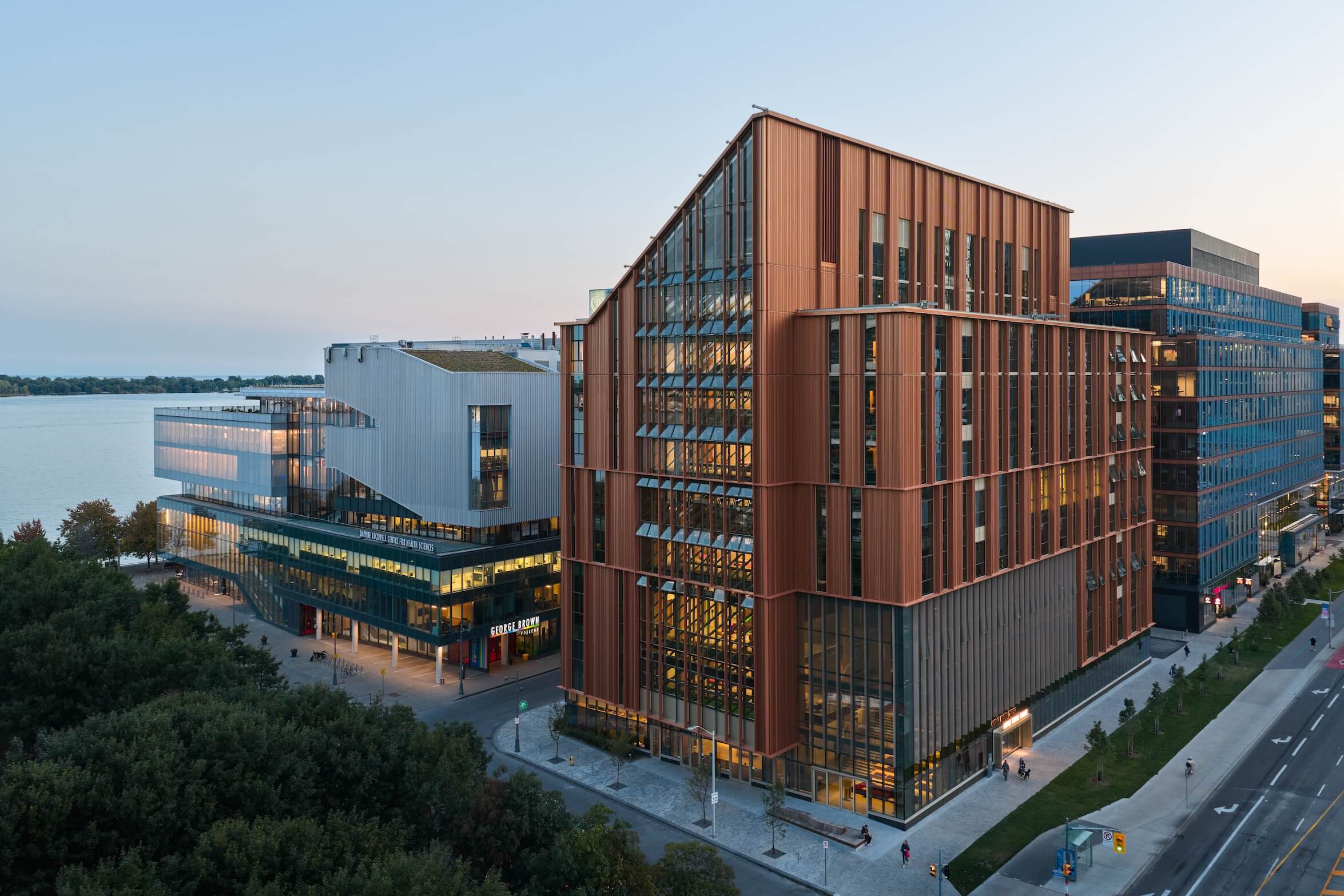
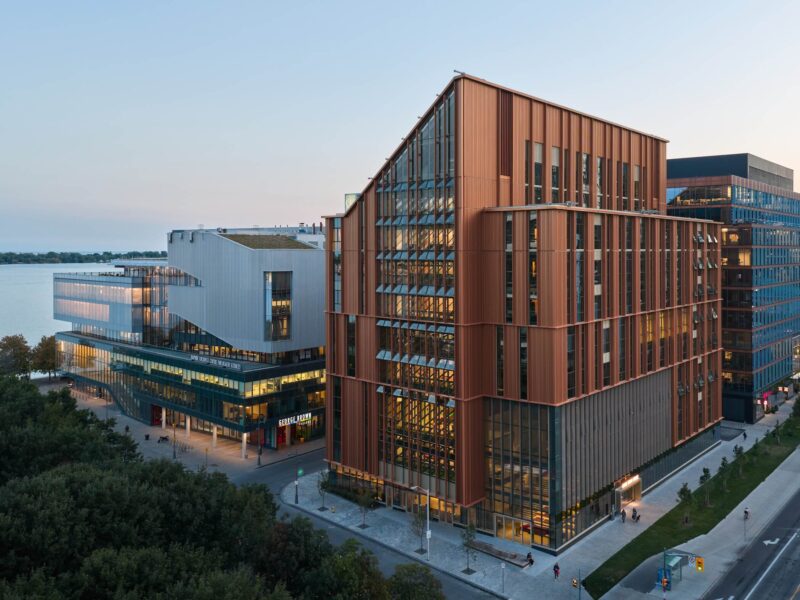
Back on the street, Limberlost Place takes on an almost civic character, its single-pitched roof stretching skyward, visible from the nearby Sherbourne Common. Its copper-coloured prefab aluminum facade echoes the nearby Aqualuna residential tower by 3XN — and protects the mass timber struc- ture from moisture that can cause cosmetic stains and, rarely, mould or rot. While there are ample strip windows to allow in natural light, most of the glazing is concentrated on the ground floor, connecting the building to the urban realm. The building’s material expression is a refreshing change of pace from the glass towers that have proliferated across Toronto, creating a sea of sameness at the urban scale. Quoting Northrop Frye, Phillips expresses her hope that, as the waterfront continues to evolve, it will in turn develop its own identity and clear sense of place — a genius loci.
It is a sentiment that hearkens back to the enduring legacy of Raymond Moriyama, whose architecture has defined public life for so many Torontonians. “When I look back on my own experiences studying in the Toronto Reference Library when I was in Grade 12 or visiting the Ontario Science Centre as a child and with my own kids, Moriyama’s buildings were like silent characters that helped to shape my life,” reflects Phillips. “I hope Limberlost Place does the same. I feel it shaping our own existence right now.”
Moriyama Teshima’s Limberlost Place is a Living Timber Laboratory
A code-shifting precedent long before its completion, the George Brown College hub offers students first-hand immersion into design innovation.