

I may be a design journalist, but when I go to Montreal, I’m there for one reason: to eat. As soon as I land, my first order of business is to secure a smoked meat sandwich at Schwartz’s deli. From there, each weekend jaunt becomes an exercise in crossing as many restaurants as possible off my ever-expanding list of must-tries. I’ve long believed that Montreal is Canada’s foremost culinary destination, and it turns out that hunch is backed by data: In 2026, the city is home to 28 of the country’s best 100 restaurants — beating out the big guns in Toronto and Vancouver, which boast just 23 and 14, respectively — ranging from Joe Beef, an institution over two decades in the making, to neighbourhood spots like Pasta Pooks serving up more casual fare.
Look closer at the list of Montreal’s top dining destinations and you’ll find that several share something beyond exceptional food: a generous helping of design ingenuity, served up by local hospitality maven Zébulon Perron and his eponymous atelier. During my most recent visit, I managed to snag three of Montreal’s most difficult reservations and unintentionally wound up on a tour of the firm’s most buzz-worthy projects.

Perron has been orbiting Montreal’s restaurant scene for over two decades. As a design student, he worked as a bartender, where the connections he made led him to gravitate toward the hospitality industry. “When I started out in the late 90s, early 2000s, there wasn’t a lot going on in the food scene,” he recalls. “Restaurateurs didn’t have an appetite for design — and for good reason. Montreal wasn’t doing well economically. People didn’t see the value. But the trajectory of the design and the food scene have been very parallel. It’s evolved to a place where you don’t question that.” Now, he co-owns several bars and restaurants of his own.

Perron’s portfolio may be stacked with fine dining gems, but Michelin Guide aspirations aren’t a prerequisite to work with him. The firm’s work runs the gamut from Marcus, the swanky restaurant and lounge at Montreal’s Four Seasons, to Papito, a Portuguese joint whose design pushed the idea of upcycling to the max, using the absolute minimum of new materials. “You can use less noble materials and still have an extremely valid design proposition,” he says. “I’d be wary of design that only relies on fancy materials — that’s very shallow. I’m trying my best to break the perception that design is expensive or out of reach.”
–
For any self-proclaimed gastronome, no trip to Montreal would be complete without a meal at Vin Mon Lapin. The restaurant topped Canada’s 100 Best list two years in a row (in 2023 and 2024) before sliding into the runner-up spot behind Restaurant Pearl Morissette. When I first visited back in 2019, the year after it opened (by Joe Beef alum Marc-Olivier Frappier and sommelier Vanya Filipovic), the humble 36-seat wine bar, tucked away on a corner lot in Little Italy, still felt like something of a hidden gem. But its inventive seasonal plates and selection of natural wines quickly won over both Montrealers and tourists alike, myself included.
Over the pandemic, the team got the opportunity to take over the corner store next door, and tapped Zébulon Perron to imagine a dining room befitting of its newfound stature. “The Montreal food scene is very convivial; everyone seems to know each other. They knew we were designing a lot of the restaurants in town, so they got in touch,” says Perron. When it reopened in 2022, with double the number of seats, Mon Lapin catapulted to 6th place on Canada’s 100 Best list.
Perron’s upgrades were critical to that success. The kitchen, for one thing, had needed a lot of work (the space had formerly been a Chinese restaurant, and so it had originally been organized around wok cooking). Now, the open kitchen holds court at the back of the restaurant, with an eat-up bar that offers a front-row seat to where the magic happens. “We gave them the kitchen they deserved,” Perron tells me. No doubt, it has allowed the chefs to live up to their full potential: From beef tartare dotted with the sweetest Sungold tomatoes to their signature scallop sandwich served with corn pudding, each dish I tried was better than the last.
Despite its place in the upper echelon of Canada’s culinary world, there is zero pretension here — neither in food nor design. The interior is reminiscent of a simple bistro (though Mon Lapin avows that it is not one): white wainscoting, bare wooden tables, Thonet chairs and all. Save for the mosaic-tiled floors, the space is relatively subdued. The lighting ranges from Art Deco-inspired fixtures to one particularly playful addition — a rabbit lit from within, nestled inside a decorative timber bracket, nodding to the creature for which the restaurant is named. Pieces from local artisans hang on the walls. It is the kind of piecemeal space that reminds you a bit of your own home, a reflection of Mon Lapin’s friendly, almost familial hospitality.
Looking back, I find myself perhaps more impressed by what Perron has not done here. There could be temptation in a place like this to make the space about design. But Perron’s restraint has ensured the focus remains on the plates, which are themselves works of art.
–
By morning, I still couldn’t stop thinking about the meal I’d had at Mon Lapin. So naturally, I booked in for lunch at their sister restaurant down the street — and sure enough, I found another Zébulon Perron-designed space waiting for me. Rôtisserie La Lune opened in 2024 and is exactly what it sounds like: an elevated take on the traditional Québécois rotisserie. And while Perron may have found initial inspiration in St-Hubert (chef Marc-Olivier Frappier cut his teeth working at the chain), this isn’t your average quick-service chicken joint.

“The rotisserie has a special place in Québécois culture,” Perron explains. “From a design standpoint, it poses a question — you have Saint-Hubert on one hand and the team helming the best restaurant in the country on the other, and you’re bringing them together into a place that needs to feel welcoming to everyone, but also project quality and professionalism, so people know that they’re walking into a place that knows what it’s doing.”

It starts at the entrance, where the arched door, which features a massive owl motif carved by woodworker Antoine Chouinard, becomes a kind of mascot (albeit less cliché than the cartoon variants of its chain restaurant counterparts) and nods to the lunar theme. “I wanted to make sure that threshold was remarkable,” says Perron.

That thinking carried forward to the host stand, which is intentionally sectioned off from the rest of the space, and flanked by a lounge vignette where guests can wait for their table. “I proposed early on that the whole entry needs to be orchestrated a bit,” he says. “In restaurants like Applebee’s, or St-Hubert, you can’t just walk into the dining room. It’s an old-school way of thinking about the entrance.”

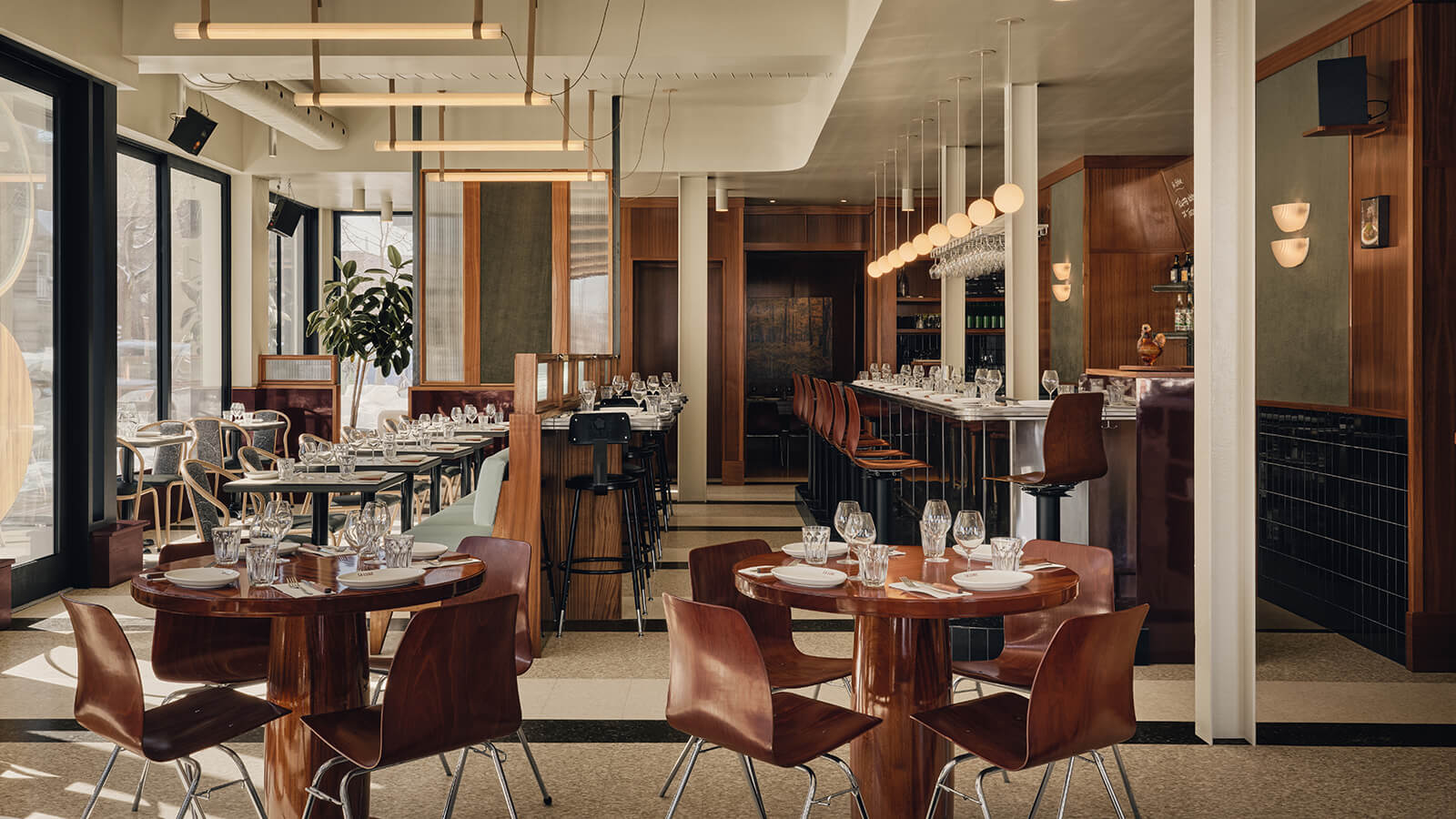
Inside, subtle references to the moon abound, like the array of globular pendants that hang above the bar. Many of the fixtures were designed in collaboration with local lighting brand Lambert et Fils, and are layered together with vintage pieces. At lunch hour, light streams in from the expansive windows, casting the dining room in a dreamy glow.
The material palette is an exercise in high-low: “We played around with juxtaposing noble materials with ordinary ones. We have really nice wood panelling, but it’s paired with vinyl composition floors you might find in a fast-food joint. Some tables are made of hardwood; others are made of laminate.” Fluted glass partitions in the dining room and square tiles in the bathroom add the perfect hit of retro flair.

As I sat on the terrasse — whose vibe feels more like that of a traditional French bistrot — looking into the dining room, I struggled to place the space in a particular design moment. It felt familiar, like somewhere I’d been before, and yet it also felt contemporary. “I love when people ask, ‘Oh, it’s new?’ It feels like it’s been around forever.” Perron tells me. “We aimed to make it feel like an institution from day one.” In true Mon Lapin fashion, the owners have resisted the urge to jump on the trend cycle that can leave restaurants feeling dated in a just few years, in favour of a concept that feels truly timeless.
–
Later that night, I made my way to the Plateau for dinner at Le Violon — a pastel wonderland, co-owned by restaurateur Danny Smiles and local artist Dan Climan. Perron had dined there with Smiles and Climan when it was still Maison Publique, the beloved neighbourhood bistro that once inhabited the space. “When we sat down at the bar, I said, ‘That’s your restaurant, guys,” he recalls.

While there are many advantages of taking over a restaurant that already exists, the space needed a complete aesthetic overhaul. “Maison Publique was more like an English pub; it was dark, with a lot of wood and other objects,” says Perron. “We needed to break from that and do something light and airy.”

At one of their first meetings, Climan brought a book of Morandi paintings, full of serene hues that would inform the final palette. From there, Smiles and Climan essentially gave Perron carte blanche. Their one request? They wanted to incorporate pink marble (which they eventually sourced from Portugal).

Perron opted to retain the original bar and the tin ceiling above it, then bathed the space in a cream-coloured hue, accented by blonde wood millwork and robin’s egg blue trim. This, and some structural work, did a great deal to open up the space. The rest of the interior was planned around Climan’s pieces. “We determined the exact size of the artworks to make the mouldings around them, so they felt very integrated,” explains Perron. The resulting design feels like an extension of the food — clean, precise, contemporary: “We talk about food right from the beginning. It determines everything.”
–
Perron has had a hand in crafting so many Montreal restaurants, he could easily have a standing reservation at a different spot every day of the week. But on any given night, you’re more likely to find him posted up at L’Express. The classic French bistro, opened in 1980, was designed by architect Luc LaPorte and has remained at the core of Montreal’s food scene from the outset. “The bistro is the best concept in food — it’s very democratic, but it feels elevated,” says Perron. “You can go there with family, on a date, for business. It’s all-encompassing.”
Much like Perron’s work, there is something timeless about this space, with its checkerboard floors, its expansive skylights, its grid of black and white photos lining the walls. “You feel like you’ve been transported to a different time and place,” he says. “It’s the platonic ideal of the Montreal bistro; it’s not an ornate brasserie that you’d see in Paris. It’s a more functional aesthetic.”
When I ask him if there’s something different happening in Montreal’s culinary landscape that’s shaping his work, he gives credit where it’s due — to the chefs he’s proud to partner with. “Montreal as a city punches way above its weight in terms of hospitality,” he says. “It’s really special to be in this scene right now. The restaurant concepts seem to come from a sincere place.” His responsibility, he notes, is to ensure that authenticity translates to design. “Whoever we’re working with, we need to express their story, their intentions. We’re part of that fabric, but we have to be very sensitive to bring real added value and make the scene even better.”
Design Is the Secret Ingredient in Montreal’s Dining Scene
The city’s restaurants are making waves nationally, but the key to their success might not just be what’s on the menu.