
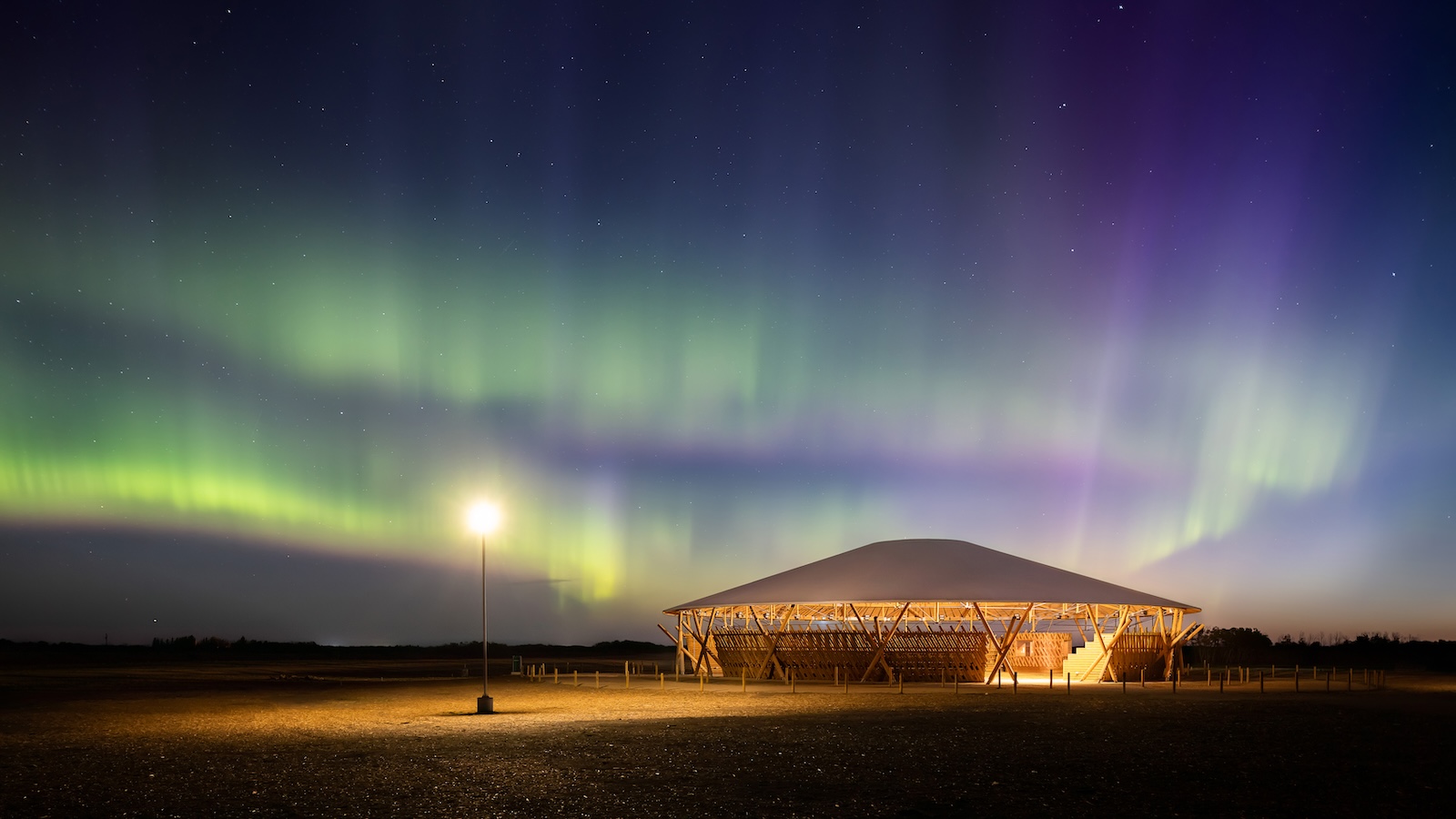
The Royal Architectural Institute of Canada (RAIC) and the Canada Council for the Arts have announced the recipients of the 2026 Governor General’s Medals in Architecture, the profession’s highest honours. Most are bestowed to private developments — and many go to residential projects: multi-unit and single-family housing that push a formal language (like 900 Saint-Jacques in Montreal and Arbour House in Victoria) or way forward in densifying single-family urban lots (like Ulster House in Toronto). Four are civic projects, three of which can be said to be truly open to the public: Muscowpetung Powwow Arbour in Muscowpetung Saulteaux Nation, Saskatchewan, Kiweki Point in Ottawa and O-day’min Park Pavilion in Edmonton.
Other honourees limn typologies: Ace Hotel Toronto is a hospitality project, but also one so rooted in Toronto’s fabric that it emanates a civic significance; it is also a cultural project, as emblematized by Howard Sutcliffe’s Horizon Line tapestry that adorns the south wall. The Parkade of the Future in Calgary, meanwhile, is a parking garage that anticipates its future as another kind of facility — an office or residential building — through its flexible design; while fulfilling a present-day need, it dreams beyond the car-first nature of the city. The Windermere Fire Station #31 is but one of the latest infrastructure projects by gh3* (which also designed the O-day’min Park Pavilion) that elevates urban utilities, making them points of civic pride through their bold, public-facing architecture.
In May, gh3* founder Pat Hanson was recognized with the RAIC’s Gold Medal for continuously pushing the envelope in her architecturally daring infrastructure projects. Hers is one of a few firms, including Patkau Architects and 5468796 Architecture, recognized with more than one Governor General’s Medal.
All are deserving — but one always hopes to see a greater variety of firms, working in even more diverse focus areas, like truly affordable housing, and more public sector projects represented.
Here are all the projects honoured in the 2026 Governor General’s Medals in Architecture:
900 Saint-Jacques, Montreal, Quebec, by Chevalier Morales Architectes and Brian Eldsen Burrows Architecte (Le Groupe Architex)

It’s refreshing to see a residential tower get this type of recognition, and 900 Saint-Jacques in Montreal’s Quartier des Gares is a deserving one. Featuring a precast concrete facade inspired by the cruciform geometries of heritage Montreal architecture, its base (hotel) and mid-rise body (rental) are separated by a recessed storey housing amenities. Topped with a crown, the composition communicates a reverence for balanced proportion while playing with volume. Its ground floor weaves in welcoming spaces: landscaped public realm, sheltered walkways and a restaurant. “Entirely novel,” the jury notes, “it recalls the substantial presence of early modern stone-clad towers in Montreal such as the Sun Life building and, even more so, the local Brutalist tradition of the neighbouring Place Bonaventure.”
Ulster House, Toronto, Ontario, by LGA Architectural Partners

As we’ve previously written in Azure, Ulster House transforms a residential lot in downtown Toronto with a sustainable, replicable multiplex model by combining a three-storey terracotta-clad main building with a laneway volume clad in Shou Sugi Ban cedar — the two zones connected by an outdoor terrace. LGA’s daring project, which is home to the firm’s two principals and their tenants, raises the bar — and pushes the code — for what’s possible on a single-family urban lot. From the jury: “Most compelling was the architects’ engagement with the limits of municipal regulatory frameworks, producing a project that thoughtfully challenged local bylaws, leading to broader regulatory change. This project speaks eloquently to the potential of the missing middle to address the housing crisis in contemporary Canadian cities.”
Veil House, Winnipeg, Manitoba, by 5468796 Architecture

5468796 Architecture is adept at crafting both inventive multi-unit residential models and striking house designs (as well as proposing novel typologies, like its similarly awarded Parkade for the Future). Veil House may seem like a luxury dwelling, but its core ethos is about aging in place, and presenting an innovative approach to adaptable living. We covered it in Azure, and we echo the jury’s sentiment that the house “skillfully balances functionality with a sublime experience of light and space.”
Arbour House, Victoria, British Columbia, by Patkau Architects

This striking home, which adds to the Patkaus’ portfolio of sublimely detailed projects, is animated by a pleated arbour of western hemlock that filters daylight deep into its interiors. While this is an undoubtedly bespoke project, an exclusive piece of architecture, it is also thoughtfully crafted to rest easy on the earth. Its combined passive strategies (deep overhangs, natural ventilation, permeable paving, water storage, etc.) and renewable systems (including geothermal and rooftop solar panels) make for a sustainable dwelling that supplies 72 per cent of its own operable energy.
Hilltop Cottage, New Brunswick, by MacKay-Lyons Sweetapple Architects

In late May, Hilltop Cottage won an AZ Award in the Houses category. The Governor General’s jury was also impressed with this charming shingle-clad, hipped roof building, citing the home’s appreciation of modest vernacular structures endemic to its New Brunswick setting, and the clever cut corner (or “bite” in MacKay-Lyons’ argot) through a two-way cantilever.
Ace Hotel Toronto, Toronto, Ontario, by Shim-Sutcliffe Architects & Atelier Ace

The true measure of a building open to the public is how joyfully and plentifully that same public receives it over time. And four years in, the Ace Hotel is as bustling as ever, beloved for its restaurants — one with a view of the ever-changing neighbourhood — and lounge spaces as well as for its aesthetic elegance. While popularity is not entirely a factor in the Governor General’s Medals, it does add cachet to this honour for this urban infill building that feels wrought from the surrounding fabric. Of note, the jury was impressed by the “dedication to craft and detail, [which] gives a delicate collage of concrete, wood, steel and clay. The project speaks to the power of architecture to evoke sensory and haptic experiences through the design and materiality of everyday human-scale objects — stairs, handrails, floors, furniture.”
Muscowpetung Powwow Arbour, Muscowpetung Saulteaux Nation, Saskatchewan, by Oxbow Architecture with/avec Richard Kroeker

Designed for summer powwow celebrations on Treaty 4 territory in southern Saskatchewan, the Muscowpetung Powwow Arbour, by Oxbow Architecture with Richard Kroeker, is a vibrant venue built for and by the community. It was erected with regionally sourced timber and by local labour. Featuring a clear-span circular form, the structure draws inspiration from Saulteaux material culture, the symbolic importance of the circle and traditional lodges. Its lightweight roof — inspired by bow-string tension and drum-head detailing — appears to float on the prairie horizon. In the words of the jury, it “honours Indigenous culture and tectonic ingenuity.”
Kìwekì Point, Ottawa, Ontario, by Patkau Architects

A public park that centres Indigenous history in the heart of Canada’s capital, Kìwekì Point not only repositions cultural artifacts but integrates new amenities — including a pedestrian bridge, Pìdàban, that reconnects the site to Major’s Hill Park. A new perimeter pathway, biodiverse planting and accessible meandering trails, meanwhile, provide visitors with better access and experience of the river and landscape. A dramatic cantilevered lookout, Whispering Point, is a crowd pleaser, serving up panoramic views and a whole new perspective on the site. This project is another winner by Patkau Architects, and it exemplifies the firm’s dual attention to site and form. “Overall,” the jury noted, “the project frames infrastructure as a continuous public realm, where river proximity, movement, material and cultural expression are tightly interwoven.
O-day’min Park Pavilion, Edmonton, Alberta, by gh3*

Another Governor General-awarded project recognized by the AZ Awards 2026, O-day’min Park Pavilion is — like all gh3* projects, among them a collection of park structures in Edmonton — a gift to the public realm. It’s characteristic of the kind of public infrastructure the firm is best known for. Park pavilions serve multiple functions, and their prominence in public green spaces should encourage formal playfulness, so why not go all out on bold form and jubilant colour?
Parkade of the Future, Calgary, Alberta, by 5468796 Architecture & Kasian Architecture, Interior Design and Planning

“Through its integration of vertical landscape strategies, carbon-conscious construction and activated shared spaces, this project reframes the parkade not as a residual urban void, but as an evolving piece of public realm infrastructure that supports both environmental performance and community engagement.” The jury’s commendation for Parkade of the Future celebrates the building’s mutability: Today, it’s a 511-stall parking structure — an urban-minded one filled with public amenities, including a basketball court and an innovation centre — but in the future, it could be an office or residential building thanks to its flexible design. This includes a removable recycled aluminum shroud that allows for future balcony integration.
Windermere Fire Station #31, Edmonton, Alberta, by gh3*

This isn’t a typical fire station. Again, gh3* reimagines a ubiquitous urban amenity through the lens of civic pride and with an eye towards deep sustainability: The net-zero-energy Windermere Fire Station #31 features a photovoltaic roof pitched for maximum solar exposure, geothermal heating and cooling, a bioswale-based stormwater management system, and a high-performance envelope. Its form, a single-storey, three-bay facility, references traditional fire stations but reinterprets them with a contemporary palette (namely, a silver brick cladding) and purpose. “Formally, the building presents a highly expressive, sculptural presence that establishes a strong thematic centre within its community, lending civic identity to a typically utilitarian programme,” the jury noted.
Canadian Excellence: RAIC and Canada Council’s 2026 Governor General’s Medals in Architecture Announced
From a park to a parkade, from a cottage to a high-rise tower, the Governor General’s Medals in Architecture celebrate an array of typologies — by some of the country’s leading design-minded firms.