

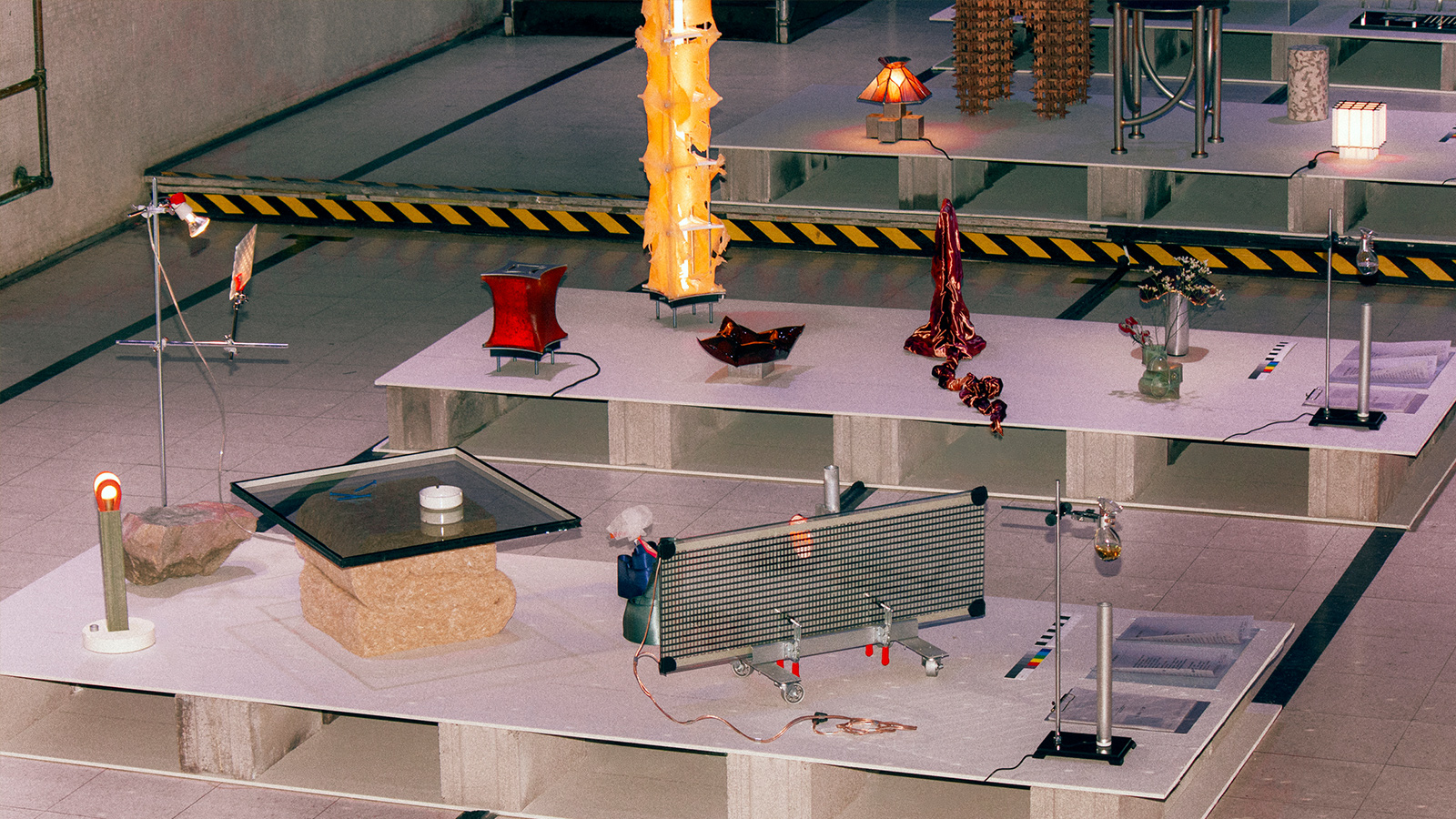
“I was working in the lab, late one night…” begins Bobby Pickett’s Halloween anthem “Monster Mash.” But Victor Frankenstein isn’t the only one engaging in a little experimentation during this time of year. The studio can also be its own form of laboratory, where designers and sculptors let their wildest instincts lead them in conceptual new directions. While these explorations don’t always produce the most practical furnishings, the outcomes nevertheless have a fresh energy that can reinvigorate anyone in need of a strong creative jolt. This fall’s collectible fairs and conceptual group shows have had a particularly exciting lineup of one-off design studies. Here are five of our favourites.
1
Oxalino Waterfall coat rack by Nicholas Holmes

This entryway statement piece is part of an ongoing collection of collectible furniture that takes its name from the combination of “oxidation” and “line” — a reference to the process that Hamilton-based designer Nicholas Holmes uses to develop each piece’s unique visual treatment. By hand-painting an oxidizing solution onto white oak, Holmes accentuates the material’s natural grain. A fluted base and series of branch-like hooks give this latest iteration a sculptural, otherworldly flair. It debuted during the DesignPhiladelphia festival earlier this month as part of the group exhibition Barpha, organized by the design gallery Dudd Haus.
2
Punched out by Tony Romano

To inaugurate its new location at 945 College Street — and celebrate its tenth anniversary — Toronto art gallery Franz Kaka staged the exhibition Soft Hardware, which brought together works by half of its artistic roster. (The other half will show in a follow-up next month.) Sitting in the front window is a jumbled almost-chair by artist Tony Romano. If the 2021 piece — which started as a pandemic project in Romano’s Warkworth, Ontario barn — evokes balusters and newel posts, you’re onto something. When Romano was growing up, his dad ran a railing company that Romano eventually went on to work at, and now runs. “I always come back to it. My woodworking, it’s always mimicking these shapes that I used to see as a kid, actually, these abstractions of the body,” he told art writer Rosie Prata in a Nuvo profile from 2024. His recent contribution to the Lassonde Art Trail (created in collaboration with his partner, Nadia Belerique) is another example of amalgamation and fragmentation, presenting three tiers of stacked tables that showcase cast steel versions of objects imagined to have turned up in the park’s lost and found.
3
Volume II by Karim Charlebois

After first catching our eye with his expressive woodwork during DesignTO at Ensemble‘s exhibition Pot au Feu this January, Montreal-based sculptor Karim Charlebois returned to Toronto for a solo exhibition at 8×7 gallery earlier this month. Charlebois describes his creative practice as a response to the overstimulation of the digital world. Carved entirely by hand without the use of any power tools, each of his sculptures represents a return “to gesture, to wood, to simplicity.” The exhibition placed the slow, thoughtful labour behind these works front and centre. Starting from a raw block of wood on opening night, Charlebois went on to spend the next five days chiseling and gouging his way to a new work. Anyone who missed out will get another chance to see his work next week, when he rejoins the Ensemble team for an encore showing of Pot au Feu (complete with some new additions) at Yabu Pushelberg’s New York studio.
4
Vestiges by Double Entendre and Chimie


Because of the way that our brains are wired, scent is one of the most powerful triggers of memory — so it’s no surprise that it’s starting to play an increasingly prominent role in the design industry. During September’s Format fair in Montreal, design collective Double Entendre staged an exhibition that looked back on some of the greatest hits from its past editions while also adding a new, olfactory dimension to the fold. An assortment of archival designs from Double Entendre’s past four exhibitions (as well as a few new additions) were grouped into “six imagined civilizations,” as if they were artifacts that had been catalogued by anthropological researchers from the future. For instance, a grouping of soft, rounded objects reflected a civilization thought to have been built around an “aversion to injury, and an attachment to comfort and reassurance.” Another cluster of designs created using traditional craft techniques was said to represent a society where “technological capabilities were lost or deliberately abandoned.” Each grouping was accompanied by an “olfactory sample” (each developed by Montreal perfumer Heather Peat’s scent studio, Chimie) that added another immersive layer to the narrative-driven experience.
5
Vortex chair and table by Partisans


Building upon its long history of leveraging technology to realize ambitious designs, Toronto architecture and design studio Partisans has developed a new furniture series dubbed Alumination. The line debuts with two pieces: the Vortex chair and table. Both are produced using robo-forming, in which industrial robotic arms work millimetre by millimetre to gradually shape metal according to digital design specifications, without the need for a custom mould. In this case, flat sheets of Canadian aluminum are warped into sculptures that are as angular as they are sinuous. The Vortex chair features crater-like indents at the base, back and on the otherwise hard-edged seat, while the corresponding table is accented by topographic protrusions. In recognition of its ingenuity, the collection was recently awarded Best Furniture Design at the 2026 European Product Design Awards. We hear it will be on view at the Partisans Halloween party this weekend.
5 Experimental Standouts from This Fall’s Design Exhibitions
At gallery shows near and far, designers and sculptors embraced forms and production techniques that challenged the industry’s status quo.