
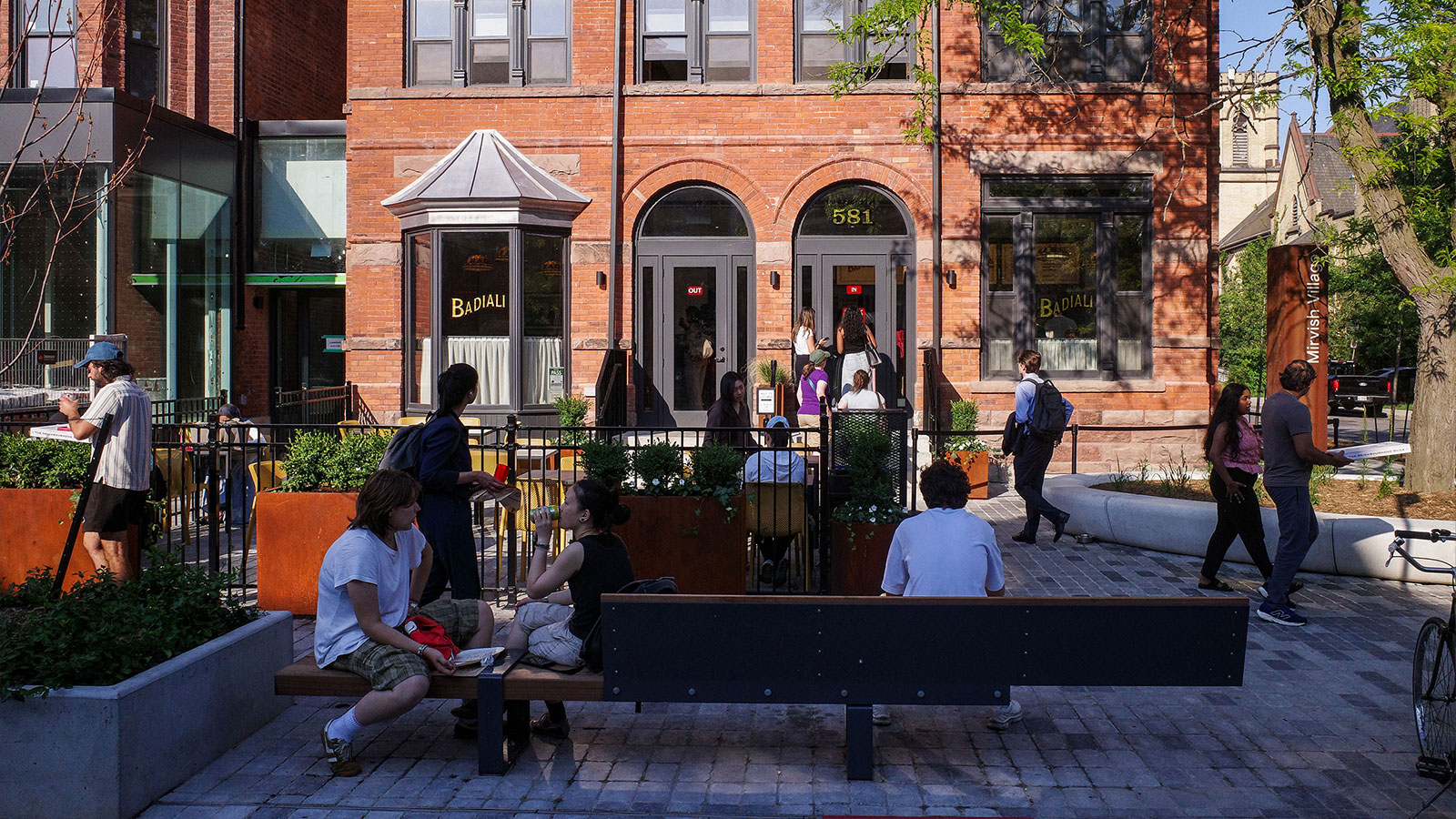
Toronto’s Mirvish Village was born in the 1960s from a failed attempt to build a parking lot for Honest Ed’s, the discount department store that once stood at the corner of Bloor and Bathurst streets. Seeking more space for his customers’ cars, “Honest” owner Ed Mirvish bought up the block of Victorians next to his sprawling marketplace — only for the city to intervene and block his demolition plans. Mirvish’s wife, Anne, suggested that Ed use his newly acquired real estate to establish a kind of artistic compound instead. Anne herself kicked things off, moving her sculpture studio into 581 Markham Street. Lured by low rents, other artists quickly followed suit, joined by a bohemian assortment of retailers and bars, and later, a gallery and art book store run by the Mirvishes’ son, David. Instead of being turned into pavement, the site became a creative paradise. (All this and more is chronicled in a great CBC documentary about the area’s history.)

In 2013, with many of Mirvish Village’s buildings looking a little worse for wear, David sold his family’s swath of land to the developer Westbank. In the years that followed, Honest Ed’s closed up shop and the Toronto landmark was torn down; over the past decade, it’s been replaced by a series of mid- and high-rise apartment towers designed by Henriquez Partners Architects with Diamond Schmitt. (In 2022, the mixed-use redevelopment won an AZ Award for Best Urban Design Vision.) The full scope of the project extended to the former store’s neighbouring Victorians, too, which (thankfully) dodged demolition a second time, instead undergoing extensive interior renovations and sensitive facade restorations.

For our 300th issue back in 2023, we ran a photo essay that documented construction progress on some of Toronto’s then-upcoming architectural landmarks, including Mirvish Village. As those photos demonstrate, the length and complexity of the overall build (which left the stretch of Markham between Bloor and Lennox streets fenced off for nearly a decade) necessitated a mass exodus of Mirvish Village’s longtime tenants at the end of 2016. Some (like The Beguiling comic book store and Victory Cafe pub) resettled on nearby streets, while others shuttered for good; none are slated to return to their former locations. With Mirvish Village’s transformation now nearing completion, the question on everyone’s mind, then, is what sort of commercial district will be waiting when all is said and done?

The first two businesses to debut in the redeveloped district (now fully owned by Peterson following plenty of financing and contractor drama) were a bank and a liquor store — practical additions to the surrounding neighbourhood, but not exactly the charming boutiques that had once called the area home. Mind you, both of those are located in the base of new residential towers, built along Bathurst Street and Bloor Street, respectively, rather than along Markham Street in what was once Mirvish Village’s core retail cluster.

It’s a relief, then, that in the past two months, a pair of businesses have moved into two of Mirvish Village 2.0’s restored Victorians and set a much more promising tone for the future of the community. The first of these establishments is the second location of Pizzeria Badiali, a Toronto slice shop known for drawing consistently long lineups at its original Dovercourt outpost. That kind of foot traffic will be a major boon for re-establishing Mirvish as it emerges from its long dormancy. “There was a knife shop here that I used to come to all the time,” says head chef and co-owner Ryan Baddeley. “But I hadn’t thought about this little pocket in a while, until we were approached with the opportunity to open something here, because the area had just been nothing for 10 years. But once I started to hear more about the project and how they were being a little more creative with leasing Markham Street specifically, I realized that, vibe-wise, it would be a pretty cool match for us.”

The second new arrival is Book Bar, a book store and cocktail bar hybrid that builds upon Mirvish Village’s history as a source of great literature (see: David Mirvish Books, R.I.P.). Other welcome destinations are up next — a Blackbird Baking Co. bakery is on the way, while a multi-vendor food hall (designed by Batay-Csorba Architects), a comedy theatre and a park (by PFS Studio) are also on the horizon. (Credit to The Behar Group Realty for the area’s commercial leasing.) Meanwhile, a narrow pedestrian corridor, Honest Ed’s Alley, will feature 25 “micro-retail” units measuring 400 square feet and under, offered on short-term leases that are less of a commitment for small businesses.

Among the many phrases that once decorated the marquee signage that ran around the perimeter of Honest Ed’s was the promise that “There’s No Place Like This Place, Anyplace.” For this rebooted version of Mirvish Village to uphold that claim, it will need restaurants and shops that understand how to deliver a strong sense of identity. The Honest Ed’s approach was to install massive red signs bordered in hundreds of flashing lightbulbs. Both Pizza Badiali and Book Bar adopt another strategy, endeavouring to be memorable but also tastefully designed — while still maintaining some spirit of eclecticism, too. Below, we delve into what sets each of their designs apart. Under their lead, Mirvish Village is well on its way to being a destination again. Here’s hoping that subsequent openings live up to the same high standard.
1
Pizzeria Badiali

When Pizzeria Badiali head chef and co-owner Ryan Baddeley sat down to his first meeting with Ali McQuaid Mitchell, founder of the design firm Futurestudio, he already had the main ingredients for his second shop’s interior in mind. First, inspired by a visit to one of the Ralph’s coffee shops run by Ralph Lauren during a recent New York trip, he was keen to go all-in on elaborate tile work. “The way it’s used there feels classic and kind of old-world,” he says. “And I knew how much tiling Ali likes to do in her projects, so that felt like a good place to start.” Sure enough, past Futurestudio projects like Dear Grain Bakery, Othership and Grape Witches Waterworks have all embraced elaborate tile patterns.


Badiali’s new home (at the corner of Markham and Lennox streets, in what was once Victory Cafe) builds upon that past success, pairing a custom mosaic floor (featuring the red, white and green of the Italian flag, and developed with Daltile) with Ralph’s-esque glossy green subway wall tiles. Both imbue the space with a retro elegance that will stand the test of time. “These guys have so many people come through the shop in a day that we knew the materials couldn’t be precious. We actually ended up wrapping the floor tiles up the baseboards and base of the banquettes, just because then people can hit them with strollers and you can wipe everything down easily,” says McQuaid Mitchell. “We’ve seen our wood floors at Dovercourt get completely destroyed,” acknowledges Baddeley.


Baddeley’s next point of reference came from his childhood memories of Pizza Hut. “There’s a strong nostalgia there,” he says. “The pizza was good — for back in the day, it was exactly what it needed to be — but Pizza Hut’s branding was really amazing.” Building off that, Badiali Markham pays homage to a few key fixtures of the franchise. Tiffany-style stained glass lampshades emblazoned with “Badiali” mimic the lighting that once hung above Pizza Hut booths, while Badiali’s custom red plastic cups (which are also available for purchase) will be instantly recognizable to anyone who ever enjoyed a glass of Coke at a friend’s pizza birthday party. Both references reflect Badiali’s evolution into a true sit-down restaurant. “At our original shop, in the summer, people will just eat wherever — they go to the park, usually — but in the winter, we’d hear from a lot of customers that there was nowhere to sit. So it’s nice now to have a space with seating.”

An abundance of warm millwork by Jeff Crews adds to the space’s classic feel. “At this point, Jeff and I are getting close to our 20th project together,” says McQuaid Mitchell. He levels me up. He’ll call and say, ‘I don’t know about this corner, I think it could be better.’ He understands detailing, and making things feel like they’ve been there forever.” That’s especially apparent on the wood-framed menu boards — another Crews production — that hang above the counter, spelling out familiar Badiali specialties like vodka sauce pizza by the slice. Also in the mix are a few new, Markham Street-exclusive offerings, like a tray-baked grandma pie and Aperol spritzes on tap.

Otherwise, the biggest departure from Badiali’s first location on Dovercourt is the greater delineation of front- and back-of-house space afforded by Markham’s extra square footage. “Ali basically said, draw me your perfect kitchen and I’ll design around that,” says Baddeley. The only downside now is that he struggles to adjust when it comes time to return to the original shop’s close quarters. “I spent a few weeks here and when I went back to Dovercourt, I was like, ‘Oh my god, how do we do this?’ The oven there is so small,” he says. Indeed, the biggest luxury that Mirvish affords is room for a second oven dedicated solely to reheating slices — which at Dovercourt happens in the same oven as initial pizza production. A walk-in fridge and dish pit in the basement add to the practical luxuries. “We inherited all the history and character that comes with an older brick building, but then because of the renovation, it also had all those nice things that usually only come with a new build — like a basement where you aren’t ducking down,” says McQuaid Mitchell. The outcome, as both Badiali’s diners and chefs can attest, feels as timeless as pizza itself.
2
Book Bar
Reading can be a solitary activity, but it can also be a social one — and Book Bar understands the merits of both approaches. Along with a wide selection of literature, the two-level shop (featuring an interior by DesignAgency) offers individual bookworms plenty of upholstered armchairs perfect for getting lost in a great novel, but also larger, more convivial spaces where book clubs can congregate to discuss exciting plot twists en masse. Speaking of which, Book Bar has a big surprise of its own: a liquor license. The drink menu includes a robust wine list (including several bottles served by the glass), and if you want a Faulkner-approved Old Fashioned, that’s an option too.

Book Bar is the brainchild of Tom Freeman and Robin Storfer, two longtime friends whose original plan to open a bar gradually merged with their love of reading. As Michelle Arlotta, an Intermediate Designer at DesignAgency explains, a core part of the studio’s concept for the interior is actually built around the shop’s origin story. “When this idea first came to them, they were around their kitchen island, drinking wine and talking about books,” she says. “So we set the downstairs wraparound bar at counter height to keep some of that residential feel.” The upstairs bar, for its part, feels even more intimate, placing a rounded kitchen island across from a small prep setup complete with pocket doors that hide the sink and appliances from sight when not in use.

Throughout, romantic details — like the scalloped trim around the downstairs seating area, plus select surfaces upholstered in textiles patterned with dreamy landscape motifs — reward close reads of every corner. Arlotta notes that Canadian manufacturers were a main focus — light fixtures hail from Huey, Hamster and Luminaire Authentik, while the ceiling tiles, which help keep the noise level somewhere between a rowdy pub and a muted library, are from Hush Acoustics. Artworks, set against walls painted in rich burgundy or emerald green, deliver even more memorable accents. Each painting was personally sourced by Storfer herself, and many of them depict readers in action.

Arlotta says the biggest challenge was balancing ample product storage with the clearances required for people to move around with drinks in hand. “We had to fit in a lot of books, but also leave enough room for people to,” she says. Downstairs is a perfect balance of airy and cozy, while things open right up in the second-floor living room area, a soaring double-height space made extra inviting by a green marble fireplace surround and illuminated bookshelves. Along with hosting author visits, the space can also be rented out for private events. (It’s already been booked for a bridal shower.)
Design Agency’s brand consultancy, StudioDA, also played an important role in the project, developing a custom “B” word mark that resembles both an open book and a flag — a way to represent the store’s ambitions to become not just a store, but a meeting place. Something tells us it’s a setting that will go on to feature in many memorable stories.
How Pizzeria Badiali and Book Bar Are Leading Mirvish Village’s Revival
Two businesses kick off a Toronto neighbourhood’s next chapter, focused on design-forward independent retail and destination dining.