
At nearly 258 kilometres, the Mondego River is the largest waterway completely contained within Portugal. Coursing through numerous cities and villages (including the ancient medieval city of Coimbra) and adjacent to destination hiking trails, the river feeds fertile agricultural lands that support the production of rice, corn and wine. While these pantry staples are fundamental to Portuguese cuisine, the process of getting them from field to plate (or goblet) results in a large amount of organic waste. Where some see a problem, others — like Porto-based Summary architecture studio — see potential.

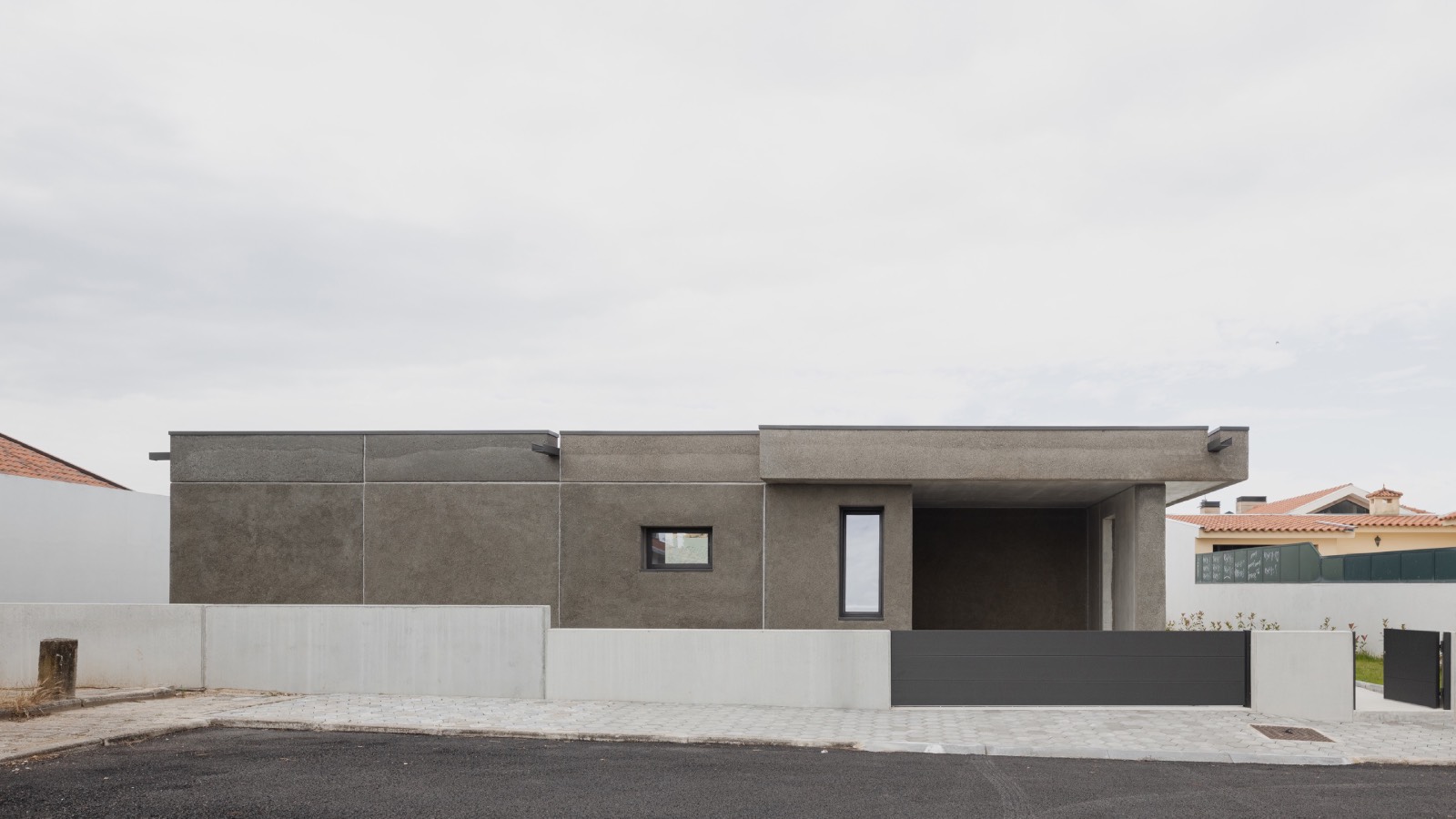
The firm, led by founder and architect Samuel Gonçalves, is taking a pivotal role in reconstituting rice husks as a building material. Case in point: its recently completed Rice Husk House in the city of Esmoriz, 25 kilometres to the south of Porto. Situated on a flat, square plot, the L-shaped structure was composed using a three-dimensional modular system of prefabricated panels made from reinforced concrete with a cement-based composite outer layer that incorporates rice husks.

Sourced from a local rice producer (some regional companies had been supplying the by-product for the research and development of a composite material for traffic acoustic barriers), the husks are saved from one of two typical fates: burning or burying. “Each has its own detrimental results,” says Gonçalves, “either waste buildup in the landfill or carbon release while burning.” But incorporated into a composite, it has a surprising robustness both as cladding and thermal insulation.

Assembled in a factory during site preparation (which included earthworks, excavation and foundation construction) to reduce overall build time, the modules arrived with a portion of the electrical and plumbing systems pre-installed. Featuring a 23-centimetre-thick rice husk layer, they provide a strikingly austere exterior envelope with a thermal resistance of 1.877 m²K/W, completely doing away with the need for more commonly used EPS or XPS foam insulation boards. To further ensure interior comfort, the layout of the house promotes both “natural cross-ventilation and optimal solar exposure.”

While Summary tends to focus its energy on social housing projects, the opportunity to build a private residence out of the bio-based material proved too tempting to pass up. “Rather than just a home, it was an experiment for us — a prototype,” says Gonçalves.
Summary Builds a Home Using Prefab Panels Made from Discarded Rice Husks
The agricultural byproduct offers an efficient and sustainable building material alternative.