

The haunted house has become one of horror cinema’s most recognizable archetypes: a looming Victorian mansion, creaking staircases, dark corridors, an overgrown garden. But what might be even more unsettling than these architectural clichés is the idea that any place has the potential to become the site of something sinister. This Halloween, we’ve rounded up four films whose settings may hold as many surprises as the stories that unfold within them.
1
Exit 8 (2025)
It’s no secret that the commute is one of the many horrors of modern corporate life — whether you end up stuck in traffic or on the train. Even in world-class cities like Toronto, which ranks sixth globally on the list of the worst commuter experiences, the average transit journey takes nearly an hour, with daily wait times of 14 minutes causing riders to lose hours of their week to delays. If it’s not because of planned track work or congestion, it is, worst of all, due to an “unauthorized person at track level.” By contrast, Japan is known for having one of the most reliable and efficient public transit systems in the world. But in Exit 8, which premiered at Cannes in 2025, the world is flipped upside down, and one rider ends up on his own personal commute from hell.
Based on a video game of the same name, Exit 8 effectively turns a subway station into an escape room. The protagonist, known only as The Lost Man, finds himself stuck in an endlessly looping corridor — a sterile, tile-clad space marked by wayfinding that apparently leads nowhere. (Though the hallway was created on a studio set in Yokohama, other scenes were filmed at real locations, including Higashi-Shinjuku Station, Meiji Jingumae Station and Kiyosumi-Shirakawa Station in Tokyo.)
Here, The Lost Man discovers a set of instructions that promises to get him to Exit 8 and leave the station for good: “If you find an anomaly, turn back immediately. If you do not find any anomalies, do not turn back.” Any mistake sends him back to his starting point at Exit 0. As he encounters new characters and frustrations while progressing through the station, it becomes clear that the liminal space in which The Lost Man finds himself is a metaphor for the existential questions he is reckoning with in his own life. Ironically, his only way out is to pay closer attention to the very environment that disorients him. For the rest of us navigating one indistinguishable subway corridor after another, perhaps it’s a reminder to look up from our phones and pay a little more attention to our surroundings — you never know when noticing something out of place might just save your life.
2
Teenage Sex and Death at Camp Miasma (2026)
American director Jane Schoenbrun’s surrealist slasher film is a love letter to cult horror classics, telling a story centred on the formative role that the genre played in one fan’s queer — and creative — awakening. That fan (Kris Williams, played by Hacks star Hannah Einbender) is now an up-and-coming director herself, eager to reboot her favourite franchise, Camp Miasma, with its original star (Billy Presley, portrayed by Gillian Anderson) back in the leading role. To recruit Presley, Williams has to track her down in the depths of winter at her unlikely residence: the shuttered summer camp where the first Miasma movie was shot. What better backdrop for a meta coming-of-age tale? Meanwhile, lurking in the frozen camp lake is “Little Death” — the misunderstood, gender-fluid killer of the Miasma franchise (named after a French euphemism for an orgasm), who Williams is determined to finally treat with the dignity they deserve.
During its off-season stay at bizarro sleepover camp, the movie explores this time-honoured setting as a source of both tricks and treats. (For what it’s worth, candy also plays a big role in the movie.) By day, camp tends to be a place of joyful artistic expression, where kids learn to braid friendship bracelets or decorate pet rocks. That crafty spirit informs much of Miasma‘s production design, led by Brandon Tonner-Connolly and Matt Hyland. To create the film’s fantastical, wintry backdrops, the duo painted storybook-like vistas on glass plates that were then placed between the camera and the movie’s physical sets. A variant of the Schüfftan process first developed for Metropolis, the pre-CGI technique perfectly captures the lo-fi ingenuity — and, thus, nostalgic appeal — of summer camp arts and crafts. As Adrienne Murr wrote in her recap of Miasma‘s production design for The Set Set, “In the era of artificial intelligence, the most innovative approach to set design might just be a return to the manual methods of Classic Hollywood.” In the movie industry, losing sight of true creativity could be one of the scariest horrors of all. Long live the analogue magic of camp!
Mind you, the classic summer camp experience can offer plenty of frights, too. While some campers are prone to hold flashlights below their faces and tell unhinged ghost stories by night, others are driven to cruelty, as is the case with the transphobic bullying that is shown to have led to Little Death’s original rampage. As a place where innocence rests on a knife’s edge, camp — and the rustic buildings, lush forest and shimmering lake that define it — can look golden in one light and sinister in another. And yet sometimes, as Miasma demonstrates, even someone’s darkest fears can serve as a strange source of (erotic) comfort. Miasma‘s architecture doesn’t judge. Its lakeside cabins shift freely between places of terror and ecstasy, ultimately proving that nightmares and fantasies have more in common than we might like to admit.
3
Backrooms (2026)
Despite the garish overhead lighting, endless rows of oversized, overstuffed recliners, particleboard side tables and nondescript mass-produced accent pieces, a discount furniture showroom is an unlikely place for terror to take hold. But in Backrooms, this benign (and somewhat depressing) setting is indeed where something truly unsettling unfolds.
Created and directed by Kane Parsons, the movie is based on the California-native’s web series of the same name (itself inspired by a 2019 creepypasta thread) and follows failed architect Clark (with no last name), played by Chiwetel Ejiofor, as he navigates his struggling business, dissolving marriage and alcoholism. While temporarily living in his showroom — Cap’n Clark’s Ottoman Empire — he discovers a secret portal in the basement that leads to “an endless network of frightening interconnected rooms.”
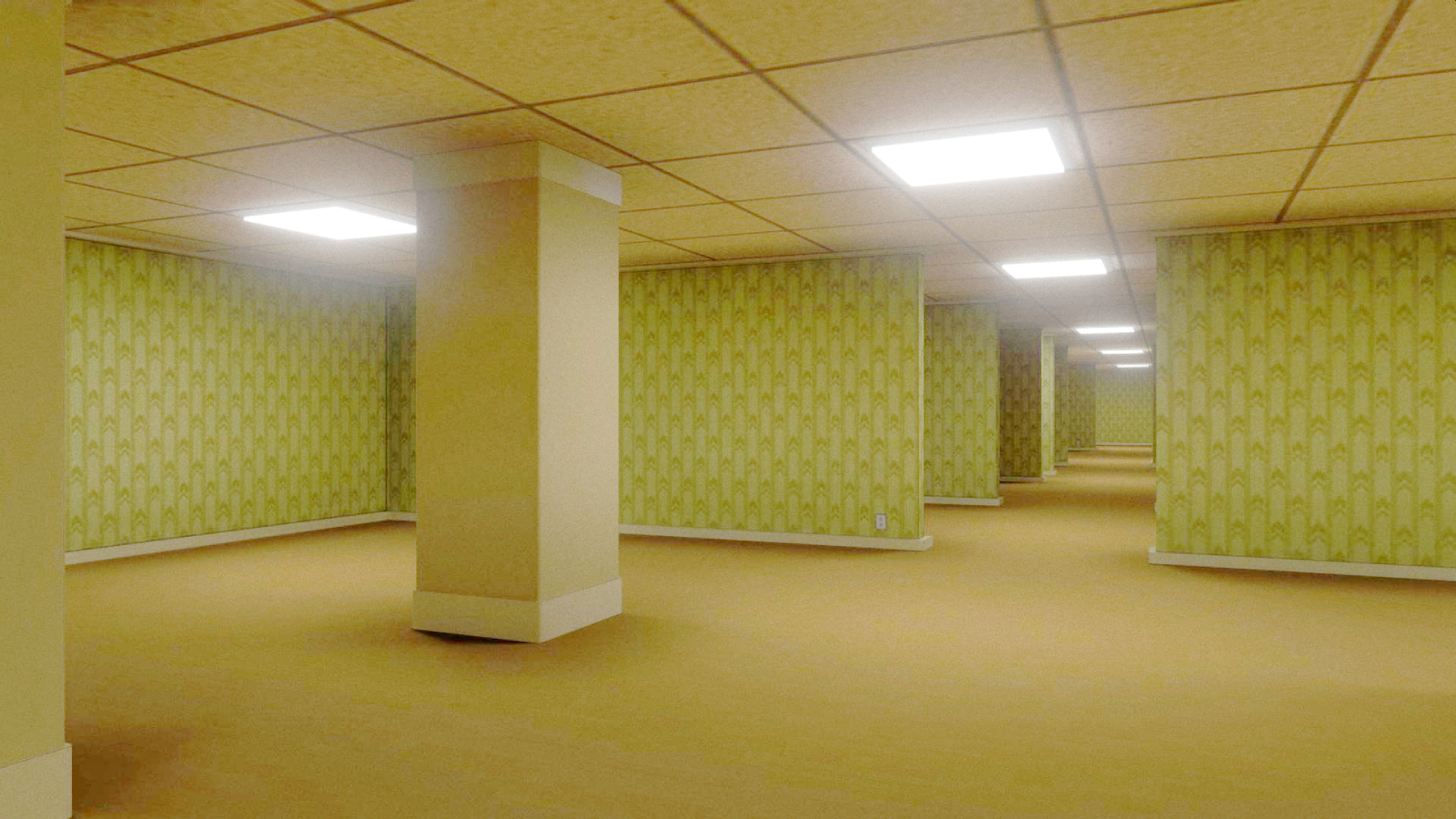
The stuff of liminal space nightmares — empty, windowless offices, labyrinthine hallways, humming fluorescent lighting, all completely drenched in a sickly yellow hue — the backroom layout was first developed by Parsons using Blender 3D software before being physically constructed across four soundstages in Vancouver, Canada, with the expertise of production designer Danny Vermette. Totalling more than 2,800 square metres, the disorienting maze-like film set required 3,400 square metres of wallpaper and up to 2,700 square metres of carpeting; apparently, more than 40 print and colour tests were conducted for the custom wallpaper to ensure the right uncanny tone of yellow was achieved.
The meticulously designed interconnected hallways, dead ends, elevated platforms and compressed passageways instill an appropriately unnerving atmosphere compounded by the custom LED tubes that flicker in cardboard troughs suspended from drop ceilings — not to mention the towering, disfigured pirate that murderously stalks Clark and anyone else who passes through the portal. Bleak, claustrophobic and disquieting, the “architectural hell” that is the Backrooms effectively delivers an amplified feeling of dread and anxiety.
4
Send Help (2026)
The notion of wilderness — of pristine nature untouched by human presence — is mostly hollow. Studies show that only 23 per cent of the Earth’s land (apart from Antarctica) is truly “wild,” yet human activity has impacted the planet so much that even these places suffer the consequences of manmade climate change. Save for Indigenous cultures, our species really knows how to wreak havoc on the land.
In Sam Raimi’s Send Help, Linda Liddle (Rachel McAdams) and Bradley Preston (Dylan O’Brien) find themselves deserted on one of the most isolated places on Earth: the Gulf of Thailand. The lone survivors of their private plane crash, Linda from “strategy and planning” and the new boss, a nepo baby frat bro, also see their roles flipped, their workplace dynamic upended. Linda, who in her past life auditioned for Survivor, quickly makes a home — and a meal — of the situation: She builds a shelter out of bark and leaves, she weaves a hammock under shade, she hews a stake for hunting wild boars. Gore and gross-out scenes ensue.
Bradley, with his injured leg, is at Linda’s mercy; she nurses him back to life, but she’s all too happy to remind him that she has the upper hand in this uncharted terrain. At one point, Linda brandishes a knife, which has “washed up on shore.” And she leads Bradley on perilous walks along the sheer rock wall of a cliff. Along the way, she points out places he should steer clear of so as not to encounter poisonous plants. The film vacillates in frequency between the survival adventures of Cast Away and the caregiver/captive suspense of Misery. Having evolved from frumpy to plucky — and a goddess of nature — Linda likes it here; Bradley wants out. And while she spots a couple of boats that could come to their rescue, she dispatches them quickly, sometimes brutally.
But (here is the spoiler!) we are not in paradise after all. The one spot that Bradley was warned away from provides a staggering view — to a modern mansion perched high on a cliff, a luxury oceanfront property owned by a “Wall Street billionaire.” In the vein of last-minute reveal thrillers, where the camera lens pulls back to show that the fantasy world we’re in is but a scene within the real one, (Old and The Village are just two M. Night Shyamalan movies that similarly rupture the artifice), Send Help reminds us that “wilderness” is a construct. It also taunts us with the easy global reach of capital, and its crass colonial aspirations. Even the most seemingly remote slice of Eden is a stone’s throw from a marble-topped kitchen island with an overflowing fruit bowl.
Looking for more spooky architectural entertainment?
- Redecorating? Consider these 8 modern furniture designs fit for a haunted mansion.
- From our archives, a roundup of 10 modernist houses in scary movies.
- More afraid of heights? Read our recap of the horror genre’s top 10 skyscrapers.
- Explore this roundup of shows and movies about being watched.
- We’ve also unpacked 10 other architectural tropes that pop-up repeatedly in spine-tingling films, and explored 10 spooky films where architecture plays a leading role.
- Look back at our conversation with the set designer of The Fall of the House of Usher.
- Or read our report about an even more concerning horror: the annual spike in road deaths on October 31. (Stay safe out there!)
4 Horror Films That Turn Familiar Settings Into Something Sinister
Just in time for your Halloween movie marathon, we’ve rounded up four films that subvert our expectations of the spaces around us — from subway stations to summer camp.