

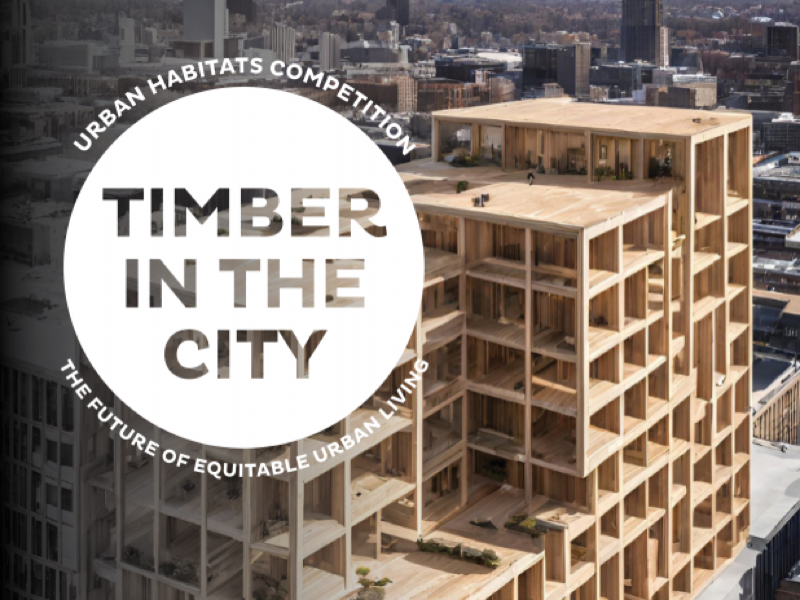
The Association of Collegiate Schools of Architecture (ACSA) is pleased to announce the 2024 Timber Competition – “TIMBER IN THE CITY 5: Urban Habitats Competition”. The program is intended to challenge students, working individually or in teams, to reimagine the boundaries of wood construction in the urban environment, leading to the transformation of our existing cities through constructing sustainable buildings made from renewable resources, offering expedient affordable construction, innovating with new and traditional wood materials, and designing healthy living and working environments.
The Challenge:
- Entrants are asked to select a centrally located building, or structure, in a busy urban area and develop an innovative wood design solution that adds density through additional floor area, via a vertical extension, to address the affordability and sustainability crisis that affects our built environment.
- Entrants are challenged to propose construction systems in scenarios that draw optimally on the performance characteristics of not one but a variety of wood technologies and are encouraged to think about the existing building as a testing ground for socially, materially, and environmentally progressive and innovative models of sustainable urban living.
- The program challenges students and educators to think creatively and critically about the way in which choices about building materials and existing infrastructure impact the health of urban environments.
Jury Criteria:
- The quality of the architectural concept and the rigor with which it is developed;
- Its technical sophistication, resolution, structural feasibility, and use of mass timber to enable a light weight vertical extension to an existing building that requires limited intervention to the existing structure;
- The effectiveness of its visualization and representation through a variety of material, graphic, and digital media, those prescribed within each studio section as well other techniques that students may employ to supplement and substantiate their presentations;
- The breadth of design consideration with respect to the environmental and social implications and impacts of the building proposed and the way in which those concerns are quantified and visualized.
- A successful sustainability and lower carbon building performance.
Awards:
Winning students and their faculty sponsors will receive cash prizes totaling $40,000. A list of winning projects will be posted on the ACSA website.
Eligibility:
- Because the support of SLB is derived from companies whose markets are mainly in the U.S., the Timber in the City Student Competition is open to students and/or student teams from ACSA Full and Candidate Member Schools, as well as ACSA Affiliate Members Schools from the U.S. and Canada. Students may work individually or in teams and must work with a faculty sponsor on the submission.
- An ACSA member school, faculty sponsor is required to enroll students by completing an online registration form prior to registration by April 10, 2024. All student entrants are required to work under the direction of a faculty sponsor. Entries will be accepted for individuals as well as teams. Teams must be limited to a maximum of five students. Submissions should be principally the product of work in a design studio or related class.


