


“Marseille is one of the sunniest cities in France and is also by the sea,” says Adrian Garcin, lead architect and CEO of French studio TAUTEM Architecture, “so it has a very particular light that we were influenced by in this project.” He’s discussing the recently completed Antoine de Ruffi School, a 4,150-square-metre complex comprising a nursery and elementary school in the new Euroméditerranée district of the southern French city.
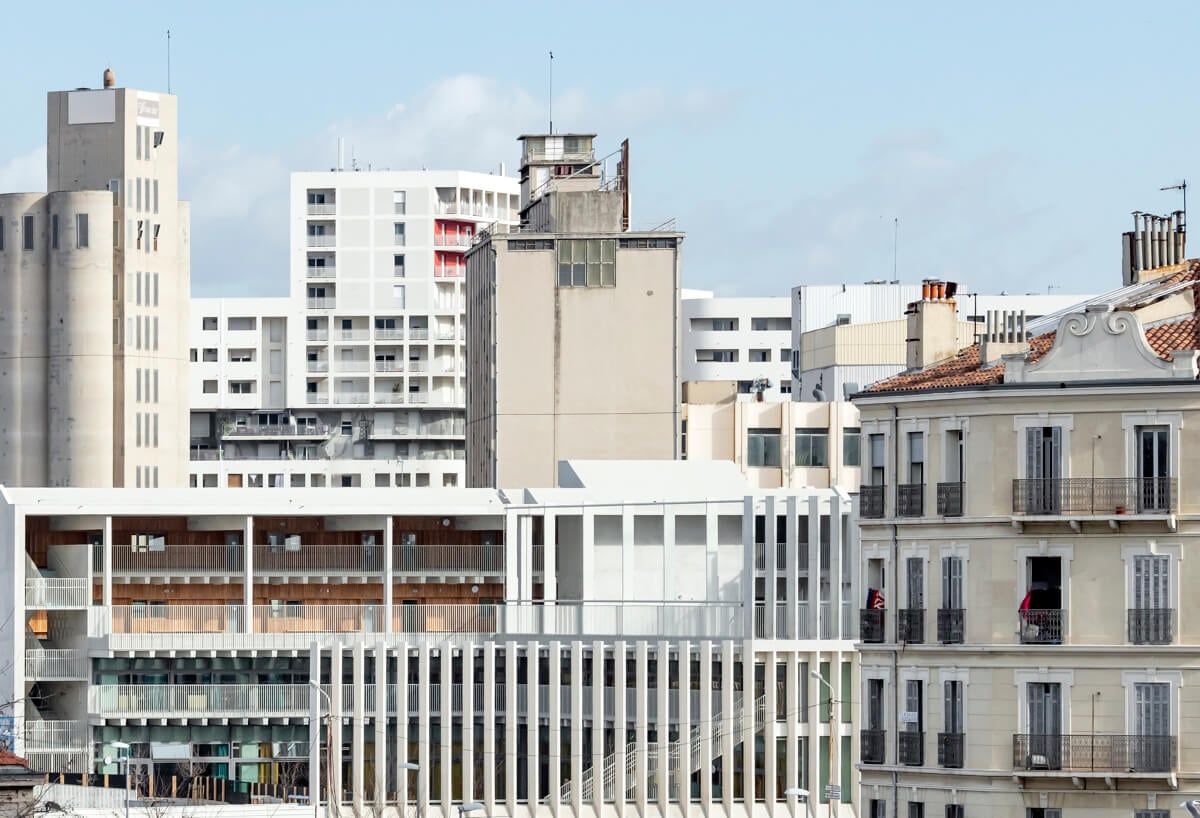
Designed by his Montpellier-based practice alongside Paris agency Bmc2, the sprawling concrete building houses (among other things) 22 classrooms for children aged three to 11 and features alluring geometries, brutalist as well as Mediterranean references and monolithic volumes that ground the four-storey facility in the rapidly changing ex-industrial port area.

Nestled amid construction sites for several high-rise apartments and office buildings, the school’s principal facades respond to both context and climate to create a strong identity while providing added solar protection throughout the day. “We were influenced by the architecture of the Maghreb region of Africa in regard to the building’s mineral quality and the scale of the windows,” says Garcin.

To that end, the port-facing elevations are defined by a rigid colonnade of hexagonal columns. The city-facing frontages, meanwhile, are sculpted by angled recessed windows of various sizes and pillars that wrap around a grand internal staircase.

The unusual “mineral quality” was achieved through the use of a light sand–toned, low-carbon concrete composed of granulates from quarries north of Marseille and slag from the blast furnaces in Fos-sur-Mer just west of the site. (The latter made it possible to soften the hue of the cement without additives.)

“The colour of the concrete is lighter than usual,” says the architect. “It’s perfect for Marseille, a stone city, and is the same shade as many of the surrounding industrial buildings.” Furthermore, the material was cast in situ, which, in addition to requiring no noisy and polluting mixer trucks, allowed for greater control over the final colour and texture. This meant that certain areas could be sandblasted to create an interplay between rough and smooth.

The interiors of the building, however, couldn’t be more different from the imposing envelope. Here, the architects sought to make the spaces warm, approachable and energetic. The two entrance areas feature banquette-style timber benches that curve up to clad the wall and ceiling, while the same larch (sourced from the southeastern Alps) is used as panelling between classrooms and in circulation areas.


It was also made into built-in furniture and elements such as shelves, cabinets, sliding panels and external seating areas. Spots of colour are provided throughout the building in the form of yellow, blue, green and orange acoustic ceiling coffers installed between exposed concrete ridges, which in turn feature integrated lighting.

Perhaps the most beautiful aspect of the project is the generosity of its views and outdoor spaces. Smaller children have the use of a large ground-floor playground replete with young trees, equipment and colourful islands, while the older ones are given the run of an L-shaped courtyard on the second floor with a soaring double-height covered area.


Both offer dazzling vistas of the port. It’s these qualities that make the Antoine de Ruffi School a relatively rare beast: a child-friendly design with an undeniable civic presence.
In Marseille, a Sprawling School Embodies its Post-Industrial Context
Mixing brutalist and Mediterranean references with a sustainable ethos, the Antoine de Ruffi school by TAUTEM Architecture and Bmc2 is a child-friendly civic wonder.