

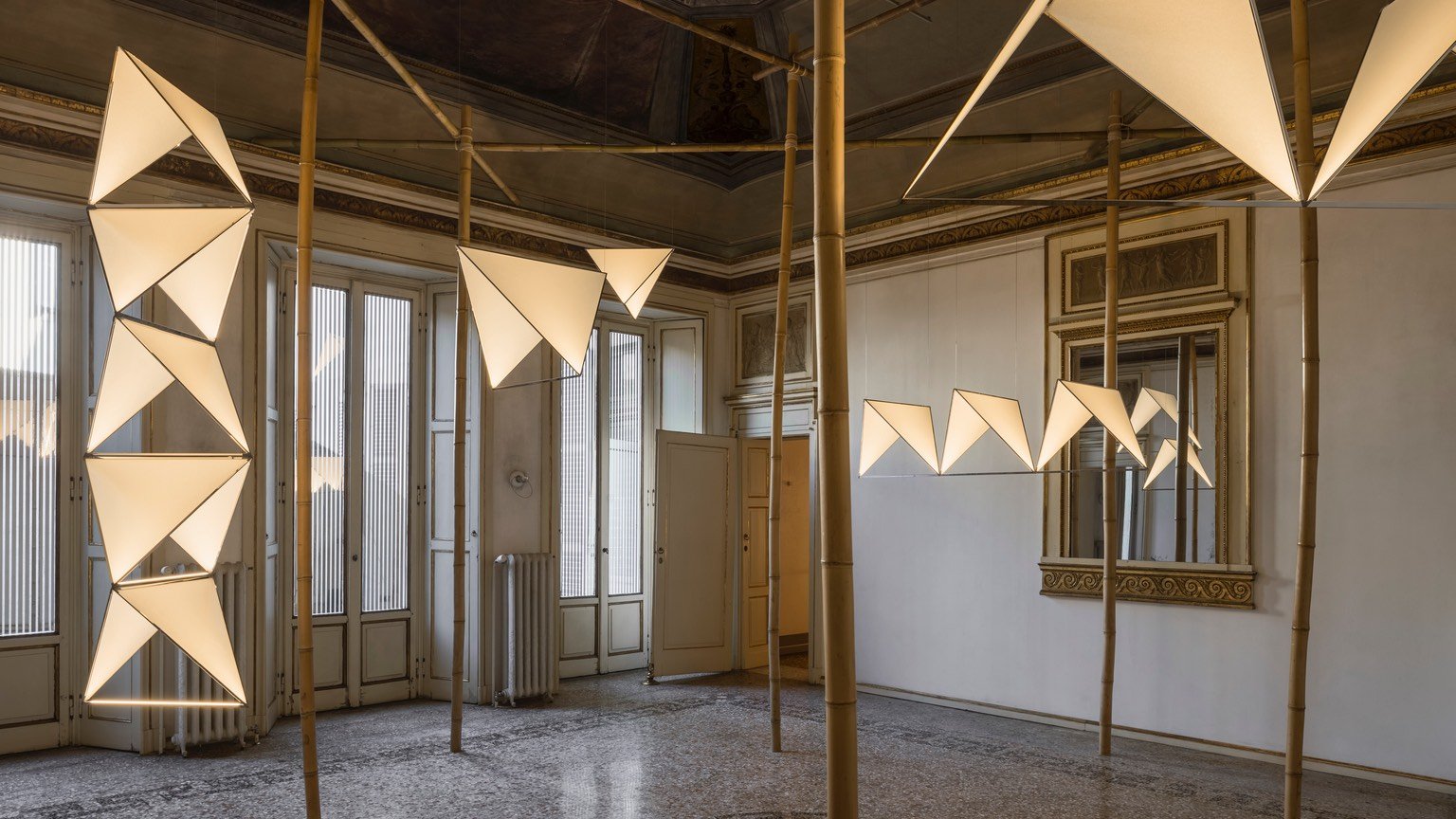
“I really believe in this idea of synchronicity — that things somehow come together and there’s a reason behind them,” says Michael Anastassiades. He’s referring to the resemblance between his Cygnet fixtures and Bruno Munari’s Scultura Pieghevole (“folded sculpture”) from 1958. During Fuorisalone, you could see both displayed at the Jacqueline Vodoz and Bruno Danese Foundation, where a number of Munari’s archival pieces, including bamboo objects, served as a prelude to the main act beyond: a room filled with luminous swans.
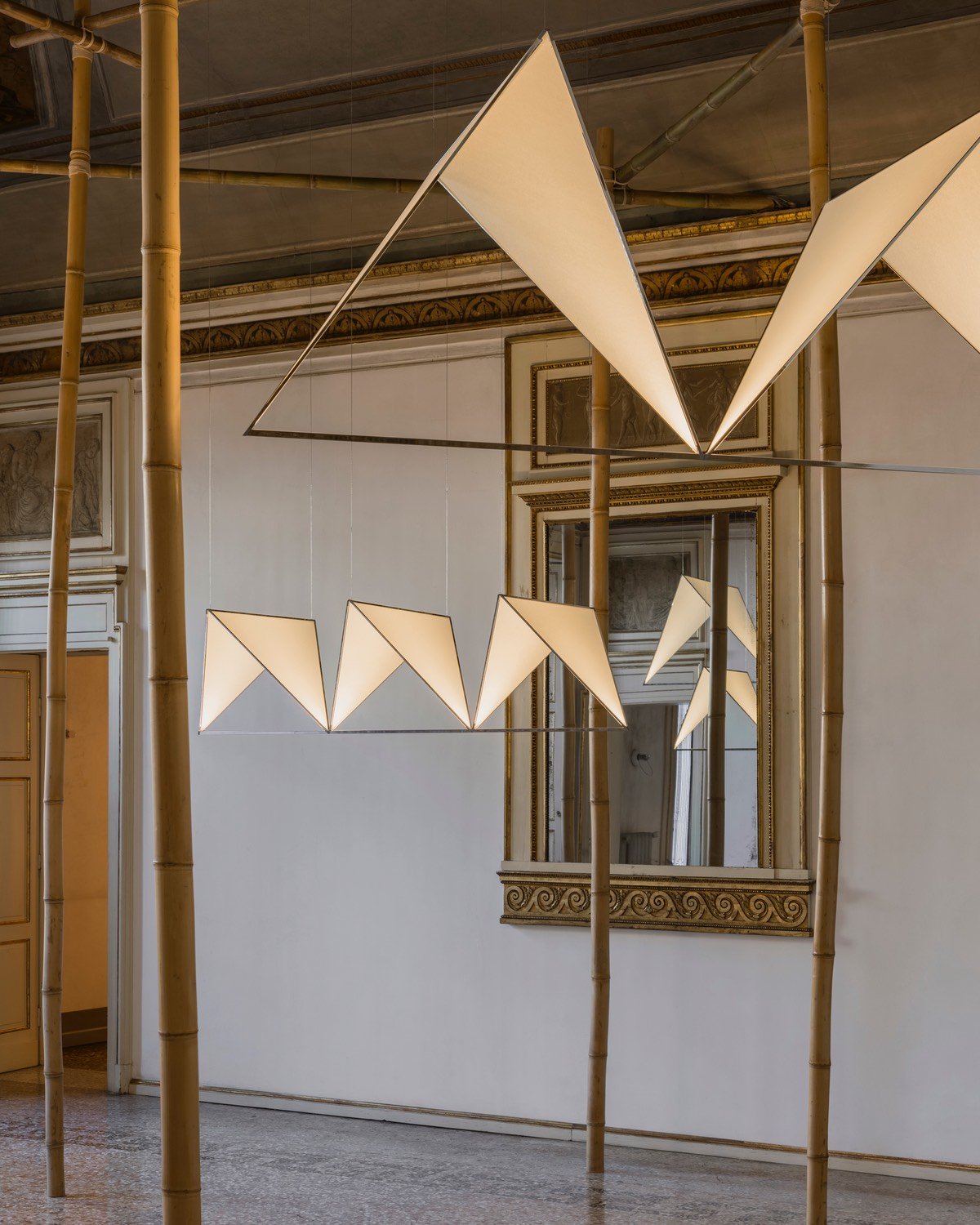
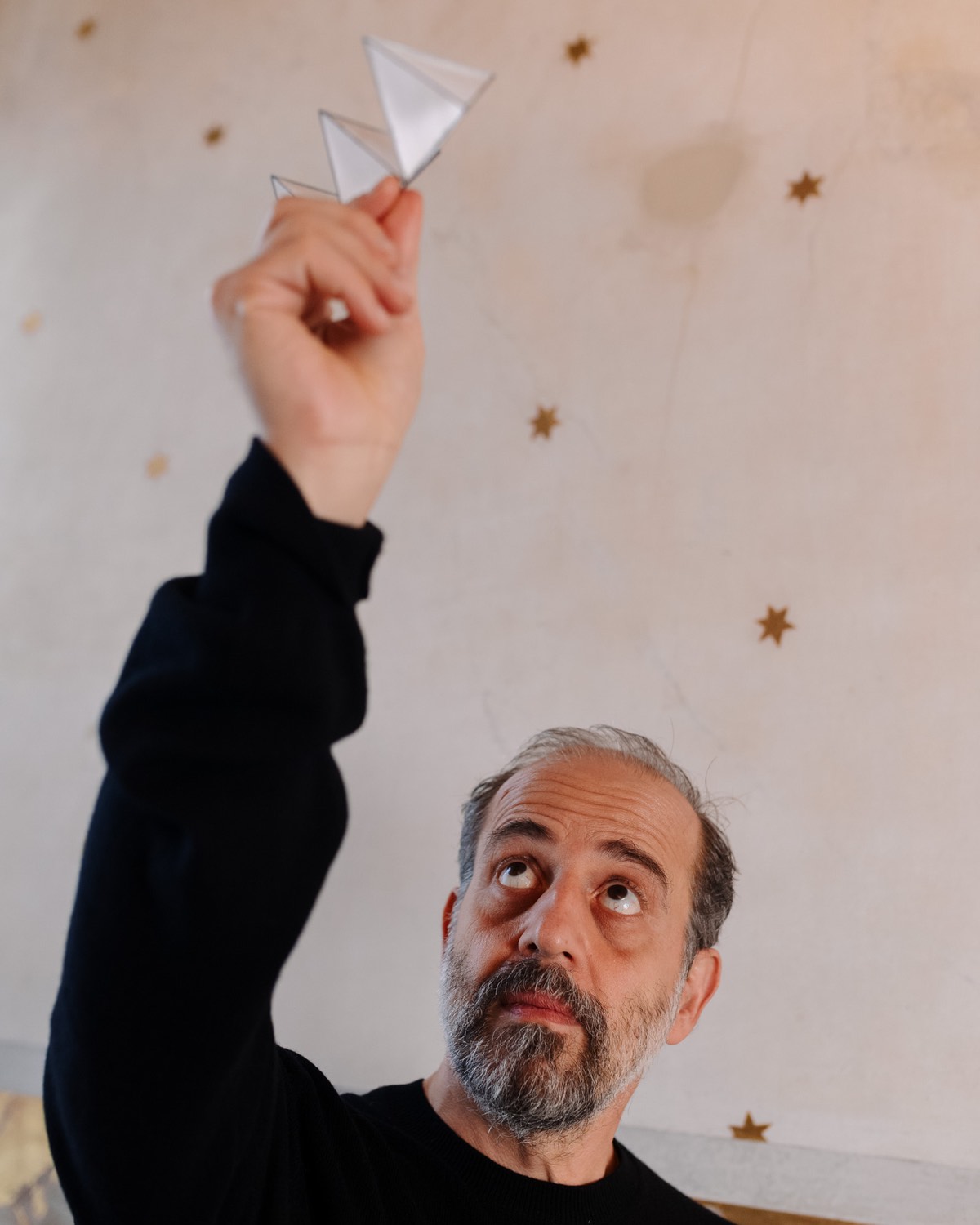
The Cygnet fixtures, while serendipitously simpatico with Munari’s experiments, were actually inspired by the kites that Anastassiades made by hand as a child. These latter-day compositions — which also borrow from Constantin Brâncusi’s sculptures, Isamu Noguchi’s lanterns and Alexander Graham Bell’s tetrahedron studies for flying machines — are made with Japanese washi paper pulled taut across aluminum frames and illuminated by a hidden LED source. “It’s indirect illumination, so it’s quite magical — they just glow and you don’t understand where the light source is coming from,” the designer explains. At the Danese Foundation, a scaffold system of bamboo poles supported the fixtures and hid their wires.


Synchronicity, or perhaps kismet, could also describe Anastassiades’s relationship with the Danese family. He met Jacqueline Vodoz and Bruno Danese early in his career, and they became some of his first and most ardent supporters. His show at Via Santa Maria Fulcorina came at a bittersweet moment, just as the foundation had sold the building; the exhibition marked both the first time it had been open to the public in 20 years and, possibly, the last. “It was an interesting closure of a chapter for me,” says Anastassiades. “But I hope that I have the opportunity to work with the foundation’s archive again in the future. That would be really wonderful.”
Michael Anastassiades Brings Swan-like Lighting to the Danese Foundation
Unveiled at the Danese Foundation, the Italian designer’s Cygnet lighting collection harmonized with archival Bruno Munari designs.