
In most urban centres, green public space is at a premium. But from Central Park to the Jardin de Luxembourg, these vital, democratic amenities are the social connectors of cities the world over. In Buenos Aires, Parque Tres de Febrero in the Palermo barrio is one such place. The approximately 400-hectare park, the city’s largest, is home to the Rosedal de Palermo, a picturesque rose garden, and the Hipódromo Argentino de Palermo, one of the country’s most prominent horse racing venues. Despite their proximity, these two landmarks were cut off from each other by the neglected parking garage plunked between them (which had become a hotbed for drug use and other illicit activity). Seeking to change this, Buenos Aires invited developers to pitch ideas for transforming the decaying structure — and the neighbourhood at large — via a public–private partnership. BSD Investments, one of the city’s leading real estate firms, reached out to New York architect Eran Chen to collaborate on its proposal and gave his firm, ODA (working alongside Aisenson Arquitectos as the project’s executive architects) carte blanche to determine the ideal program for the site.

The original plan was to demolish the garage and start from scratch, but the concrete behemoth possessed untapped potential. “When I saw the building for the first time, it occurred to me that the structure was quite decent,” Chen recalls. “It had big spans of waffle concrete slabs, generous spacing between the columns, the ceilings were pretty high. And I felt, Wow, what a waste would it be to tear it down?” The flexible floor plate also made the building a great candidate for adaptive re-use, while its central location drove the mixed-use program. Dubbed OLA Palermo, the new development features a combination of Class A office spaces, restaurants and retail (a portion of the ground floor provides parking for tenants).

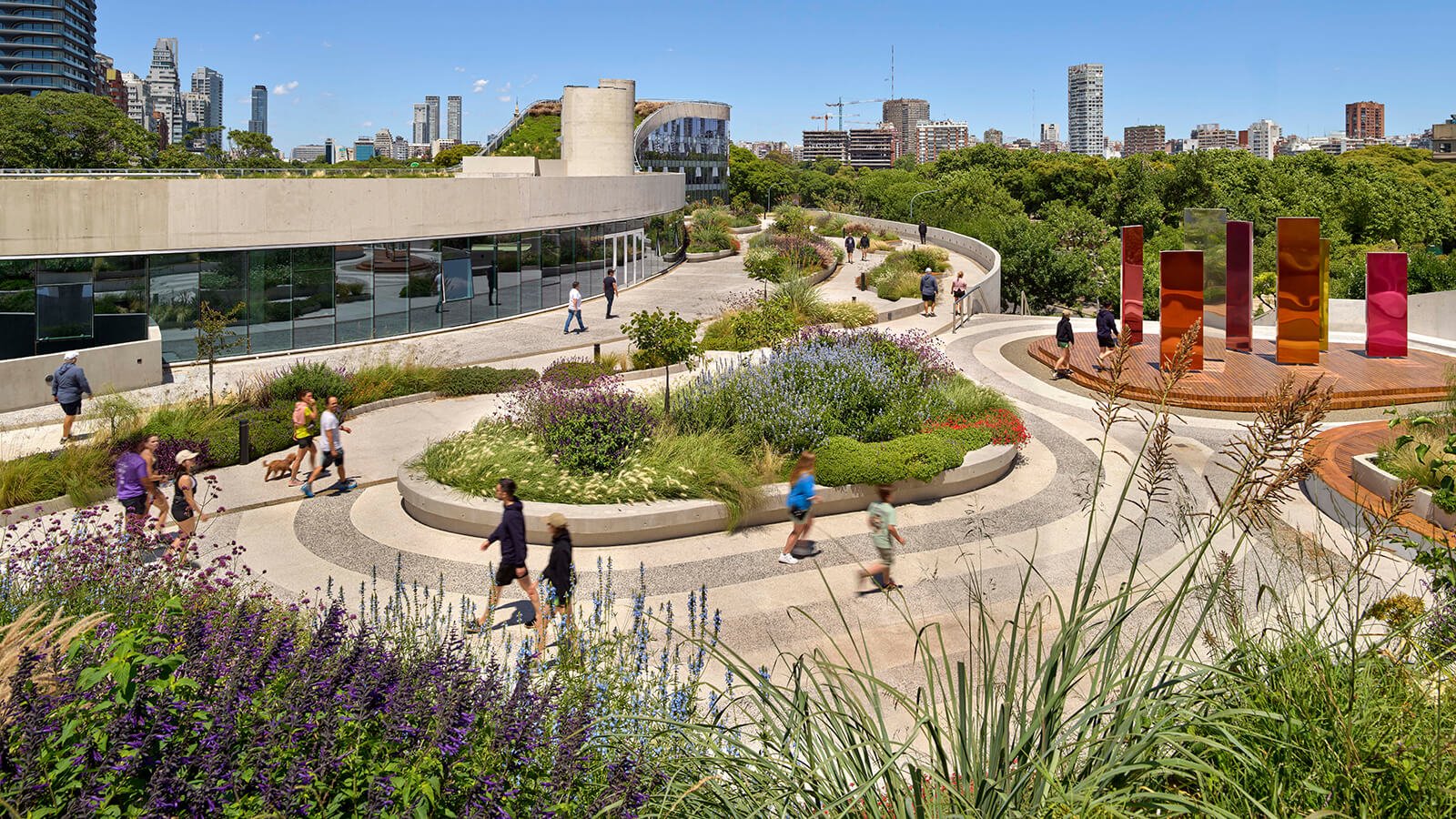
Besides its good bones, the building also had a roof that boasted some of the best views of the neighbourhood, above the treeline all the way to the Rió de la Plata. Chen saw this as an opportunity to bridge the two previously disconnected ends of the park and foster a more cohesive experience. With that goal in mind, the architect devised a pedestrian ramp that leads up to an elevated landscape, welcoming the public into the complex. Nearly 20 per cent of the building’s floor area was cut away to create the ramp and terrace; this space was reallocated to the upper floors thanks to a zoning variance granted by the city in recognition of the value the project would bring to the area.

“Traditionally, there’s a big tension between what’s private and what’s public. But at ODA, we often search for a win-win-win — where the tenants, the developer and the general community all benefit,” says Chen. “The only challenge is how to convey this idea to both the city and the developer, and that’s what we do. Basically, I told them form should not follow function here. The form should create an experience, and if we do that, the function will come.”

Adapting a building for an entirely new use is, of course, not without its challenges. While the interior fit-out was fairly straightforward, local engineers told Chen that it would be impossible to execute his landscape design without reinforcing the entire structure for soil and irrigation loads. “At that junction, I said, ‘Hold on, time out.’ The whole point was to do an adaptive re-use project. We have to be more creative than that.” ODA delivered a clever solution, consolidating the plantings atop columns. Looking at the lush landscape, you’d never know the difference. “Every project has its sets of unknowns, and part of the beauty of the process is finding creative solutions and making sure that the main idea adapts to the circumstances in a way that doesn’t compromise it,” he says.

A vibrant symbol of sustainability, OLA Palermo has become one of the most attractive offices in the city, and the high rents reflect the demand. The diverse mix of tenants ranges from tech start-ups to the satellite campuses of Columbia and NYU. Public reception has been just as strong, and cyclists, joggers and even buses of tourists now take in the views. “The magic here is that you don’t feel like you’ve come to an office building; you feel like you’ve come to an urban park. The experience of being here is just unique. It’s dynamic, and the different users are contributing to one another’s experience,” says Chen. “It’s almost become a gateway to the city.”
An Adapted Garage Becomes a Gateway to Buenos Aires’ Largest Park
ODA transforms a defunct parking garage into a mixed-use building topped by a public green space.