






The Lost Graduation Show, which took place at Milan’s Supersalone in September, showed that the kids are alright after all. Design students around the world are exploring how they can positively affect entire ecosystems — and the results are astounding. (You can see them all at @thelostgraduationshow on Instagram.)
1 Max Guderian (HFG Karlsruhe – University of Arts & Design, MA Industrial Design)

Guderian is establishing a startup based on his Potted furniture system, which makes plants integral to its completion. “This allows users to benefit from a symbiosis with a wide variety of plant species,” he says. “The air quality is increased, the general well-being is raised and extraordinary settings are created.”
2 Amelie Graf (UDK Berlin – University of the Arts, MA Product Design)
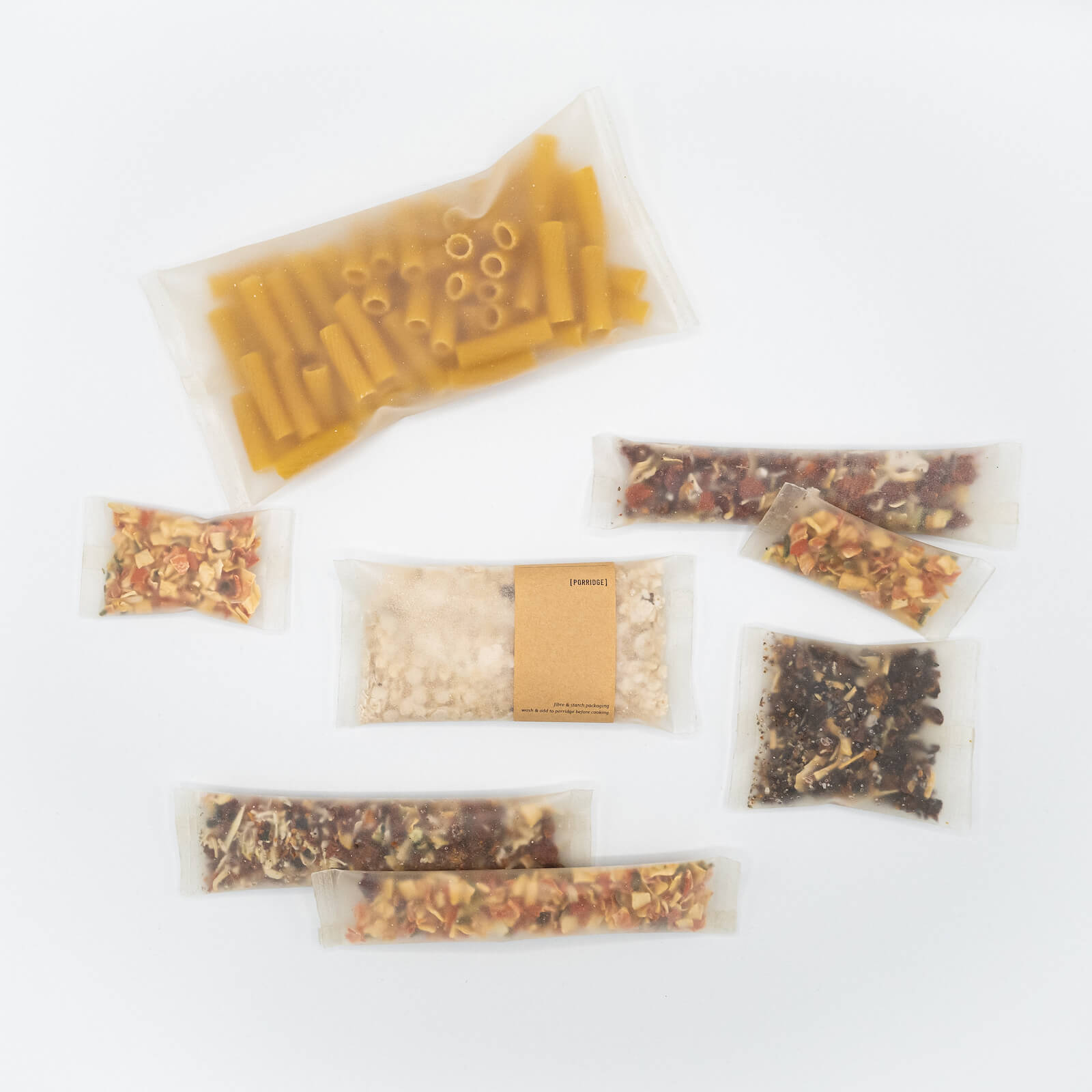
Graf has always been fascinated by biomaterials and interested in “the Japanese aesthetic of transience, in wabi-sabi, in leaving no traces, in natural things,” she says. Her edible fibre and starch Meal Bag ups the ante. “There are so many possibilities [in terms of] how we can make our everyday life more sustainable, without fossil raw materials or plastic. I think the material revolution has only just begun, so there is a lot to do.”
3 Fabien Roy (ECAL École cantonale d’art de Lausanne, MA Product Design)

Fabien Roy developed RobustNest – one of the major standouts at The Lost Graduation Show – in collaboration with the Essential Tech Center of EPFL, a Swiss organization that prototypes design solutions for global problems. The incubator for newborns was conceived for sub-Saharan Africa, where 1.1 million infants die of hypothermia during their first month of life. Unlike existing models, RobustNest can withstand power outages – delivering heat to the baby even when not connected to a power source thanks to its special thermal battery – as well as climate extremes, such as high heat and humidity. All of its components can be easily replaced.
4 Herbie Hodson (Falmouth University School of Architecture, Design & Interiors, BA Sustainable Product Design)

Hodson lived by the coast during his university years and witnessed just how much waste is left on its beaches during the summer. “I decided to look into preventing the plastic being on the beaches to begin with,” he says. “This led me to focus on one particular source of plastic: bodyboards.” His is made of cork — which is both lightweight and renewable.
5 Bastiaan Stoker (Design Academy Eindhoven, BA Public/Private)

Dennis the Desk Lamp is “functional, but also sleepy by nature.” That’s how Bastiaan Stoker describes his anthropomorphic fixture, which responds to a person’s presence by awakening, opening his big spherical eye. But, as one would expect with a Design Eindhoven project, there’s more. “After shining his light for some time, Dennis ‘gets tired’ and falls asleep.” Without the user’s input, the lamp shuts its lid so that his human owner can do the same and get some away-time from everyday tasks.
6 Rashi Sharma (National Institute of Design, Ahmedabad, BA Textile Design)

Sharma delved into her own family history and how it was affected by Partition (she is Punjabi but grew up in Mumbai) to produce these storytelling textiles. “Sainchi phulkari, a figurative style of embroidery narrating scenes of rural Punjab, became the medium to express migration stories, along with the story of khes,” she says, citing another regional craft.
7 Alejandra Díaz Zulueta (IE University School of Architecture & Design, BA Design)

Form Follows Organism is a response to the wastefulness of the garment industry, and fast fashion in particular. But rather than upcycling last season’s discards, the project encourages a complete reassessment of how textiles are made in the first place. With bio-textiles, derived from red or blue-green algae, we can create clothing that, at the end of its useful life, can be dissolved in seawater “to feed marine ecosystems.”
8 Micromort Group (Politecnico di Milano Scuola del Design, BA Communication Design)

Micromort might seem macro-morbid, but its intention is more than just or provoke. The interactive monolith, conceptualized and engineered by Alvise Aspesi, Carlotta Bacchini, Elisa Carbone, Pietro Forino, Davide Perucchini and Enzo Taboada, allows users to view how many accidental deaths have occurred in any given nation due to major world events and regional conditions (including but not limited to Covid). Its fictitious currency then assigns an average monetary value to each death, taking into account “the number of deaths from non-natural causes in a given country, the GDP per capita and the total population of that country.” The team hopes that its digital “stock exchange” could evolve to collect information in real time and be of use to data analysts seeking to identify universal patterns. (Read more here.)
Evolving Education: 8 Greats from Supersalone’s Grad Show
A power-independent incubator, a story-telling textile collection, food packaging you can eat and more.