


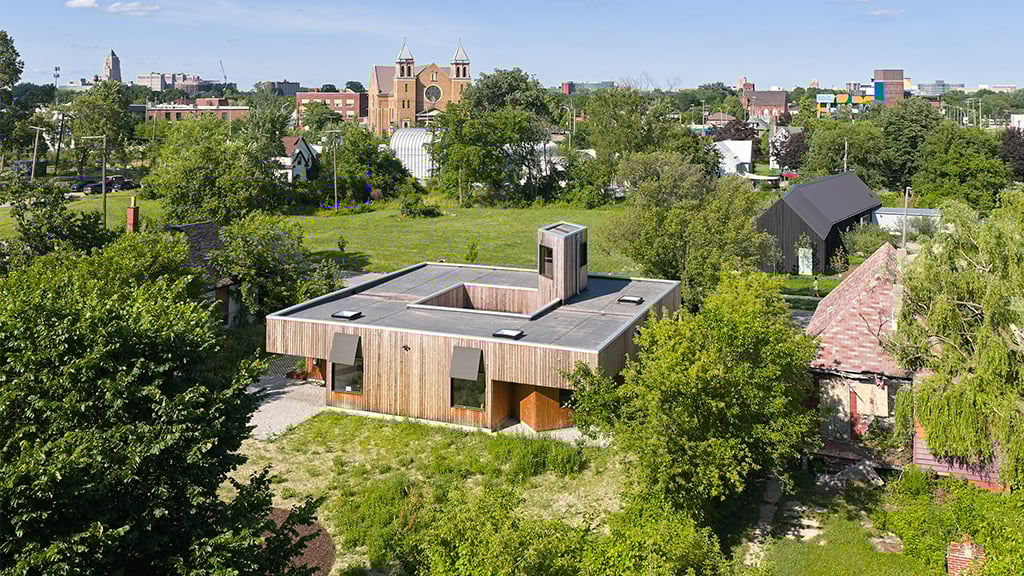
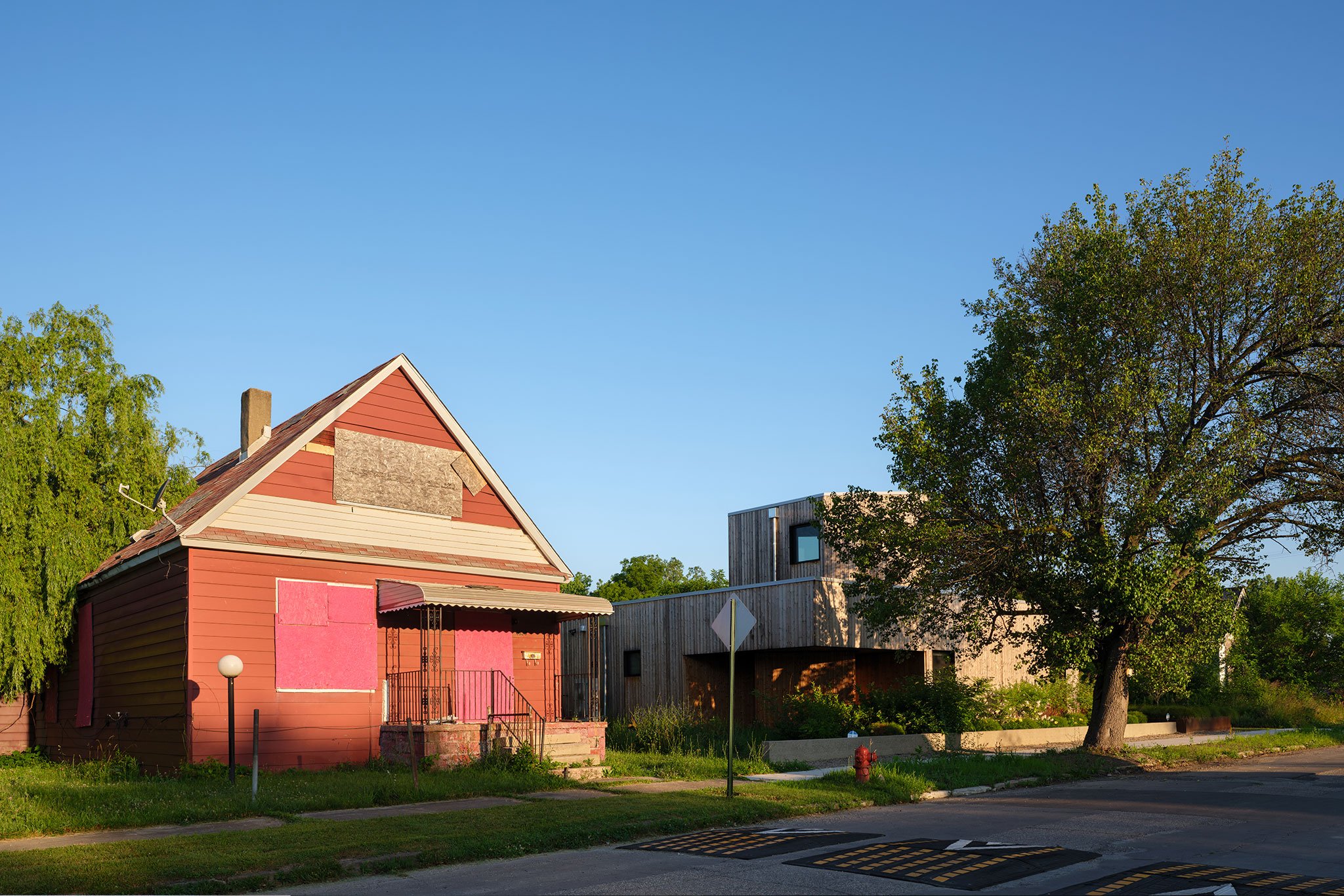
The most recent Google Street View of Detroit’s 17th Street is dated November 2022. Looking south from W Hancock Street, you can see that a single boarded-up home, surrounded by a landscape of vacant green lots, fills the foreground. Just down the block, however, change is stirring where a fresh concrete slab is contoured around the promise of a courtyard. Three years later, the site is home to an understated yet deeply unconventional house by architecture studio Dash Marshall.
Designed by Dash Marshall co-founder Bryan Boyer, the building was conceived as both a weekday office space and a weekend retreat — essentially, a second home for Boyer and his partner, Laura Lewis. “We could have built a house in the forest up north as an escape from the city, but then we’d spend four hours driving to get there — both ways,” he says. “Then we started thinking about Detroit. We’re both originally from California, and we find Detroit to be quite bucolic. Although it’s a major city, it’s also quite chill. So we decided to create a second home right across town — and a home office that’s not down the hall, but down a short stretch of highway.”

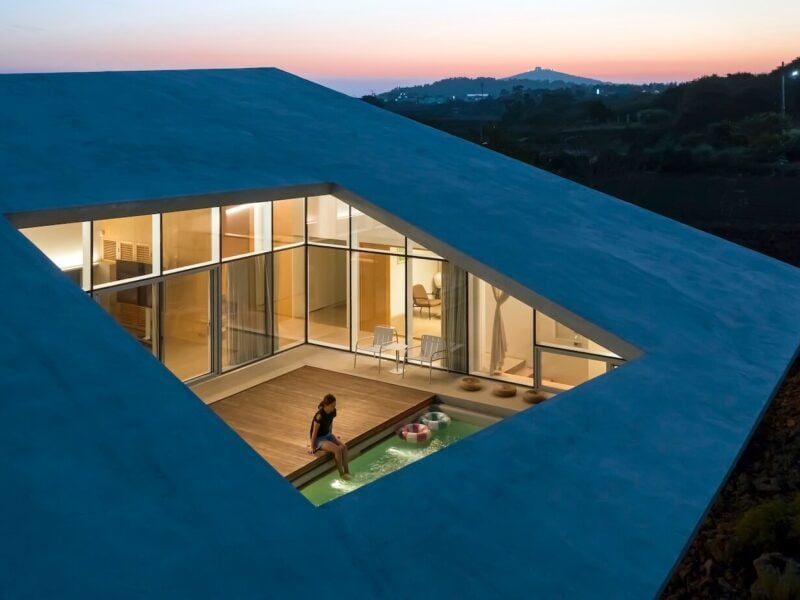
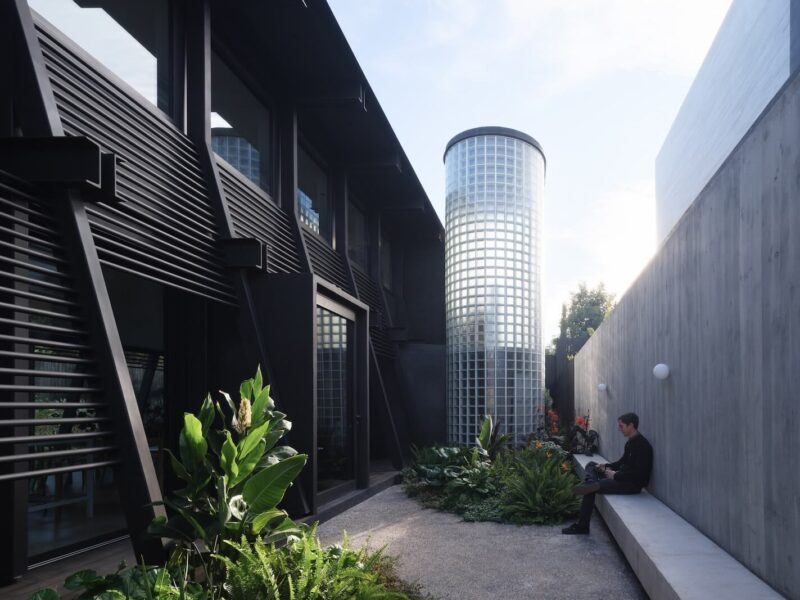
And while Detroit’s increasingly popular Core City neighbourhood is hardly remote, the quiet street and generously sized lots were able to accommodate a 170-square-metre home shaped around a tranquil central courtyard. From the street, the single-storey building is an unassuming, rectilinear composition of Lunawood Thermowood pine cladding; cuts create sheltered porches on the home’s four corners. The simple yet elegantly resolved public face is further distinguished by angular window awnings and punctuated with a solar chimney that pierces the roof’s datum line, offering a playful hint of the surprising interior.

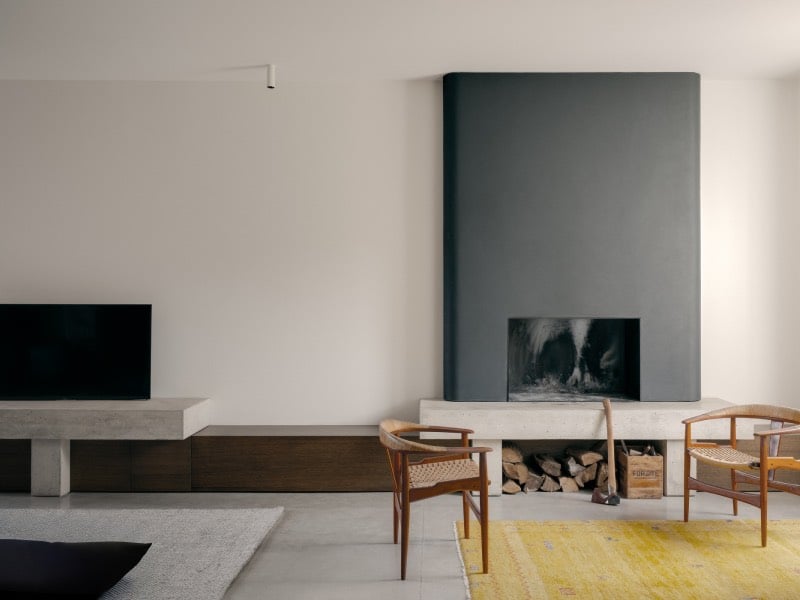
Past the front door, the house is organized into four distinct zones around the courtyard, beginning with a dining room featuring a library and a long table. Used for both entertaining and communal work, the space functions as a flexible landing pad where the Dash Marshall team, based primarily in New York, can convene on several upcoming Detroit projects.

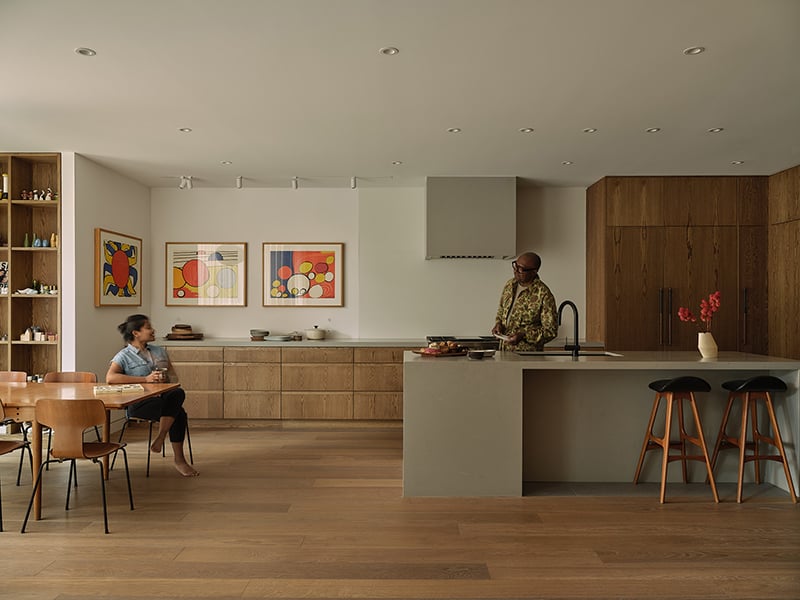
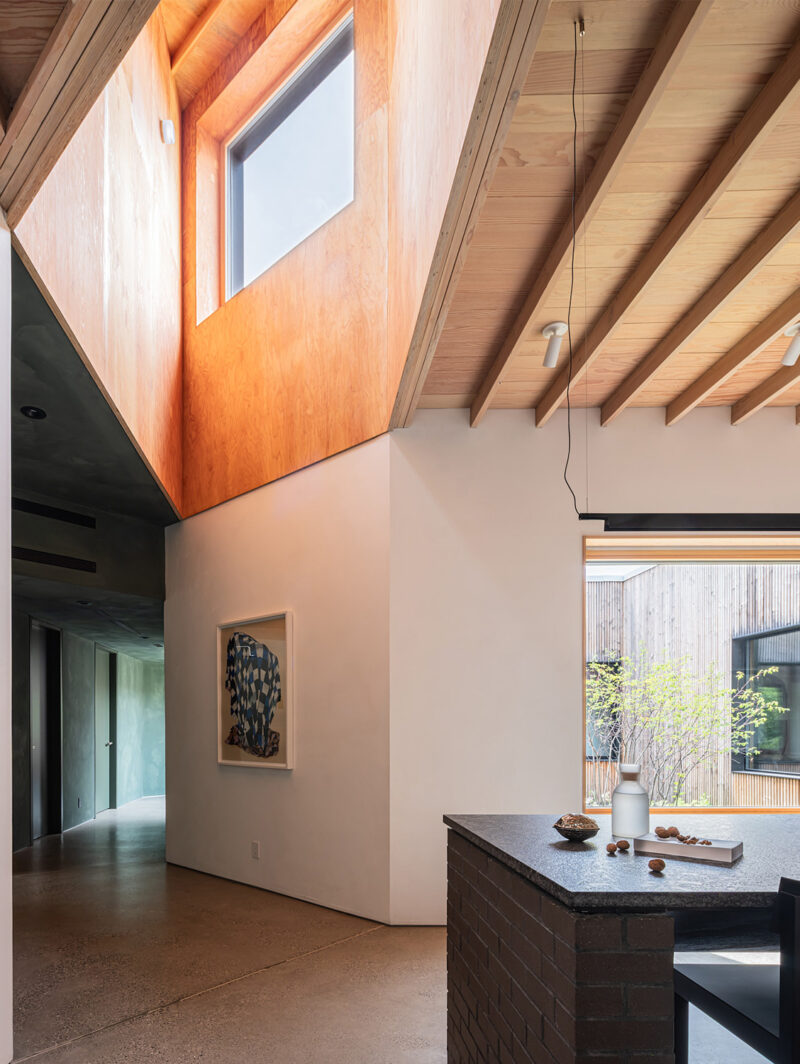
Around the corner, an open kitchen facing both the courtyard and the front yard is anchored by a sleek, grey granite island wrapped in black brick. Parallel to the dining room and on the opposite side of the courtyard, a sauna and an enclosed office occupy one volume, while a pleasantly expansive living area across from the kitchen forms the home’s most private zone. In the middle of it all, the compact courtyard gives the home an intuitive heart and brings sunlight deep into the space. “When you’re in the courtyard, it feels more like a room without a lid than like an outdoor space.”


When you’re in the home, the courtyard remains the organizing principle. “The layout is actually an enfilade plan, which is quite formal, hierarchical and traditional, but when we wrap it all around a courtyard, it creates the inverse effect: a kind of casual flow between spaces,” says Boyer. A walk through the home bears this out; the angular, almost textured light elevates the quality of space, the variation in mood amplified by skylights and light scoops, as well as the dramatic solar chimney that rises above the kitchen.

Touring the place, it takes me a few minutes to realize the obvious — that something’s missing. “It’s a house without a bedroom,” says Boyer. This omission is rooted as much in budgetary constraint as conceptual bravado, the architect explains. While the house was initially envisioned as a two-storey dwelling with bedrooms upstairs, soaring material costs during the COVID-19 pandemic saw the project scaled down to a single level. For the couple, it spurred a discussion of how to reconfigure the layout — and what to cut. “I lived in Finland for years, so I really appreciate the sauna from that aspect,” says Boyer. “But it was actually Laura who really wanted us to keep it. As she put it, ‘We have three bedrooms and zero saunas at our other house.’”

It makes for a deeply unconventional — even downright weird — little project, albeit also one that reflects Detroit’s distinctive spatial and socio-economic fabric. “On a basic level, if we were living in Toronto or New York, all of our resources would be tied up in a mortgage,” says Boyer. Still, the architect doesn’t hesitate to describe the project as “an indulgence.” But a pragmatic one: The home has helped shape Dash Marshall’s innovative work on courtyard houses. In Detroit’s Little Village, for example, the studio is designing a filmmaker’s triangular residence contoured around a sliver of a courtyard. On Long Island, meanwhile, the team is working on a private home whose two volumes — which create a V-shaped courtyard — respond to both the waterfront site and the adjacent road.

More immediately, the house is an anchor for the young family’s weekly activities. “On an average week, Laura and I are both here during the day. She’s an attorney, I’m an architect, so it’s a lot of phone calls — I like to take them doing laps around the courtyard,” says Boyer. Visiting friends and colleagues fill the house throughout the year, and the couple has also hosted everything from political fundraisers to a bespoke dance performance by local artist Biba Bell. On weekends, the family organizes gatherings and dinners. “At least one day a week, we’ll sort of camp out here as a family after swimming lessons, try to read a book together or do something relaxing — though our daughter is 18 months old, so there’s not much of that happening.”

Boyer describes these routines as family rituals. The sauna is one of them, too, along with the gatherings for friends and the weekend après-swim time. Nature also plays a part. As Boyer puts it, all sorts of characters make an appearance. “There’s a cardinal that shows up every summer and eats the berries from the tree in the courtyard,” he tells me. “I have no idea if it’s actually the same bird every year, but there’s only ever been one at a time. My son calls him Jimmy.”

In Detroit, Dash Marshall Designs a Courtyard House With No Bedrooms
A live–work build in the city’s Core City neighbourhood exalts family rituals — and makes a case for modern courtyard homes.