


Founded in 1967 to protest Toronto’s plans for the Spadina Expressway — which would have connected the downtown core with the growing neighbourhoods to the north and led to the demolition of both natural habitats and hundreds of homes — the Republic of Rathnelly boasts what may be one of the city’s more eccentric histories. The Midtown neighbourhood was established during Canada’s centennial; it recognized its symbolic independence movement by electing a queen, issuing passports and drafting a constitution, among other spirited initiatives. While the declaration of independence was somewhat tongue-in-cheek, it played a successful role in the cancellation of the proposed expressway and laid the groundwork for a sense of community pride that is still celebrated today.
So when local architecture and design firm Studio VAARO was called to renovate an early 1900s semi-detached Edwardian in the pocket community, that solidarity and shared respect partially informed its approach. On the surface, the brief the young, active family of three handed the architects was straightforward; it asked them to focus on increasing the interior living space. But it had one caveat: Work within the existing footprint.

Transforming what was a cramped and disjointed layout into a free-flowing and fluid one would take both dexterity and subtlety — two attributes that define much of the firm’s portfolio. “We are always very sensitive when working with existing structures to retain something of value,” says Aleris Rodgers. She co-founded the firm with Francesco Valente-Gorjup in 2021; in the short time since, they’ve created formally adventurous works, both built and unbuilt. The two are also co-authors, with Gabriel Fain Architects, of Impossible Toronto, a design and research book published by the Neptis Foundation exploring the many ways in which Toronto can adopt Europe’s courtyard typology for mid-rise developments. For Rathnelly House, the firm stayed within the footprint, as the clients requested, but stretched its possibilities.

In hand with a “boundaryless” interior layout that accommodates family time and frequent social gatherings, the clients also wanted to maximize the ceiling heights on all levels — aiming for a three-metre-high ceiling on the ground floor — and desired additional storage space for their sports gear (which includes bicycles, snowboards, surfboards and golf clubs). To achieve this, the architects applied “extensive structural interventions” that fundamentally reorganized the floor plans without drastically altering the exterior. “The design intentionally overlapped the reality of the neighbourhood,” says Valente-Gorjup. “We kept the front roofline to not disrespect the adjoining house.”

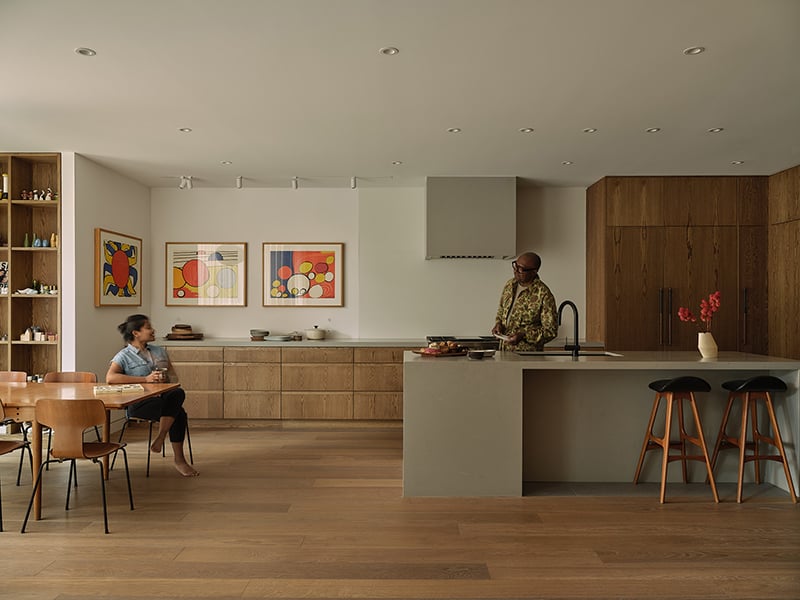
To maintain that street-facing integrity, the architects dug down instead of bumping up, excavating 1.5 metres in the basement — an extremely complex dig — and underpinning it. Previously unfinished, the subterranean level now boasts a 2.4-metre ceiling height and contains ample designated storage for sports equipment, plus a spa and a lounge. They also lowered the ground floor to be one step above grade. The clients wanted two main spaces per floor, so zones were created accordingly. Studio VAARO removed most of the internal walls on the first and second storeys, replacing them with “sculptural geometries and volumes to delineate and optimize” the space — a move that, combined with the basement excavation, effectively increased the living space by 60 per cent.

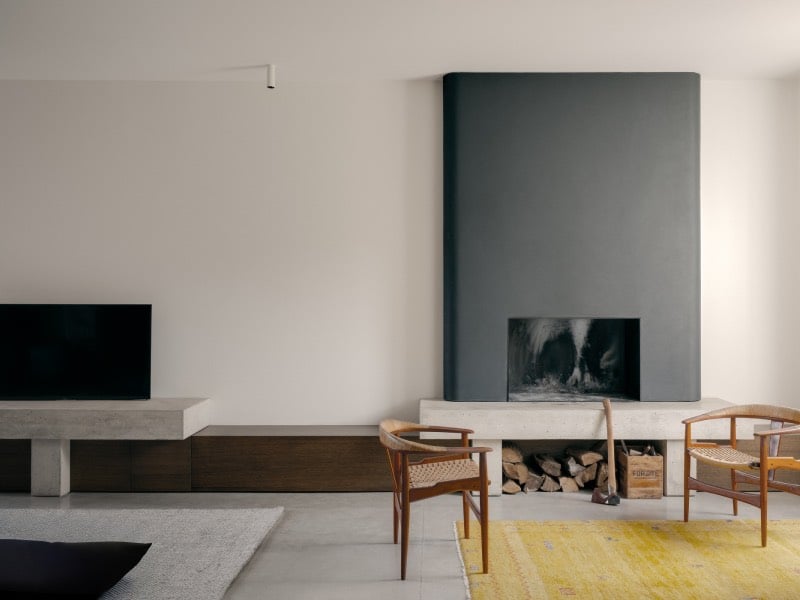
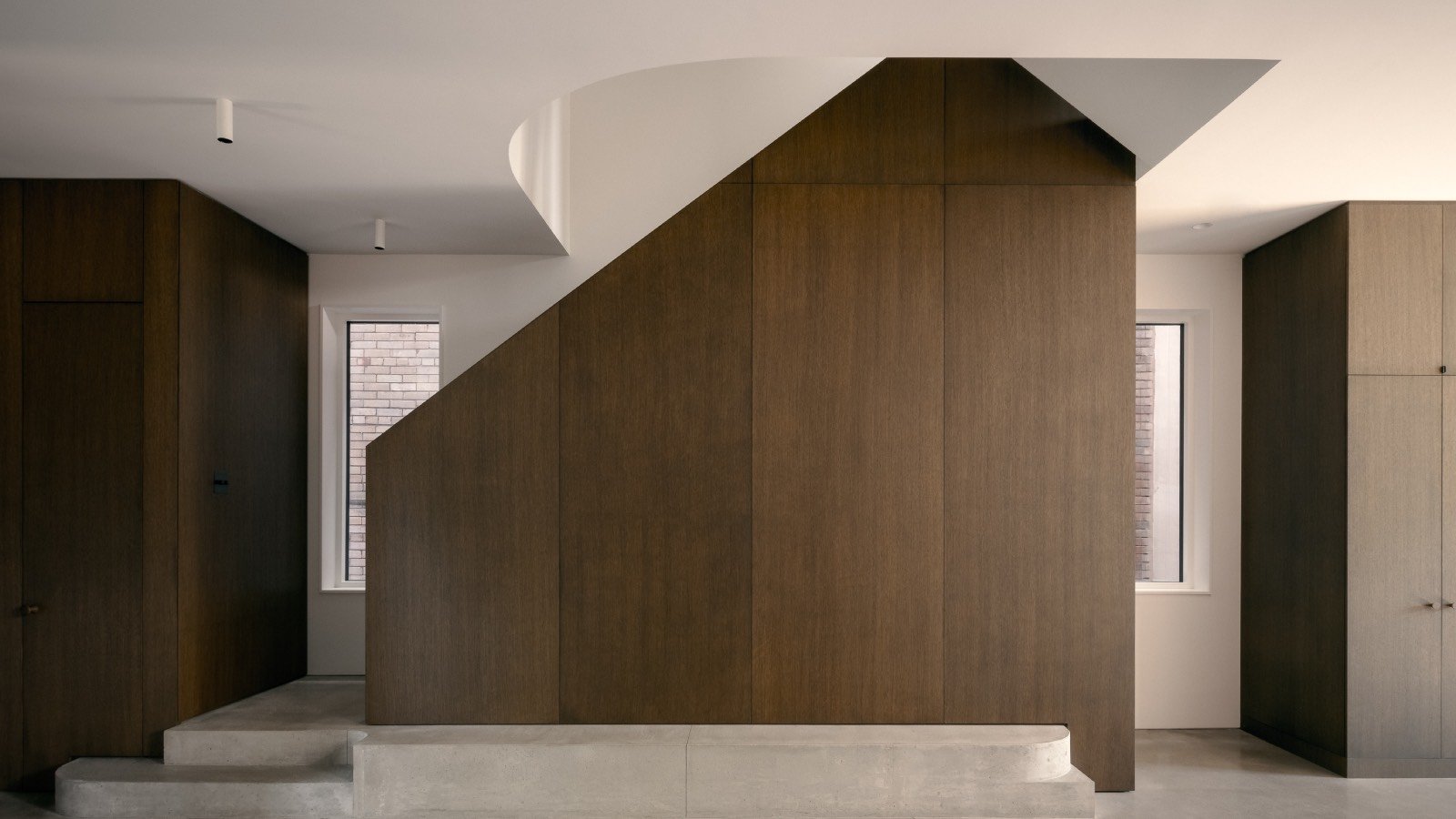
Entering the front door, one is greeted by a soaring main level comprising a living area in front and a kitchen at the back of the house. A curved, mid-height banquette forms the only visible divide while not obstructing sightlines; clad in walnut-toned millwork, the volume also conceals the air return behind a custom vent and serves as a dining booth, negating the need for a conventional dining room set-up. An existing fireplace in the living room was upgraded to code, re-clad in pigmented plaster and outfitted with a chunky concrete hearth that acts as a pseudo datum line that indicates the original floor level.

A sculptural plaster and walnut staircase appears orthogonal at the ground floor and transitions into something more curvaceous as it ascends, capturing and filtering light down from the expanded third storey (more on that in a bit). The second level was opened up to contain only three functions — the primary bedroom with a large walk-in closet at the foot of the bed that introduces the rounded geometry, an ensuite with a circular shower enclosure and a library overlooking the backyard. Painted a lovely forest green, this secondary living space is one of the only rooms of colour in the entire house (the others are the blue tile–clad spa in the basement and the sage green tile washroom on the third floor). To create a functional third floor out of the attic, which previously was only partially accessible, the architects rebuilt the rear roof and installed an angled dormer at the front of the house to add an additional 32.5 square metres of livable space that is now home to the child’s bedroom, plus a yoga/guest room and bathroom.

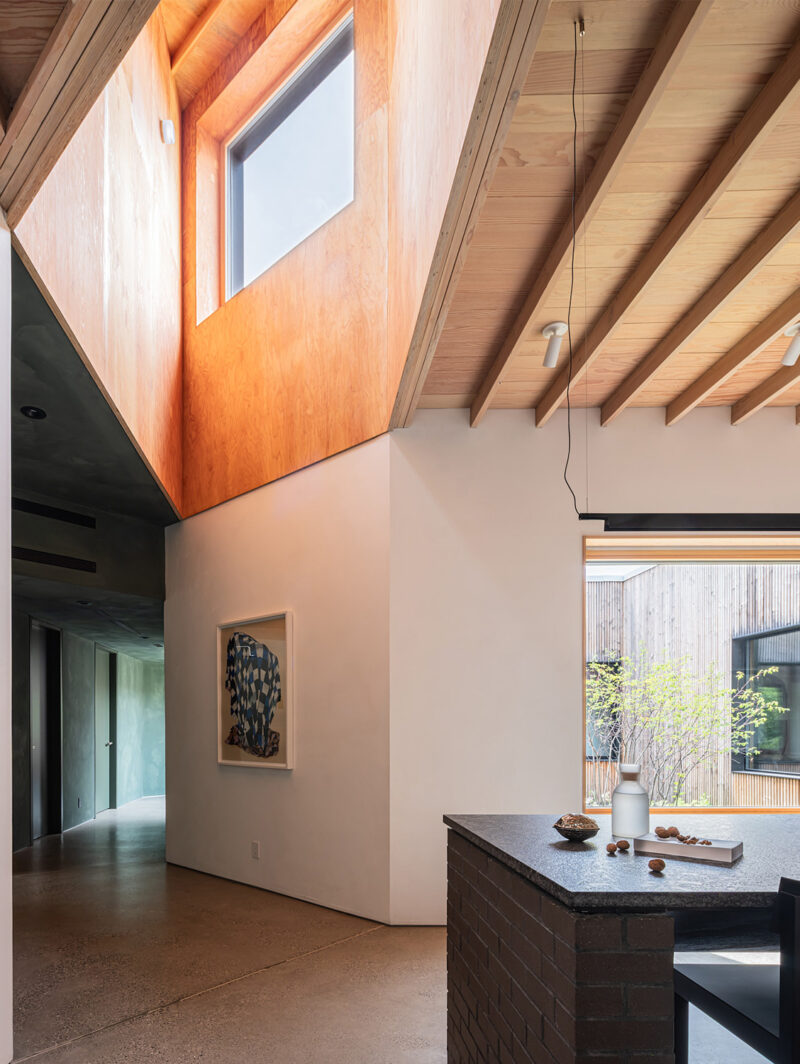
Connecting all levels is a restrained use of materials that contribute a sense of inviting calm. Composed primarily of plaster, walnut-toned millwork and concrete, the “tactile and timeless” palette serves as a backdrop for the life the house contains and highlights the geometric language of the interventions. All of the home’s venting and mechanics are concealed within the millwork volumes throughout, avoiding the need for distracting bulkheads — a feature Studio VAARO actively omits whenever possible. The two also custom-designed linear grills for the venting in key places (like the sauna and kitchen), another considered touch that keeps the focus elsewhere.


“We try to push what it means to live in a space, and what is conventional is not always right,” says Valente-Gorjup. At Rathnelly House, that meant devising a family home that is highly functional, spatially fluid and thoroughly original — a fitting complement to the rebellious history of its surroundings.
Studio VAARO Brings Space and Modern Character to a Toronto Heritage Home
Rising architecture firm Studio VAARO respects the existing footprint of a heritage home while carving out more living space inside.