

As we make our way to King’s College Circle along one of the now-granite-paved tendrils connecting the University of Toronto’s back campus to our destination, Shirley Blumberg pauses to pull out a sheaf of colour printouts. The KPMB founding partner and her colleague, associate architect Nick Jones, flip to an illustration showing the central green inside its square outline. Once a car-dominated asphalt thoroughfare, this hard edge isolated the circular lawn from the buildings that comprise the St. George Campus; it was a dangerous traffic and parking zone between Frisbee-tossing students and storied structures like University College and Convocation Hall. What Blumberg and Jones point out: The square outline is in fact larger than the green circle within it: 20,066 square metres compared to the circle’s 17,782. The edges, then, are where possibilities live.

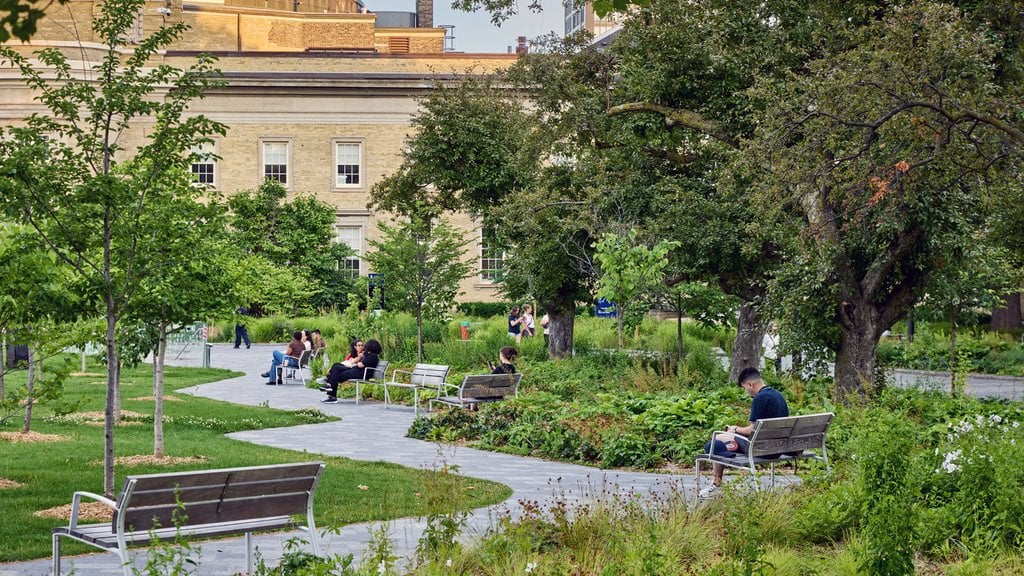
And now they are linked together in a cohesive landscape — a “necklace,” in the words of Michael Van Valkenburgh, that primarily rings the east and west sides of the circle. After jointly winning the design competition in 2015, his New York landscape architecture firm, MVVA, led the revitalization, and KPMB coordinated the project and contributed thoughtful architectural moments. Furnished with dozens of new benches, light poles and even movable chairs and tables, the granite walkways and the planted islands within them manifest an active and engaged sense of place. They deliver welcoming forecourts to each of the historic campus buildings — “these old dowagers,” as Blumberg calls them — and even pay homage to them: In subtly variegated shades inspired by the purples and greens of University College’s slate roof, the granite pavers shift in tone in sunlight and rain. (Another wonderful landscape adjacent to the site, Ziibiing by Brook McIlroy, adds a meaningful Indigenous presence to the campus.)

“On the first site visit we had,” Blumberg recalls, “Michael Van Valkenburgh said, ‘This is remarkable. It’s all hiding in plain sight!’ He overlooked all the traffic and the mayhem and saw the buildings framing the landscape spaces.” The first order of business, then: Divert the vehicular noise to a new underground garage (a concession to the greater community’s fears that traffic would be displaced to neighbouring streets). Much more important — and the true impetus for the project — was the creation of a geothermal exchange, the largest urban field of its kind in Canada, beneath the garage; comprising 372 boreholes drilled 240 metres deep, it is projected to reduce carbon dioxide emissions by 15,000 metric tonnes per year and ensure U of T’s status as one of the world’s top sustainable universities well into the future.

But you would never guess what lies beneath King’s College Circle — unless you were heading down to the parking lot, where a window provides a captivating view to the colour-coded geothermal machinery. The detour is worth it for KPMB’s entrance pavilion alone: A delightful folly, glazed on all sides and topped with an overhanging roof supported on slender cylindrical steel columns, it adopts the geometry of the gardens while introducing a gentle curve to that language. The green circle is complete again, except that it’s no longer a mud pit during heavy rains. Slightly crested in the centre, it channels runoff to a cistern. “Every garden around the circle gets irrigated with captured rainwater,” says Jones, “because 80 per cent of the garage roof below slopes south. But it was so well-graded that you would never know that.”

The renewed ecosystem harks back to an earlier era when Taddle Creek and its lush landscape bloomed through the campus. In more recent history, just after the landscape’s revitalization was completed, encampments of pro-Palestinian protestors filled the green until the Ontario Superior Court ordered the structures dismantled. To be sure, while they still allow public access (and student- and faculty-led protests, without encampments), the university grounds constitute private property.

Yet the project, informed by deep community engagement and aimed at universal accessibility, was guided by a generous spirit from the start. And the design team certainly aspires for King’s College Circle to be seen and felt as belonging as much to the greater public realm as to the campus proper. “I promised our clients that this would be Toronto’s Central Park, because it’s an extraordinary space,” says Blumberg. “It’s right near downtown, and the city grows up around it, so the surrounding community has embraced it as well. You know, it feels like it’s for everybody.” As the surrounding necklace fills in with maturing perennials and shrubs, this vibrant gathering place — with its intimate gardens, pockets of shade and a truly joyful pedestrian experience — should be experienced by all.
A Necklace of a Landscape Wraps Around the University of Toronto
A walk through the granite-paved, geothermal-generating campus park by Michael Van Valkenburgh Associates and KPMB Architects.