

Shortly after the Centre Pompidou in Paris closed its doors this fall for a multi-year renovation, another landmark cultural space debuted to fill the critical void left behind in the French capital. Mind you, “debuted” may not be quite the right word; really, the Fondation Cartier pour l’Art Contemporain has moved on from its celebrated glass building imagined by Jean Nouvel in the 14th arrondissement, where it had been operating since 1994. (Before that, from 1984 on, it overlooked an immense park in Jouy-en-Josas, near Versailles, where two gigantic sculptures, Arman’s Long Term Parking and César’s Hommage à Eiffel still stand, now a bit lonely.) Today, the foundation has taken up residence facing the Louvre, surrounded by historic monuments in a Haussmann-era building that was, in past lives, a hotel, a department store and, finally, an antiques market that closed in 2019. It is a strategic location, right outside metro Palais Royal–Musée du Louvre on Lines 1 and 7.
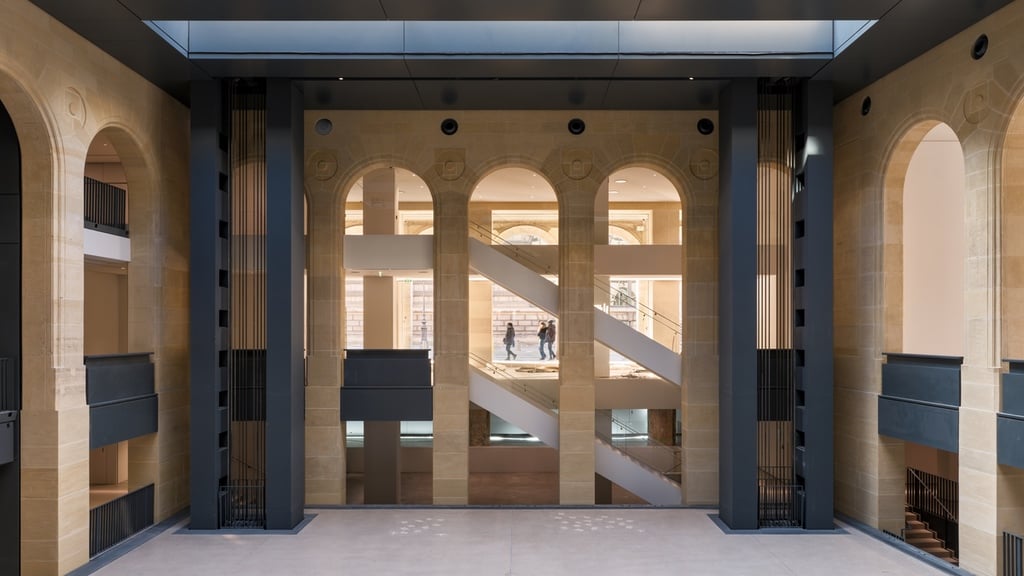
But this is no mere relocation. Nouvel returned for the Fondation Cartier’s revamp, and he did far more than simply refresh the interior of its new home. (The historic exterior was untouchable, aside from a glass canopy added on the rue Saint-Honoré side.) In fact, Ateliers Jean Nouvel reinvented the museum experience as we know it, creating a fluid, transformable architecture designed to adapt to every exhibition like a custom-made suit. How? By introducing five gigantic mobile platforms (which range from 200 to 363 square metres) that run throughout the length of the building. “I have always imagined the Cartier Foundation for Contemporary Art building as…not just another gallery, more or less neutral, but rather as a place of free inspiration, a large workshop adapting to the creations of artists and their ideas,” says Nouvel in his recent monograph about the project.

The architect was an obvious choice for Cartier; apart from achieving great success with the foundation’s previous site (not to mention his design for a Cartier watchmaking plant and the headquarters of Richemont, Cartier’s parent company, both in Switzerland), he is a mastermind of museums. Back in 1971, his first competition entry was a proposal for the Centre Pompidou; more recently, he envisioned another major French institution’s expansion abroad with the Louvre Abu Dhabi. Even still, nobody expected what he drew here. “There was no specific brief except to create a Fondation Cartier downtown,” says Béatrice Grenier, the foundation’s director of strategic and international projects. “Immediately, the idea of the platforms was outlined with the first proposal, which shocked and convinced the decision-makers.” It helped that, along with delivering ultimate flexibility, the concept also allows for five times more exhibition space than was available in the foundation’s previous home.


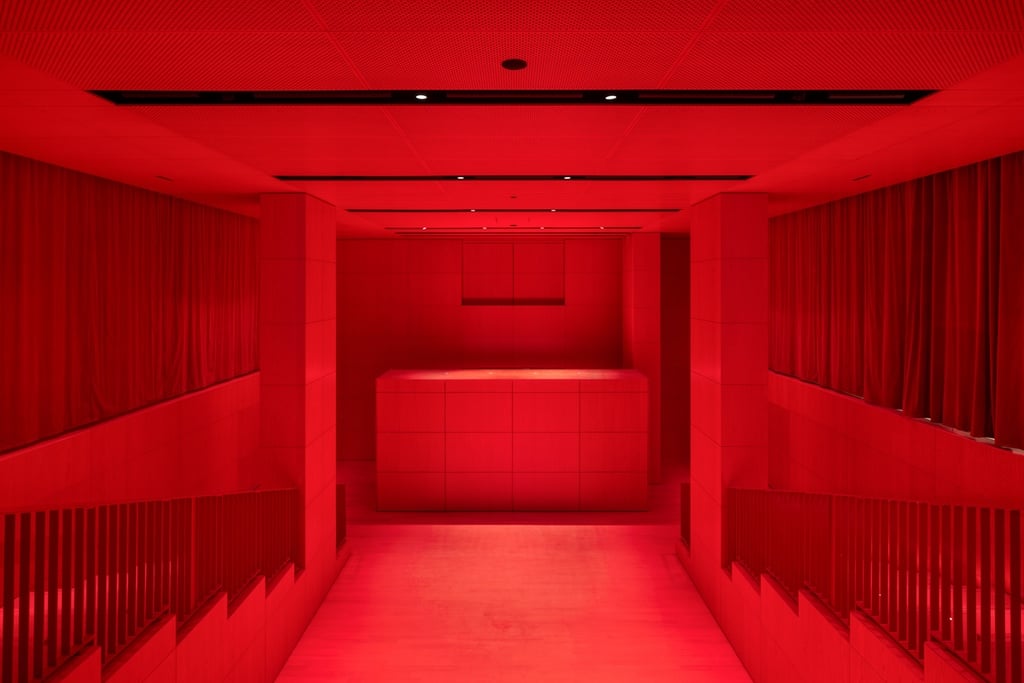
Essentially, the platforms function like large elevators, moving, once activated, at a speed of six millimetres per second to form spaces with ceiling heights of up to 11 metres. “They can all be placed at the very bottom, creating enormous volumes,” explains Grenier. “Or they can be placed at different levels, which allows for the addition of scenography or the creation of monumental installations where the artwork can be viewed from above.” Together, the five podiums follow the architecture of a Haussmannian construction, taking the place of interior courtyards and illuminated by three glass ceilings that are equipped with retractable shutters. As Grenier explains, the dynamic scheme also has another historic connection. “This building was constructed in 1855 as the Grand Hôtel for the Exposition Universelle, and it was one of the first to get an elevator in the 19th century,” she says. “In 2025, we could have had much more sophisticated technology, but it’s still cables and pulleys — visible to the eye — that control this mechanism.”

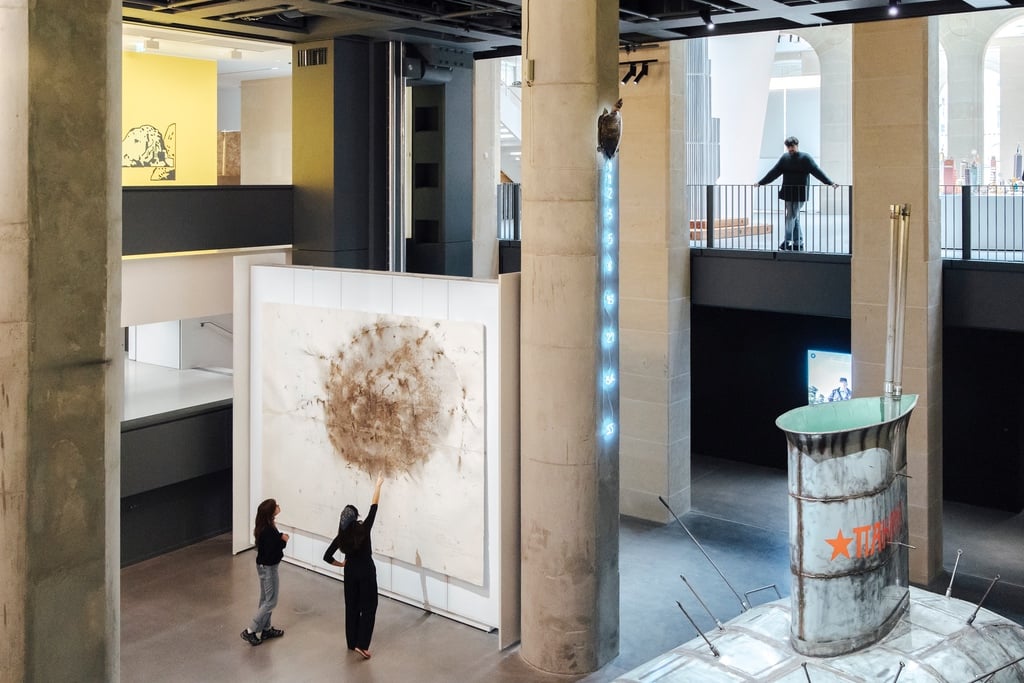
The result is striking: architecture in movement. A visitor quickly loses any sense of how many floors surround them as sightlines open onto two or three levels at once and, thanks to large picture windows, out to the city beyond. One is constantly drawn forward, always sensing the next artwork just beyond the corner or over a balcony. It feels like scrolling, but in a 3D space — one that breaks all the traditional rules about floors. I felt a slight tremor when walking onto a platform as I noticed narrow gaps at the edge that reminded me I wasn’t entirely on solid ground. I began to imagine Jean Nouvel standing where I was, amused by the path he has set for visitors. In his book about the project, the architect is clear about the radical impact he expects it to have. “The Cartier Foundation will likely be the institution offering the greatest diversity in its spaces, the most ways to exhibit and the most perspectives,” he says. “The powerful platforms allow very heavy works to be displayed, enabling them to be hung in entirely new ways. It allows us to do here what we couldn’t do elsewhere, by changing the system of exhibition.”

Grenier agrees that, for her and the team at the foundation, the building represents nothing less than a paradigm shift in how they will curate. “Each exhibition’s set-up incorporates architectural reflection, and this brings a new possibility for creativity, and also an awareness of the exhibition’s very structure,” she says. The opening show, “Exposition Générale,” serves to showcase the possibilities, with no shortage of large-scale sculptures (like Junya Ishigami’s sweeping suspended arches and Luiz Zerbini’s tropical ecosystem Natureza Espiritual de Realidade) afforded spectacular breathing room from some vantage points and overlapped with other artworks into exciting visual collages from others. “It highlights the demonstration process, which formulates the discourse in art, and of always returning, with this building, to architecture and questioning how we look at things,” Grenier says. “Ultimately, this is very important; it is what produces the history of art.”
Timeline:
The Many Lives of 2 Place du Palais-Royal

• 1855
The Grand Hôtel du Louvre hosts its inaugural guests, in town for the Exposition Universelle. Built in just over a year thanks to construction crews who worked day and night, the project embodied French industrial prowess, with gas lighting, a ventilation system, a telegraph office and an elevator — one of the first in Paris.
• 1887
The ribbon is cut on one of the earliest department stores in Paris, the Grands Magasins du Louvre, while the Grand Hôtel relocates across Place du Palais-Royal, where it still stands today as the Hôtel du Louvre. The department store remains in business until 1974.
• 1978
Le Louvre des Antiquaires opens with 240 antiques dealers spread across three levels. The luxury marketplace closes its doors in 2019.

• 2025
Spanning a total of 8,500 square metres of publicly accessible space, the Fondation Cartier moves into the three sub-grade floors, combining 6,500 square metres of exhibition space, a restaurant and bar (both of which are opening in 2026), an auditorium, a bookstore and a café. The building’s five upper floors remain offices, a portion of them occupied by the foundation’s teams.
Jean Nouvel Reimagines the Fondation Cartier as a Museum in Motion
Art institutions shouldn’t rest on their laurels — hence Jean Nouvel’s revamp of the Fondation Cartier as a building that doesn’t sit still.