


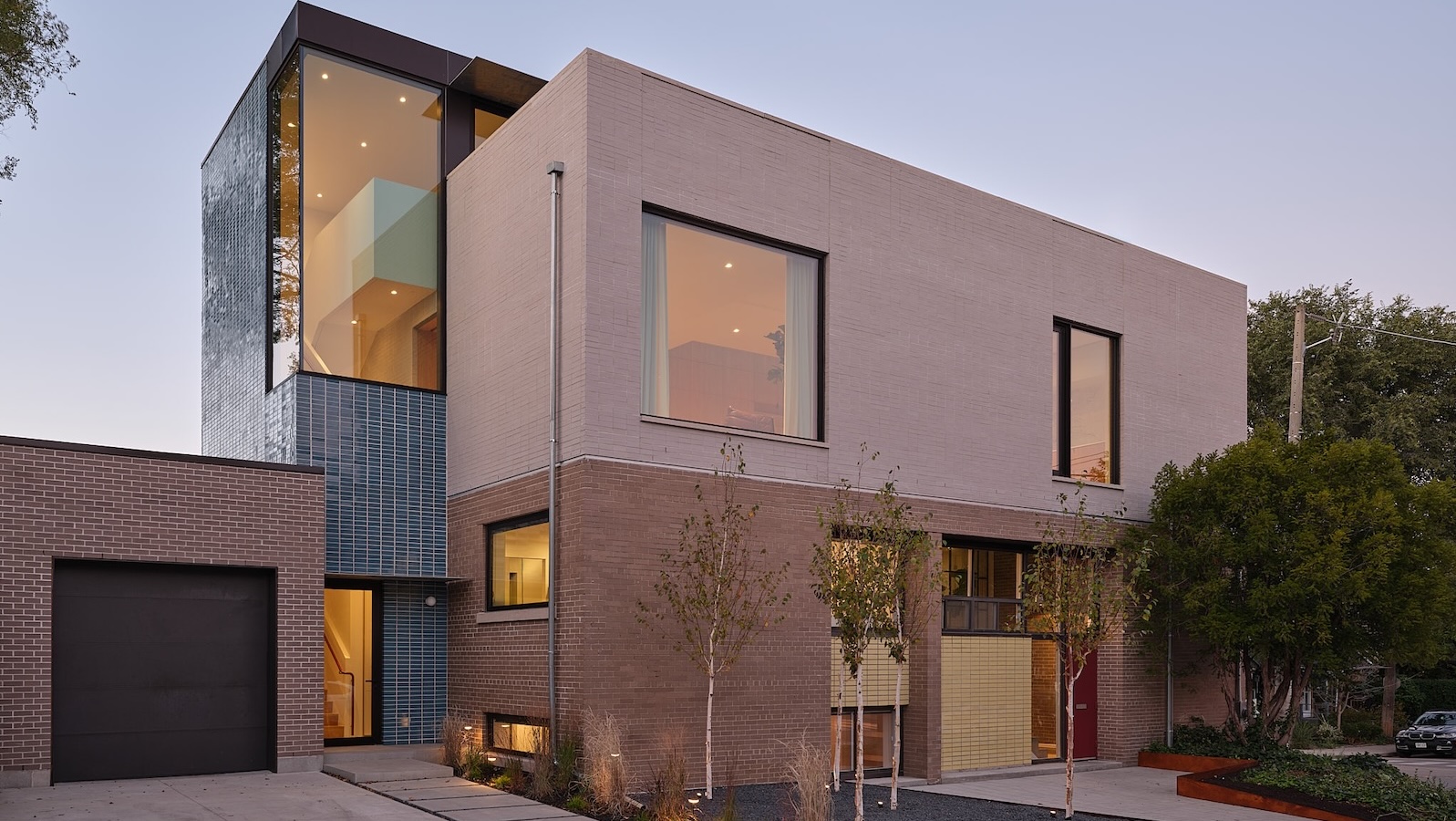
A few decades ago, if you arrived at 584 Jones Avenue, just south of Danforth Avenue in Greektown, it would likely be to see one of the Coulters — Dr. George Coulter or his cousin Dr. S.G. Coulter — or a colleague of theirs, like Dr. Axler, who liked to play banjo during his lunch break. And then you might walk around the building to Coulter Drugs, where Dr. George’s dad would fill your prescription. Patients grew so fond of the medical staff here — who were known to make house calls — that they’d show up with baklava and sponge toffee. Dr. George Coulter was even celebrated at Toronto East General Hospital for delivering the most babies.

At first glance, the corner-lot address on Jones and Hazelwood Avenues appears to be the same modest box that the 1956 building has always been, the yellow brick that contours its windows a nostalgic callback to its past life as a healthcare hub with a magnanimous staff. But it has been thoroughly refurbished and ambitiously expanded in a pandemic-era gut-reno that brought out the locals. “We would meet people on the street all the time, especially as the building was in construction, who would say, ‘I grew up going to these doctors, and we’re so happy that you’re caring for this building and that it’s not being knocked down,” says architect Anne-Marie Armstrong.

Armstrong’s partner, Todd Temporale, purchased the building before the two met to transform it into his home. He’d lived in the neighbourhood for over 25 years and always admired the building from afar. “My love for modernist architecture (and the building itself) always made me curious about its previous life,” he recalls. “Why is this modern, low-slung commercial building on a residential street? Is there more glazed brick under the vinyl siding? I’m sure you could add a floor or two over that flat roof.” When he saw a for sale sign go up in 2017, he jumped at the chance to buy it.

Then Armstrong became involved, and together they completed the vision for the adaptive re-use marvel that it is today. The couple set out with big plans for the humble pile, which they topped with a two-floor addition: It would house their offices; Armstrong is a co-founder of the architecture firm AAmp Studio — which has offices in Toronto and Portland, Maine — and Temporale is the creative director at Viva & Co., founded by frequent New Yorker contributor and children’s book illustrator Frank Viva. It would also be their home, a place in the city to raise their young daughter and teenaged kids from Temporale’s previous relationship. Plus, it would be a multi-unit building, with apartments in the half-level below grade.

Even though they sought to introduce more density to the site, maintaining the building’s character as part of the neighbourhood fabric was a primary consideration. “It has this really nice transitional scale between the more residential character of Hazelwood Avenue and Jones Avenue, which is much more directly connected to the commercial corridor of the Danforth,” Armstrong explains. To keep the building in sync with its surroundings, they decided that the uppermost storey of the two-storey addition would be set back, both to create a marvellous roof deck and to align the overall scale with the higher pitched roofs of adjacent structures. “It doesn’t feel out of whack with the scale of the neighbourhood.”

Rounding the corner at Jones Avenue, you enter the building through a red door on Hazelwood. This distinction makes all the difference: On Jones, the building’s full height comes into view, while on Hazelwood, where the sidewalk is sloped, it appears to rise only three storeys. By designating this side as the front elevation, the project met the requirements of Part 9 of the Ontario Building Code, and did not require another egress and a sprinkler system. This is also the facade where the original yellow brick — a calling card for past patrons — was power-washed and preserved. (Temporale and Armstrong also employed a mason to replace the brick on the Jones Ave. massing, which was in bad shape after vinyl siding had been drilled into it, with a colour-matched replica from Italian manufacturer S.Anselmo.)

Just inside, you can step up a few stairs to the office or — if you’re a tenant — down to one of the two apartments below. The brick exterior continues inside, where the terrazzo stairs also nod back to an institutional setting.
In the office, a large communal table is oriented along the street-facing glazing, through a wall of mullioned windows.
To reach the Armstrong-Temporale residence, you step back outside and walk a few paces down the road to a blue-brick stair volume (next to a garage where Temporale tinkers on his motorcycle collection) and climb to the third floor via a crisp oak stair with a red handrail.

An elevated living room, dining area and kitchen stretch out before you, and there is an immediate sense of soaring sightlines and natural light: Two joyous picture windows on either end of the street-facing wall allow even wan winter light to brighten the living room and the kitchen; at the centre of the space, the intimately low ceiling is carved away to create a double-height, skylit volume. Soaring through this opening where the addition’s two levels converge, a massive millwork monolith contains most of the kitchen’s storage and provides the main delineation between this central space and the bedrooms behind it. The room’s gesture of compression and expansion draws your eye up to the loft-like uppermost floor, glimpsed through a glazed barrier: a dreamy lounge space featuring a long, narrow bar, a sauna and direct access through massive sliding glass doors to the roof terrace.

The terrace takes up the brick motif, which appears throughout the project not as a symbol to pacify the neighbours but as a meaningful architectural material. This is real brick, not brick veneer — yellow for the original building that everyone remembers so fondly (and that inspired Dr. George Coulter’s daughter to write to the new owners about the building’s past life) and glazed blue for the stair volume, which establishes a respectful conversation between the building’s two eras. The addition’s light grey brick, meanwhile, matches the limestone sills of the original windows — old and new strata showing up in poetic interior moments.
Combining these two lives, past and present, posed a formidable challenge. With the guidance of Moses Structural Engineers, the addition was envisioned as a bridge over the existing building, supported by three columns that stake their presence in the building in the same red tone as the handrail. “They’re strategically located to minimize the impact between units and existing circulation,” says Armstrong. “And then we celebrated them; we tried to find a place where you could expose a column and make it part of the architecture.”

Typically, to reinforce the walls for such a top-heavy addition, you would open them up to install new rebar. But because the couple already had tenants at this point — including themselves and their then-infant daughter who were living in different parts of the building throughout the process — they opted for a less intrusive, albeit more unorthodox, way: drilling from the top down with a “really giant, super-long drill bit,” says Armstrong. “From the very top of the roof, we very slowly drilled through the CMU block wall of the original building and put the rebar down. And only at the basement, where we had to rip out most of the interior because we had so many plumbing upgrades to do per code, could you see it and confirm that the rebar had gone all the way through the building.”
To further lessen the impact on the original building, they eschewed ripping off the roof to accommodate the expansion and instead built a new floor package, making the floor deeper between the original building and the addition.

When it came time to furnish the home, Temporale’s passion for collecting vintage pieces — and for wielding a hammer — came in handy. Upon entering the living room, you encounter what at first appears as a wonky shelving unit. It’s not — the wall-mounted piece is in fact a Jean Prouvé brise-soleil panel from Cité Scolaire de la Dullague, in Béziers, France, which, as is the case with many of the home’s to-die-for mid-century furnishings, Temporale acquired with help from Jeffrey Graetsch of New York’s Raisonné gallery. In the dining area, a salvaged Droog light and original Pierre Jeanneret chairs (which Temporale and Graetsch procured in Chandigarh) furnish a Carlo Scarpa–designed table that once belonged to Temporale’s father.
“I have wonderful memories of dining around Scarpa’s Doge table as a child (under the Castiglioni light that’s now in our office),” says Temporale. “It later became the boardroom table at my father’s architectural practice, and then he gifted it to us as we were completing the project.”

Temporale also fashioned the red handrail; he and his friend Brandon Cambareri built the kitchen island with a welded steel frame and red jasper quartzite top; and he and his teenaged daughter crafted one of the home’s most charming furnishings: the loft-style bed for the couple’s four-year-old, made with offcuts collected by their millworker, Wood Studio, and a section of steel column. High enough to free the space beneath for a comfy play area, it speaks to the home’s clever use of constrained footprints.
As personal as this project is for Armstrong and Temporale, it has a broader appeal — as a potential model for updating and adapting similar unsung heroes. Armstrong’s thinking in this area is rooted in the practice she and co-founder Andrew Ashey established in both Canada and the U.S. in 2017, and in the journal they publish, AAnnotated.

“Andrew and I would write these observations and walk in the city. We started out in L.A., which has all these wonderful, strange conditions that might not have been designed by architects: interventions, changes, ad hoc conditions in the built environment that were just really interesting to us. And when I came back to Toronto, I mean, it’s just everywhere. Toronto has a layered quality to the city that is super intriguing.” Part of this “wonderful fabric” are unfussy buildings, like 584 Jones Avenue, with a rich history and embedded memory. “We’re always interested in the stories behind these spaces — the material inheritance, their significance to the community that might not necessarily be acknowledged officially. I really appreciate the honesty of the building — and our approach is to treat every building with care and to see how to work with it and be in conversation with it.”
Live, Work, Adapt, Multiply: AAmp’s Toronto HQ Does Quadruple Duty
An architect and a graphic designer revamp a 1950s medical clinic for their family, their studios (AAmp and Viva & Co.), their tenants — and the whole neighbourhood. How a humble Toronto building now packs in more density, multiple uses and major joy.