


Stair Ways
What will it take to make single-stair egress possible for small-unit buildings in urban areas? Conrad Speckert, a building code consultant and designer who serves as a member of the single-egress task group at the Canadian Board for Harmonized Construction Codes, looks at recent progress across the country.
Since the city of Vancouver changed its building code in January, housing discourse in Toronto has been buzzing with talk of so-called “single-stair” and “single-egress” design. Architects have even coined new acronyms like SES (single-exit stair) and PAB (point access block) to explain this trending topic to more Canadians.
“Single-stair,” however, is not a new idea.
New York City has been building six-storey single-stair apartments since the 1930s, Seattle since the 1970s. On other continents, mid-rise blocks of flats are predominantly designed this way, with a few apartments on each floor and windows on multiple sides. Barcelona’s Superblocks, Berlin’s Mietskasernen and Paris’s Haussmannian buildings are composed almost entirely of such floor plans. New mid-rise housing in Sweden and Australia is also mostly single-stair.
A review of building codes worldwide raises an unexpected question: What do Canada, Pakistan and Uganda have in common today? These countries require two exit staircases in any apartment building of more than two storeys. Canada’s rules date back to the first edition of the National Building Code, published in 1941, at a time when methods of construction and fire protection did not reflect today’s conditions. Even the United States, which follows the pompously named “International Building Code,” allows single-stair designs up to three storeys, with a maximum of four homes per floor.
In fact, at a recent symposium on this topic, technical experts from the U.S.-based National Fire Protection Association explained how they changed their model building code to four storeys after reviewing the reliability of sprinklers in the 1990s. Modern sprinkler systems reduce the risk of fire and smoke spreading beyond the room of origin so that the probability of compromising the shared means of egress is extremely low. Regulators are now considering a change for the 2027 edition of the International Building Code to allow single-stair design up to four storeys across the United States.
While this clearly isn’t a new solution, it’s becoming a very timely one. Until recently, zoning bylaws prevented small apartment buildings from going up in most urban areas across Canada. Now, these are actively encouraged by city planners and some city councils. Toronto has legalized fourplexes citywide, sixplexes in some areas, small apartment buildings along major streets and even more housing near major transit stations.

Tearing down an old house to erect a small apartment building with an elevator and sprinkler system, one that also meets the newest codes for energy efficiency, should be an obvious win for policymakers. This new housing is required to be much more accessible, safe and sustainable than previous housing and would pay a lot more in property taxes.
Except it turns out that “missing middle” housing has a bit of a building code problem.
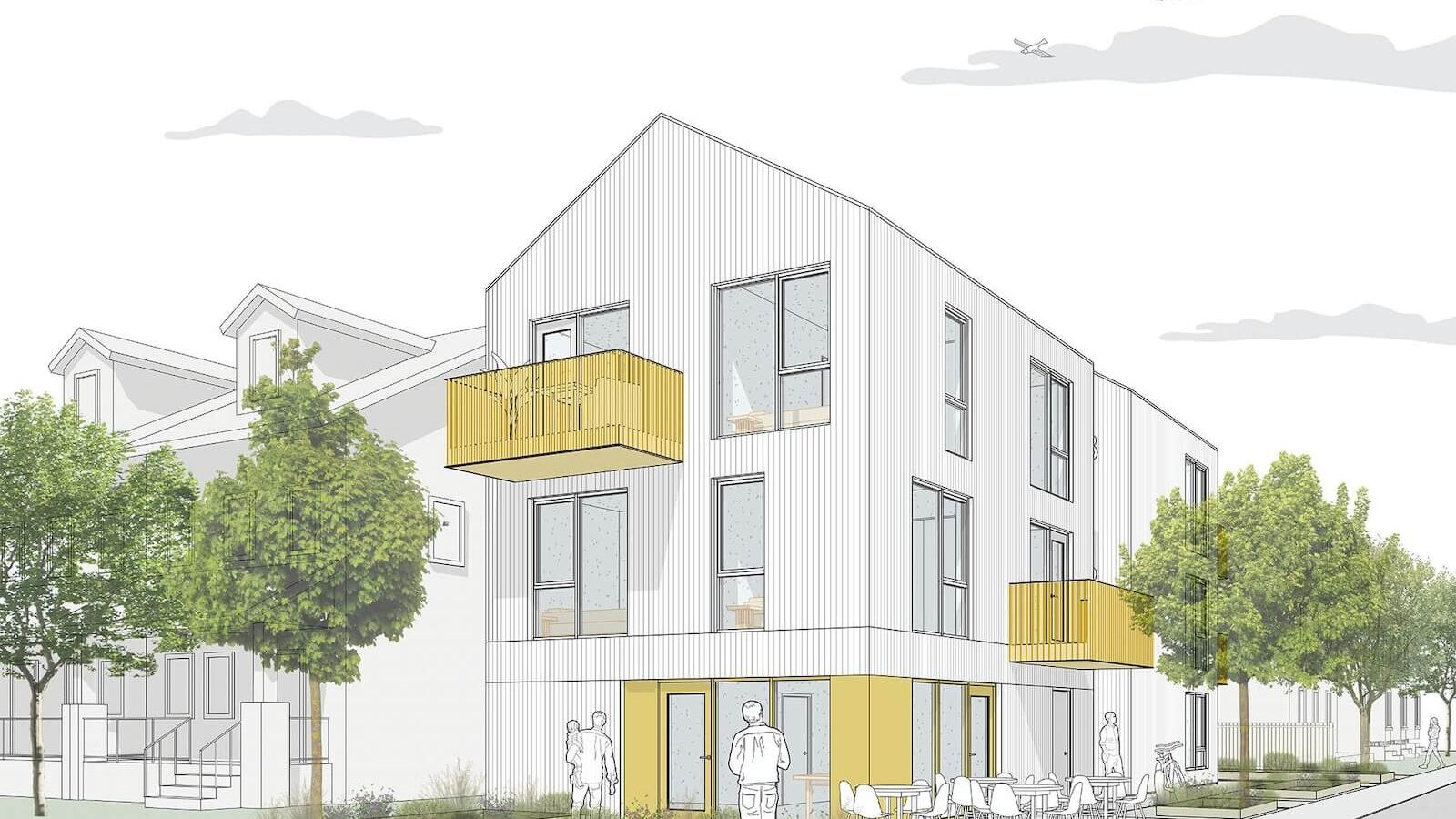
The second staircase and connecting hallway — which the building code currently necessitates — don’t just take up space. They fundamentally change what kind of building you can design. They force corridor-based layouts, limit cross-ventilation and produce apartments that feel more like hotel rooms than homes. The smaller the building, the more this matters — not only because it sacrifices area, but also because it restricts architectural design flexibility. There are many cases where two stairs and double-loaded corridors are appropriate — but a small building with a few homes per floor is not one of them.
Single-stair design unlocks a fundamentally different kind of housing with more daylight and fresh air, and it makes it much easier to provide an elevator in low-rise buildings for barrier-free access. These are not marginal differences. They are the key to building small apartment buildings with homes that feel more spacious and can compete with houses.
Once upon a time, Ontario understood and even almost led the country on this topic.
Thirty years ago, the provincial government assembled a working group to recommend changes to the Ontario Building Code (OBC) to make it easier to build main-street housing. The first recommendation of its report was to allow a single exit up to six storeys, provided that the building is sprinklered. At the time, however, sprinklers were not required and homebuilders were so concerned by the cost of introducing them that the single stair recommendation was not implemented. Fifteen years later, the OBC was changed to require sprinklers in any building over three storeys in height, regardless of the number of exits, but the province did not revisit the previous recommendation to unlock single-stair design.
Following a letter-writing campaign from architects and planners, the provincial Ministry of Municipal Affairs and Housing announced it would consider allowing single-stair up to four storeys with a maximum of four homes per floor in 2022. However, many years have since passed without any provincial progress or consultations on the topic.
The intent of single-stair design is to achieve the same level of fire safety as the prescriptive code. This is what makes it an interesting discussion. The current code allows a wood-frame apartment building to have a large footprint with no limit on the number of homes per floor and a maximum hallway travel distance of 45 metres to one of the two exit stairs. The doors into each dwelling unit can be solid wood with a fire-protection rating of only 20 minutes. Compare this to a single-stair apartment building with a much smaller footprint, a maximum of four homes per floor and a hallway travel distance of no more than six metres to the exit. The result is far fewer people travelling a much shorter distance to get out of a much smaller building. Upgrading the fire rating of the doors and requiring smoke door weatherstripping further enhances safety well beyond what is otherwise required by the current code.

There are other safety benefits as well. Frequent false alarms in large apartment buildings contribute to the dangerous phenomenon of fire alarm fatigue, where occupants become desensitized to the sound and neglect to leave in a real emergency. A much smaller apartment building with fewer kitchens inherently reduces the risk of delayed egress.
The building code also strictly regulates the interior finishes within exits and requires stairwells in wood-frame buildings to have increased sprinkler coverage. Fire statistics show that the occurrence of fires in exits is rare, and when they do occur in sprinklered buildings, they do not result in injuries. A recent risk analysis for the State of Minnesota also found similar conclusions after analyzing the probability of multiple system failures (“risk” being defined as the simultaneous failure of sprinklers to suppress the fire, failure of self-closing doors to contain the fire and failure of the fire alarm system to notify occupants). The study concludes that an eight-storey single-stair building can be as safe as a four-storey single-stair building, and that both of these are significantly safer than a much larger two-stair building.
Following a similar technical analysis, British Columbia changed its provincial code in 2024 to allow single-stair designs up to six storeys. The City of Vancouver also recently adopted similar code language, with modified conditions that require a protected exterior staircase. Toronto and Edmonton have also created guidance documents to assist designers with “alternative solutions.” In Edmonton, city staff collaborated with a local architect and fire protection engineer to conduct a comparative risk assessment and illustrate several design options for typical residential lots across the city. Single-egress is a priority topic for the 2025–2030 code cycle of the national model codes development system.
Supported by the CMHC’s Housing Supply Challenge initiative, LGA Architectural Partners recently led a team of architects and engineers to develop pilot projects across Canada and test the approvals process for alternative solutions. In each case, the design team demonstrated to the municipal building official that their scheme provides a better level of safety than the prescriptive code. So far, five of these alternative solutions have been approved for construction. As part of the same research, LGA also created six prototypes for typical residential lots and compared them by floor area efficiency, construction cost, rental income and residual land value. On average, single-stair design improves the feasibility of a small apartment building by five to 15 per cent and adds another bedroom on each floor.
Change is coming. The need to expand housing options in urban neighbourhoods is trending across the country, such that the era of building mostly tall or sprawl has, hopefully, ended. With pilot projects and building code changes across North America, we are now developing a much better understanding for the safety and other benefits of single-stair design.
Hopefully we don’t need to wait much longer for the code to let us build this way.
Common Grounds
The co-op, the courtyard block and the collective third space promise a better way to live together. These three projects — conceptual, in construction and fully realized — celebrate a denser urban fabric brought to life through bold architecture and urbanism.
When shovels hit the ground on 2444 Eglinton, Canada’s largest co-op housing development in over 30 years, the Toronto project reignited excitement about this type of affordable housing, which emphasizes collective caring for shared spaces. Co-op housing is notoriously difficult to get into, but during an ongoing housing crisis, the city is working to unlock more land for this much-needed solution. Part of a larger CreateTO development called Kennedy Green that will include market housing, the co-ops at 2444 Eglinton also demonstrate how formally adventurous affordable housing can be: Vancouver’s Henriquez Partners Architects designed the colourful facade as a “sun-capturing skin reminiscent of a honeycomb or a field of sunflowers,” and Montreal landscape firm CCxA carried that playfulness into the shared realm.
The overwhelmingly positive reception to a book by the Neptis Foundation also shows that we are ripe for change. Part of the Impossible Toronto series, On the Courtyard imagines what the city could be if it could just overcome “impossibilities” like single-stair egress. Toronto firms Studio VAARO and Gabriel Fain Architects visualize Toronto courtyard housing, above, with glorious shared spaces — evolving greenscapes conceptualized by PUBLIC WORK. Their ideas draw from European precedents where the typology is rooted in history yet completely adaptable: Degli Esposti Architetti’s Domus Thalia project in Milan, top, is an infill that maintains the urban fabric’s consolidated appearance but injects a contemporary language; its units face both the street and the courtyard, bringing light and views deep inside. — E.P.

2444 Eglinton, or Kennedy Green, is a Toronto development with co-ops funded by the municipal and federal governments. Designed by Henriquez Partners Architects, it boasts 612 co-op units and 306 rent-geared-to income affordable units.

Domus Thalia is one of Degli Esposti Architetti’s many infill projects that maintain the courtyard block in Milan while introducing a modern texture.

In On the Courtyard: Learning from European Blocks, authors Studio VAARO and Gabriel Fain Architects interpret the typology for a future when Toronto has evolved its building codes.
Trends: How City Blocks Could Change for the Better
Conrad Speckert on the exciting possibilities afforded by single-stair egress. Plus: three inspiring developments in co-ops and collective third spaces.