
Let’s set aside the robots. In Intelligens. Natural. Artificial. Collective at the 19th Venice Biennale of Architecture — where a robotic arm has been upstaged by Bhutanese artisans, where a humanoid mask on a metallic body delivers more weariness than wisdom, where a robot suspended within a mechanically woven architectural structure beams its eyes and waves its arms eerily — attempts to awe with these avatars of artificial intelligence fall flat.
Rather than bolster the curatorial thesis, which embraces an outdated techno-optimism, their physical presence feels dystopian. Ironically, these performative dolls distract from the compelling technological innovations that can be found throughout. Whether high-tech, low-tech or a hybrid of both, the tangible results of the research and labour that commingle human and robotic enterprise show how we can maximize the properties of both new and old materials, new and old forms, to create climate-adaptive architecture.

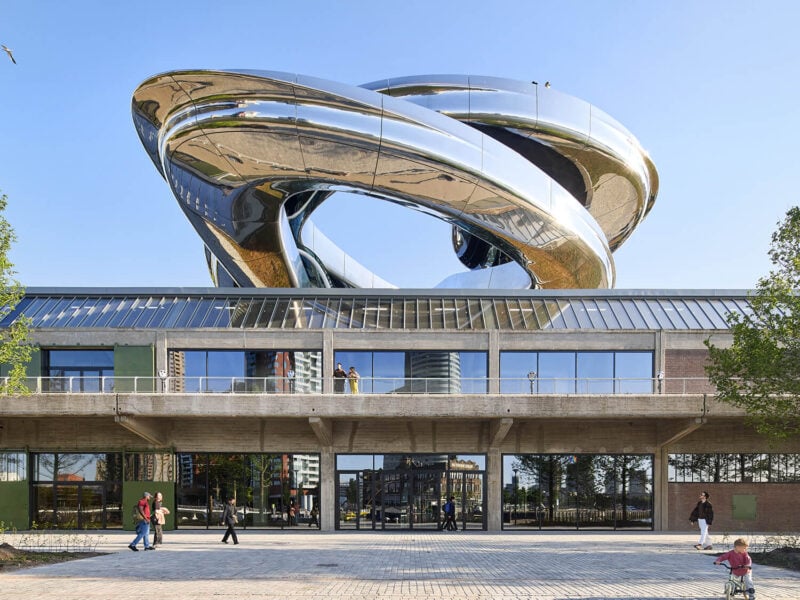
If traversing Carlo Ratti’s main exhibition, with its 750 participants, is akin to making your way through a synthetic tangle of forest, nourishing specimens here and there sustain the journey. Many take the amorphous shape of structures that appear techno-organic, seemingly rising from the earth and genetically modified along the way. Among them, Liminis is a torqued totem in 3D-printed ceramic bricks by Swedish studio Polymorf, an experiment in conjuring “living” buildings with deep resonance for people. Another is ARBOR.Pilae, a “cyborganic” architecture by Maria Kuptsova that uses machine learning to reverse engineer the properties of Venetian wood species into a carbon-sequestering simulacrum. “Biological data is extracted from living systems, processed through inorganic machine-learning algorithms and reintegrated into synthetic matter.” In the future, it seems to posit, a 3D-printed building might behave like a tree, but without the need for timber. Another material exploration, this one market-ready, is FRICKS, a malleable block made from construction waste infused with geopolymer.

Alongside these preternatural growths are more fully realized structures: Earthen Rituals, by the Natural Materials Lab at Columbia GSAPP, is a cylindrical building that resembles a tapestry, its earth-fibre modules imprinted with abstracted bitmaps “by an A.I. apparatus.” Tiny Penthouses by Hedwig Heinsman, meanwhile, is a whimsical idea for augmenting existing buildings with “urban fabrics based on principles of full circularity, adaptive architecture and community-driven design.” These urban fabrics are also 3D-printed — from recycled waste materials that can be “continuously shredded and reprinted” — and look like, well, anatomical sacs.
An antidote to these complexities is an easy-to-miss project: The Refreshing Square, a marble slab placed on the floor by architect Philippe Rahm, serves as a palate cleanser reminding us that the simplest solutions are often the best. Indeed, the most intriguing — and decidedly low-tech — architecture is Thai practitioner Boonserm Premthada’s arch erected with hand-pressed and sun-dried discs of elephant dung. At both the Venice Biennale and the Triennale di Milano, Premthada is presenting works as part of his nation’s Elephant World Project, which “seeks to centre humanity through its empathy towards other creatures.”

Here, we leave the main exhibition, which my colleague Stefan Novakovic covered in rich detail, capturing the abundance agenda at its heart, which promises “a sustainable and prosperous technological utopia.”
The most impressive material exploration, in fact, is happening in real time outside the main exhibition — and in the Canadian pavilion. Looking squarely into the future, “Picoplanktonics,” by Andrea Shin Ling and her Living Room Collective, displays two voluptuous scaffolds embedded with sediment structures infused with bacteria: “live Synechococcus PCC 7002, a species of picoplankton, that slowly strengthens the structures by consuming and storing atmospheric carbon dioxide, producing oxygen and minerals in the process.”

This presentation of a speculative material — audacious in its singular focus — is vibrant and sensorily engaging, its refreshing minty hues reinforcing the notion that something remarkable is growing here. Tended by caretakers who regularly spritz water on the lattices, “emphasizing care and stewardship as essential elements of the design,” the bacterial growths are fragile (they are already beginning to dissolve at the bottom in their shallow pools of water) but might one day evolve into natural cooling systems for our buildings.
More prosaic building stock — excavated rammed-earth blocks, concrete subfloor cut-outs and sediment piles — characterize the Danish pavilion, currently under renovation by curator and architect Søren Pihlmann. Build of Site embraces the opportunity to perform an audit of the structure’s makeup in a manifesto championing renovation and re-use. The disassembled structure resembles an archeological site, its floors stripped away to create cavernous spaces and doors and windows taken off their hinges and displayed like canvases — all waiting to be upcycled into a new design.

As the Danish building is being stripped down, the Swiss pavilion superimposes an additional structure, one inspired by the architecture of female architect Lisbeth Sachs, over the existing one by her contemporary Bruno Giacometti; the Nordic Countries Pavilions, meanwhile, deconstruct and reconstruct various spatial paradigms to better reflect the experiences of how trans people move through built spaces.

Perhaps the most compelling dematerialization is exemplified by the unravelling taking place in Serbia’s pavilion, where wall-mounted interpretations of the “Belgrade Hand,” the world’s first bionic hand, are unweaving an intricate, billowy textile that fills the entire building. It’s an effective testament to zero-waste, circular design — the wool will be returned to yarn — and a striking argument for adaptable structures.

Good, old-fashioned wood and rammed earth are the building blocks of the U.S. pavilion. Curated by Marlon Blackwell Architects, Stephen Burks Man Made, D.I.R.T. studio and TEN x TEN, Porch, the American contribution to the Biennale, reads as monumental — with its massive wooden structure of inverted gables and blue-painted ceiling — but its character, close up, is warm and inviting. The intervention, which does not touch the pavilion building, proffers a gregarious architecture: Below the canopy, the wood-plank platform atop a base made of Venetian clay hand-pressed into blocks forms a gathering place where kids play, dancers and bluegrass musicians entertain, and featured architects convene for talks.

Inside, a wall-mounted historical narrative of the American porch, from colonial times and slavery to the modern movement — and its adaptations in institutions that were modelled after homes, including churches, banks and saloons — charts the evolution of this distinctive typology and its role in negotiating the realms of inside and out, individual and collective. Models of works by 54 participating studios illustrate its myriad typologies, from public hubs like Studio Cadena’s Domino Square building to multi-unit residences like Williams Terrace, an affordable housing community in Charleston, South Carolina, by David Baker Architects. Some of these, including Brooks + Scarpa’s Canopies & Curiosities: An Architectural Wunderkammer, are presented in vignettes that riff on the slatted-wood structure of the outdoor canopy.

At a time when the U.S. government is forcefully deporting immigrants and shutting its doors to the outside world, the American pavilion feels like a bittersweet gesture of generosity. The politics of the day tinges perspective: How can something so seemingly anodyne — the porch, a mainstay of single-family homes in both the U.S. and Canada — be made to feel radical?
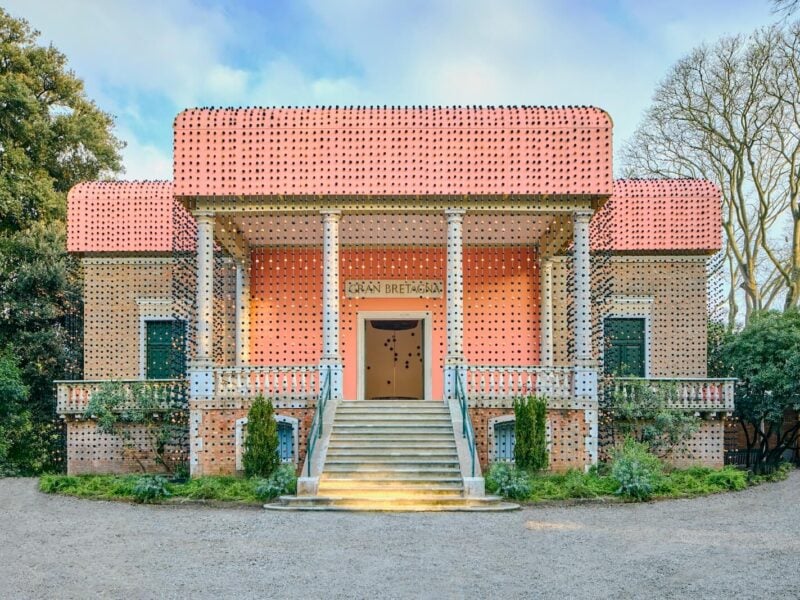
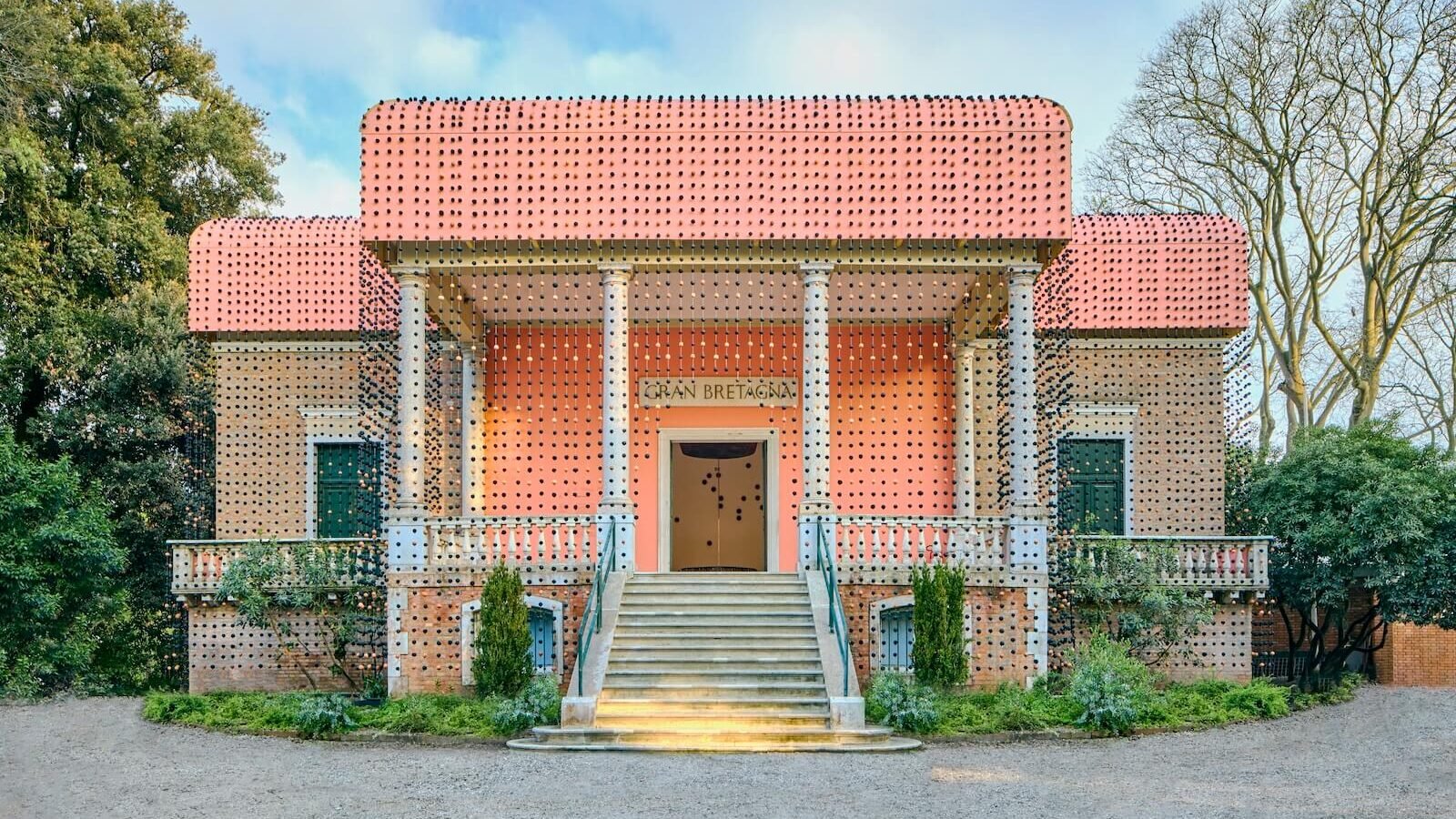
If Porch mines American history to contextualize how the architectural threshold between private and public has morphed through various eras, the British exhibition delves into its legacy as a colonizer to bridge the distance between then and now. Geology of Britannic Repair takes as a point of departure the British pavilion’s “pivotal alignment along an axis that runs between Britain to the northwest and Kenya and the Great Rift Valley to the southeast.” The building is draped in a beadwork veil, Double Vision, made with agricultural waste briquettes and clay and glass beads, and inspired by Maasai and Murano traditions (image, top of article). Inside, each room is given over to an installation. In one, there is a fascinating cast bronze sculpture of a Kenyan Rift Valley cave, a site known locally as the “baboon parliament.”

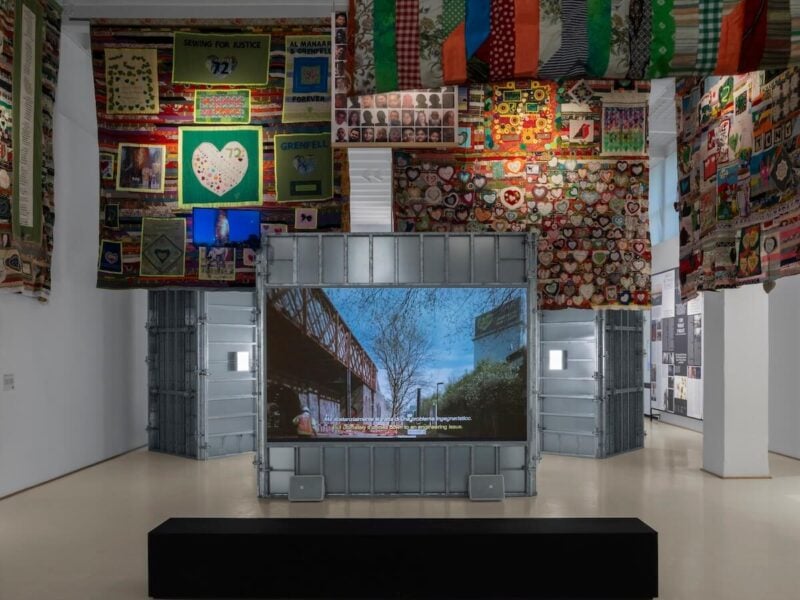
In another, Yara Sharif, Nasser Golzari and Murray Fraser of the Palestine Regeneration Team present Objects of Repair, their ongoing initiative that explores methods for reconstructing buildings across Palestine, including Gaza. This praiseworthy undertaking “looks to the potential of re-using salvaged materials in rebuilding what has been lost to create new architectural skins that incorporate the scars of trauma.” The construction systems, at once rudimentary and sophisticated, attest to the resilience of Palestinians, who must rebuild after every siege. What happens when everything is obliterated? Can a people keep rising up from the rubble? Sharif, who was born in the West Bank, has lost 54 members of her family over the past two years. In the rubble, she and her team see a vital lifeline, a resource that is both an endlessly pragmatic material and a symbol of struggle and perseverance.
Let’s set aside the performative robots. At the 19th Venice Architectural Biennale, the most fertile intelligence is wielded by the people.
The 19th Venice Architectural Biennale runs until November 23, 2025
What Deserves Attention at the 19th Venice Architecture Biennale
Natural, synthetic and hybrid building systems, new and old technologies, futuristic leaps forward and resilience on the ground: The 19th Venice Architectural Biennale presents worlds of possibilities.