
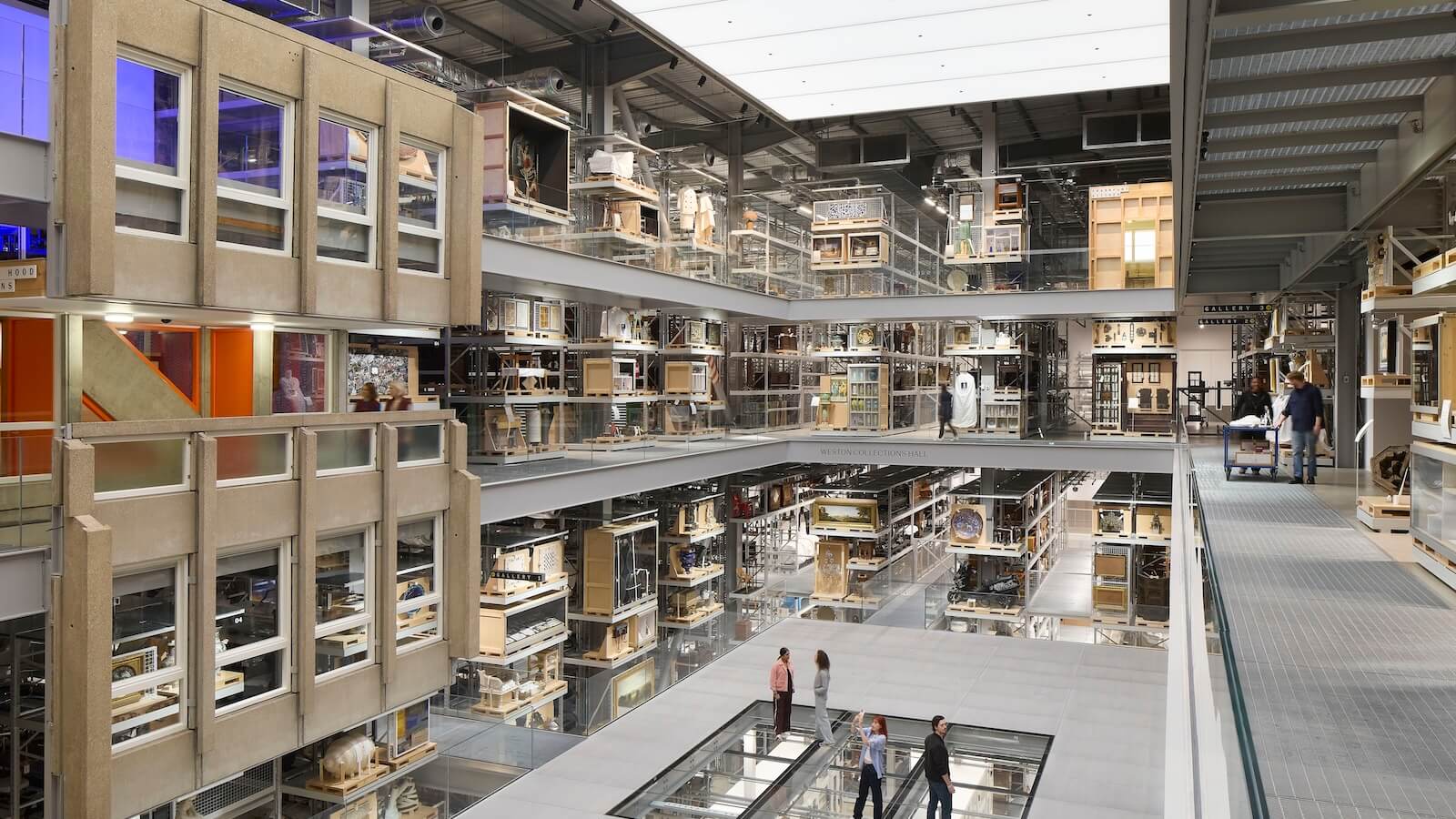
The V&A East Storehouse in East London, situated in a long warehouse building that served as the London 2012 Olympics Media Centre, is a beguiling beast. With its soaring 20-metre-high central Weston Collections Hall and its dazzling storeys of racked storage bookended by wide sociable walkways with see through glass balustrades, it is a 21st-century temple to artifacts. “Metaphorically, the idea was about fitting as much stuff into that package as possible and then coring out the middle, almost like a geological material, so you can see a cross-section of everything,” explains Elizabeth Diller, co-founder of Diller Scofidio + Renfro, the New York–based architecture firm behind the new museum’s design.
The architects and museum technical services team “leaned into the eclecticism” of the V&A’s collection and turned the 16,000-square-metre storage facility into an “immersive experience.” The artifacts, many within reach on the racks, range wildly and excitingly in geographical provenance, era, form and scale. You are as likely to come across a collection of thimbles as an original Frankfurt kitchen by Austrian architect Margarete Schütte-Lihotzky; the latter is wrapped in a timber-panel exterior that underlines the artifice of the decontextualized setting but allows (through two cut-out doors) an intimate and forensic look inside the modernist 1920s relic.

This is architectural — and museum — theatre at its finest, but it’s much more than that. The idea for the V&A East Storehouse grew, in part, out of a desire to address the “classic problem of collections in large institutions — namely, that only around one per cent of your collection can ever be shown at any given time,” explains Brendan Cormier, chief curator of V&A East at the Victoria and Albert Museum. “And what does this mean in the context of a national collection that belongs to the public? And how can we inch closer towards full access of our collections?”
Embracing visible storage and putting some of the more than 250,000 objects, 350,000 library books and 1,000 archives housed therein on display is one way. The museum’s quietly audacious seven-day-a-week “Order an Object” service is another; it allows the general public to browse over half a million of the museum’s works online and select up to five items to view in person in one of the study rooms on Level 2. It’s an enormous, generous and staff-intensive enterprise, says Diller, and “a beautiful thing because you don’t have to be a scholar, you don’t have to demonstrate a need, you just have to want to see five artifacts.”

Presenting work in innovative — almost transgressive — ways is part of a multi-pronged attempt by the V&A (which is also opening the nearby V&A East Museum, designed by Dublin-based O’Donnell + Tuomey, in 2026) to engage young people 16 to 24 years old, and to introduce audiences to the world of applied arts and material culture. Contrary to what one might expect given its youth remit, V&A East Storehouse is not overtly digital or high-tech (though you can use your phone to find more information on the objects). And purposely so. The antidote to being “terminally online,” as Cormier calls it, is offering an “interesting space and an interesting experience.”
This seems to reflect a global trend: Although there are notable exceptions — Dataland, the first “museum of A.I. arts,” is due to open in late 2025 in Los Angeles — most new or renovated museums hesitate to go all in on technology in appealing to younger people brought up on screens, which might seem counterintuitive after COVID-19. “I think the big question on everyone’s lips post-pandemic was, Do we even need a building?” says Kaarina Gould, CEO of the Foundation for the Finnish Museum of Architecture and Design, which is scheduled to open its new waterfront museum in Helsinki in 2030.

“But a big role of cultural institutions is to offer places that bring different groups together and facilitate friction and diminish polarization in society by introducing them to different viewpoints.” How can design play a role in this? And how can it appeal to more diverse groups, allowing people with disabilities or of various socio-economic and ethnic backgrounds to all feel welcome? The Amos Rex art museum in Helsinki, which has cleverly used its quirky and unusual design by JKMM Architects to help attract younger visitors (its mound-like roof lights create a whimsical urban square for art and play), has also created a step-by-step guide for autistic visitors. Gould says the future architecture and design museum in the Finnish capital has already hired consultants to look at the acoustics of the building, even though they are still only in the competition stage. “In a lot of museums, the audio landscape is really chaotic and causes a lot of discomfort and stress for visitors — not only those with disabilities but also visitors with high sensitivity to sound.”

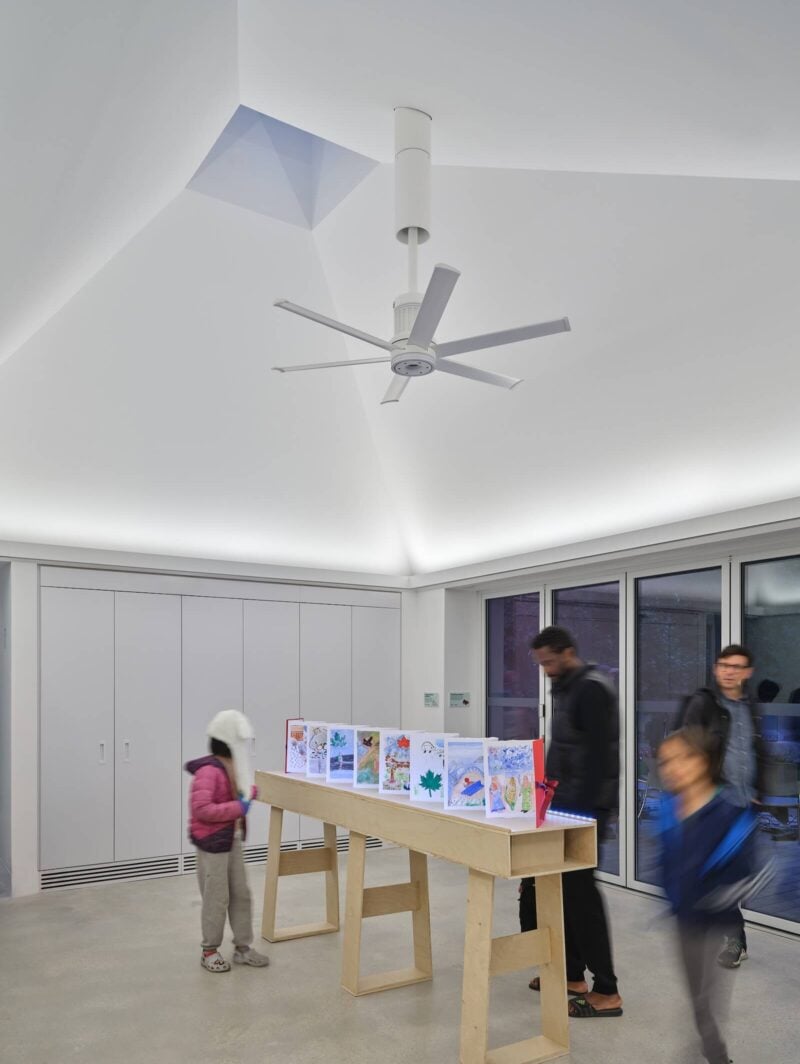
In 2024, the Natural History Museum in London transformed the underused two hectares of gardens outside its buildings into a series of outdoor “living” galleries by landscape architecture studio J&L Gibbons. Free to enter, this accessible oasis of urban nature and biodiversity can form part of a wider museum visit or just be a stand-alone experience in itself. Architecture firm Feilden Fowles created two new timber and stone buildings for the project — a Nature Activity Centre (supported by AWS) and the Garden Kitchen and café — that nestle into the landscape and are a case study in sustainable materials and practices (the Nature Activity Centre, for instance, has no gutters or drainpipes, but rather large eave overhangs where the water is collected in drainage channels that filter into planted areas).
“There is a real interest in trying to expand museums into the open space around them,” says Edmund Fowles, director and co-founder of the practice. “It’s about trying to break down the barrier of quite formal institutions, some of which have a colonial or pompous feel to them. Trying to bring some of the art and the learning outdoors breaks down that threshold.” Many museums are similarly connecting to the civic realm in a bid to reach visitors with more than just engaging collections.

The revamped London Museum, which is due to open (the first part at least) in 2026 in the city’s iconic former Smithfield Market will feature a public space at its heart. “The general market is about the size of Oxford Circus and is a place for exhibitions and events — and a place to come and be and sit and talk that is open and free to the public all day,” says Asif Khan, part of the architectural team alongside London practice Stanton Williams and conservation architect Julian Harrap Architects.
Part of this project will see the many original shopfronts along the Victorian market building renovated and adapted for use by both the museum and its invited partner institutions, which could include independent retailers, charities, music studios and local brands. “The façade will be a working part of the city — something unprecedented for a city museum, if you think about it,” says Khan. There will be a café that will be open early and venues that stay open late — different levels of participation that, Khan says, allow you to “put your foot in the water first and see if that institution might have something of value to offer you.” This approach goes some way toward addressing the feeling many people have that museums are “spaces that they don’t feel welcome in or will get anything from.”
It’s something of a departure from the Guggenheim-effect wishful thinking that churned out flashy architecture at the turn of the millennium. “In the past,” Fowles says, “the emphasis was on the starchitect designing an iconic museum building and that being the draw, but we’ve moved past that.” Big-name firms are still undeniably a major path to attracting visitors for many institutions, and many are on the way: the Met’s new wing by Frida Escobedo (due to open in 2030), Fondation Cartier’s overhaul of a mid-19th-century building in Paris by Jean Nouvel (opening in October), the British Museum’s upgraded Western Range galleries by Lina Ghotmeh (no opening date yet), LACMA’s David Geffen Galleries by Peter Zumthor and the new Guggenheim by Frank Gehry in Abu Dhabi (both are due to complete in 2026).

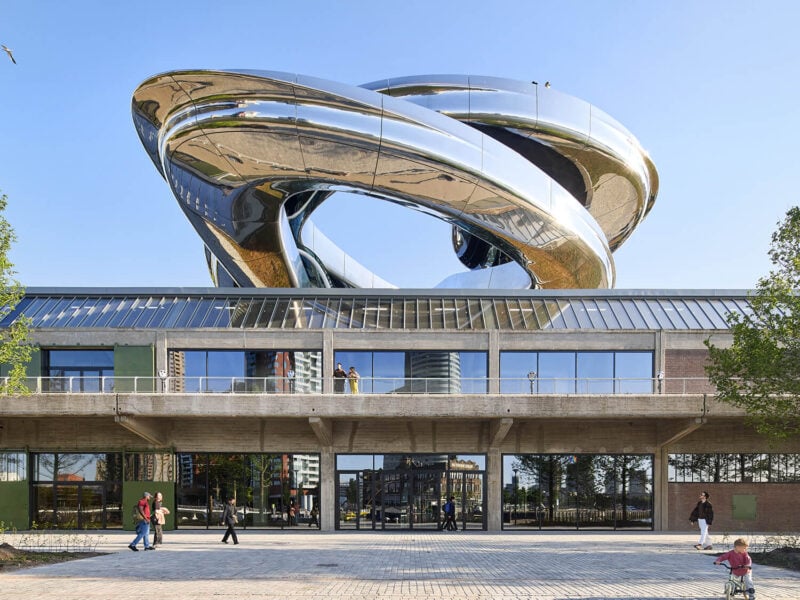
The focus even in these high-profile projects, however, has arguably shifted to more thoughtful design and refurbishments, rather than monolithic or statement pieces, providing, as in the case of the redesigned Tang Wing at the Met, an opportunity to improve accessibility, infrastructure and sustainability rather than just create a showy new structure. The recently opened Fenix art museum in Rotterdam, which is dedicated to migration, is an unexpectedly good example of this shift in focus. Yes, it features a stainless steel double-helix staircase and panoramic rooftop platform designed by Beijing-based MAD Architects — absolutely an “icon” or folly intended to lure people in and “bring us from the past into the future,” according to Fenix director Anne Kremers — but, for the most part, the museum is a very well-executed refurb of a beautiful historic warehouse, an adaptive re-use of a building like V&A East Storehouse.
If the design of museums is finally centring greater accessibility and equity, the politics surrounding these values are becoming outright hostile. It’s a troubling paradox that threatens the very financial security of these institutions: Despite the dozen-plus major museum openings or expansions in the works, funding and budgets for museums have been in free fall for years across the Western world, and cultural institutions are now political footballs. Stateside, amid a clamping down on diversity, equity and inclusion programs and free speech, the Trump administration has targeted through executive order the Washington-based Smithsonian Institution’s network of museums, for example, with the aim of purging “improper ideology” — an Orwellian term if ever there was one. It has also gutted the National Endowment for the Humanities, where 65 per cent of jobs were cut and more than 1,200 cultural grants were cancelled nationwide.

“It’s a very sensitive issue,” says Diller, “as our work is really affected by the policy-making of the White House, from tariffs on architectural and building materials and the cost of things to the cutting of grants or curtailing of the ability of cultural and educational institutions to do things openly.” America’s image problem abroad is greatly reducing visitor numbers and tourism all on its own, she says. “This has a big effect on museums, and that’s not good because we’re very dependent on box office.”

What can museums do to become more resilient? “I think one thing that can be helpful is being as transparent as possible around your collections and operating practices,” says Cormier. “We always run the risk of being framed as elitists by the far right, and I think part of that negative framing comes out of a lack of transparency. A political outcome of what the V&A East Storehouse does through its design is render visible the amount of work that goes into maintaining and running a national collection, creating a value system around museums.” Granting free access, which the U.K. has done for national museums since 2001, is another way of reinforcing that value system. “It’s one of the most successful policies in culture anywhere in the world in the last 100 years,” Cormier says, “because people brought up with fond memories of museum spaces will want to make sure they exist in the future.”

Khan, who is working on two other cultural projects of note aside from the London Museum (the Tselinny Center of Contemporary Culture in Almaty, Kazakhstan, and the Museum of the Incense Road in AlUla, Saudi Arabia) contends that there may also be an argument for a model that turns away from endless growth and expansion. “I think the museum sector is at a challenging point where there is a conflation of the idea of ‘improvement’ and ‘renewal’ with growth,” he says.
He invokes smaller, slower or more holistic experiences where the “content and architecture speak to each other and the scenography and sequence of your visit have been thought about” in a more powerful and effective manner — places like The Feuerle Collection in Berlin (set in a former Second World War telecom bunker renovated by John Pawson and housing early imperial Chinese furniture alongside international contemporary art) and Naoshima Island, where you can sleep among artworks and stay in a Tadao Ando–designed hotel that is also a museum. Ultimately, he says, instead of focusing on how many visitors a museum gets every year, shouldn’t we be asking “How can the places we visit transform us?” To do that, the museum of the future may have to work even harder.
The Show Must Go On: The Future of Museums
At a time when cultural institutions are under threat, V&A East Storehouse, Fenix in Rotterdam, London Museum and other cultural projects around the world are staging a daring new act.