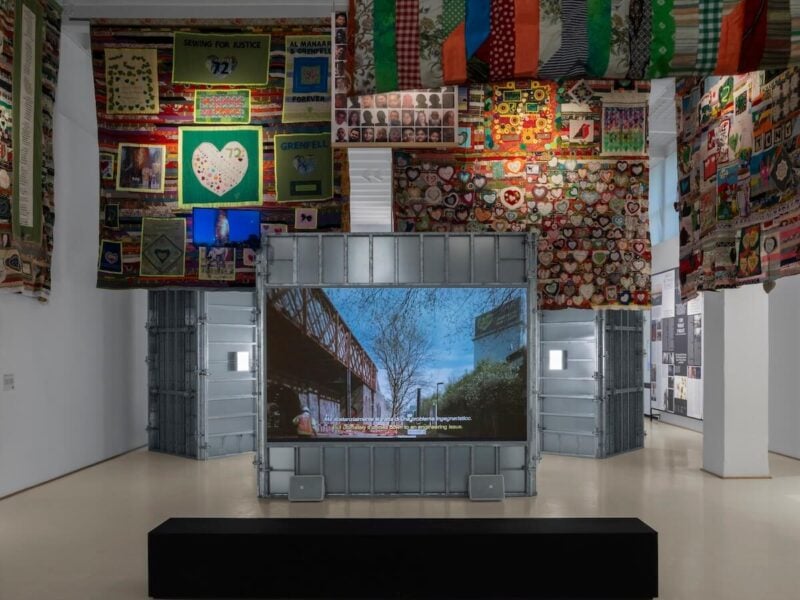

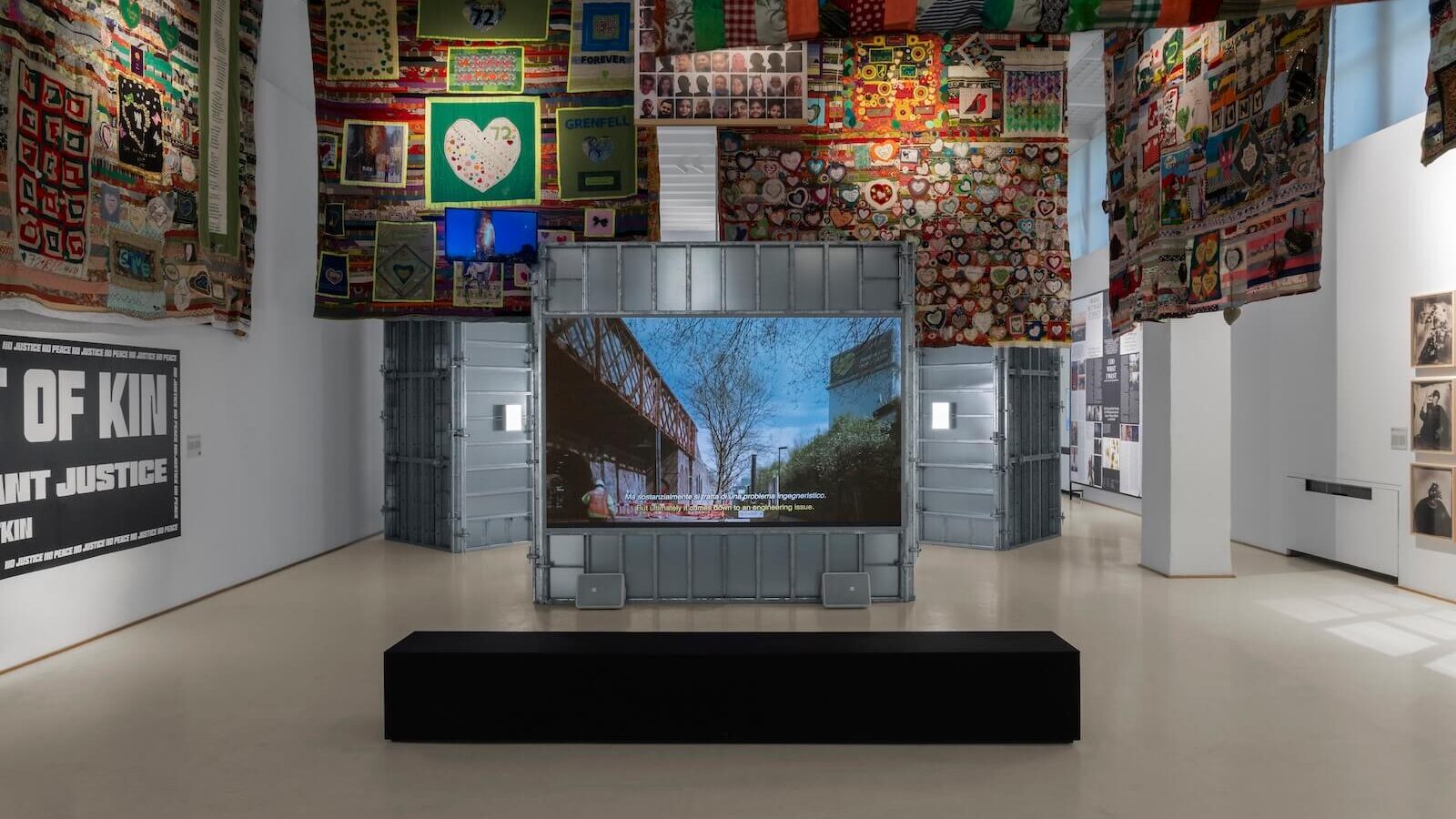
One of the first installations you will encounter at the Triennale di Milano is Grenfell Tower: Total System Failure. It’s an apt title for the horrific tragedy that unfolded in the early hours of June 14, 2017, when a fire engulfed a council housing tower in London, U.K., killing 72 people. From the bottom up, an evil brew of forces beyond the control of residents seemed to have converged to foment the disaster, from the value-engineered building renewal project to the catastrophic municipal fire policy to the abdication of responsibility by all in positions of power when it came time to support survivors.
The tower’s aluminum composite cladding, a low-cost retrofit meant to redeem the concrete “eyesore” in well-to-do Kensington, spread the fire up the building in an astonishingly short time. Meanwhile, the London Fire Brigade, responding to increasingly panicked callers, parroted the “stay put” mantra — an official policy informing residents of high-rises that they are safe to remain inside during a fire. When the flames were finally extinguished, and survivors were left scrambling to identify the missing and find shelter, their tenant management organization and politicians left them to fend for themselves. In the aftermath, many residents felt that their working-class status had something to do with this systemic negligence. Would a more affluent group have been so ignored? At the Triennale, the community, still fighting for restitution, is represented by the organization Grenfell Next of Kin, which has installed a documentary and videos of the fire as well as memorial quilts crafted by some of its members.

With a broad theme that could be laid over any situation on Earth, “Inequalities” is a lot to take in. (“We are all born unequal — all of us,” Triennale president Stefano Boeri told the pre-opening audience, reciting from his vision statement a phrase slightly nonsensical considering that “we” are “unequal” in relation to one another and not individually so. Touring Sheikha Al-Mayassa bint Hamad bin Khalifa Al Thani, the Qatari royal and generous arts patron, through the exhibition’s opening surrounded by bodyguards, Boeri tinged his words with unintentional Orwellian irony.) For the same reason, “inequalities” is a worthy lens to wrap around an exhibition that seeks to capture the times we’re living in, at scales from the urban to the microscopic. The Grenfell Tower installation is a special project within the sub-theme of Cities, curated by Nina Bassoli, which balances stark realities with optimistic visions.
In another special project, this one in the cavernous alcove behind the gift shop, I watched what seemed to me to be a kin of Grenfell Tower; Radio Ballads, commissioned by London’s Serpentine Galleries, is a film series about the labour of caregiving in the boroughs of Barking and Dagenham from 2019 to 2023, which combines interviews with residents and performance pieces co-created with artists. The project explores how “creative collaboration can open up new spaces to process experiences of mind–body health, domestic abuse, terminal illness, grief and end-of-life care, and to generate interdependence and collective healing.” The working-class people centred in these films, including a woman looking after her husband with mesothelioma, do unseen, inadequately compensated labour every day as institutional systems of care break down around them.

The curatorial statement for Cities asks, “What can urban planning and architecture do to restore a balance between inhabitants, cities and opportunities?” It goes on to state that the exhibition’s aim is “to propose an alternative vision of development — one that departs from traditional economic and geopolitical analyses of inequality — and to suggest unexpected pathways for growth.” Amid the dissolution of societal institutions, as Grenfell Tower and Radio Ballads both show, people will necessarily form their own local networks to fill in the gaps. This is beautiful, but it’s not enough. HouseEurope!, another featured project in Cities, is attempting to bridge grassroots and governance. At this point, the activist campaign led in part by Berlin firm Bplus.xyz is gathering votes from EU citizens — we will soon see if it results in new legislation to incentivize the renovation and adaptive re-use of building stock over demolition and redevelopment.

Mostly, the projects in Cities visualize the current reality or present site-specific interventions — all commendable — without consolidating a “vision.” Interboro’s The Arsenal of Exclusion & Inclusion provides a map and a taxonomy of ways that cities enforce unwritten rules about how we can — and mostly cannot — behave in public space. Michael Maltzan Architecture’s multimedia Los Angeles on Fire seeks to illustrate the socio-economic disparities among the Los Angeles enclaves charred by the fires of January 2025. People’s Architecture Office’s Plugin homes in China and the U.S. and Kazuyo Sejima’s transformation of Inujima into an art island are inspiring yet rarified approaches to adapting sites marred by forces of de-urbanization.

The other sections of the Triennale explore “inequalities” in various intriguing ways that seem to deviate further from the theme. Towards a More Equal Future is mostly a showcase for innovations by the Norman Foster Foundation that, while boundary-pushing, feel somewhat loftier than what is called for. Clay Corpus, by Theaster Gates, is a cabinet of curiosities filled with the pottery of Yoshihiro Koide, a Japanese artisan whose work Gates now stewards, that wraps around Ettore Sottsass’s permanent installation Casa Lana. Speaking to the theme of humble craft — the “power, dignity and humanity of everyday objects” — it’s definitely a stretch. But it’s enchanting. We the Bacteria: Notes Toward Biotic Architecture, curated by Beatriz Colomina and Mark Wigley, is also a worthy detour.

If we think of bacteria through the lens of inequality, we can perceive how architecture has facilitated our ongoing battle against infection — and our obsession with cleanliness — and thus the rise of antibiotic-resistant diseases, which will in turn ravage the most vulnerable. A vibrant tower of detergent bottles sets the scene for the exhibition, which also includes a historic overview of our understanding of bacteria, first through microscopes and then through our built environments, with futuristic proposals for how we might better coexist with micro-organisms. And then there are the national participants, among which Lebanon’s and from my heart I blow kisses to the sea and houses deserves special mention (and won a Triennale award). It tells the story of an elderly man fighting to safeguard his coastal house, which dates from the late 1920s, from developers preying on the disenfranchised after the massive port explosion in 2020.

“And we will talk about Gaza.” Boeri’s words sounded like a gambit, as if
to talk about Gaza is in itself risky business. It is. But more importantly, what will you say? There is much overlap among the participants of the Venice Biennale and Milan’s Triennale, and the two shows — with their simpatico titles of Intelligens and Inequalities — can be read as companions. In Milan, there were two particularly compelling pieces related to Palestine. The first is in the garden of the Triennale: Tiamat, a narrow stone vault inspired by Arab arches and created by Bethlehem firm AAU ANASTAS, is a striking work of architecture, its stretched proportions and narrow opening conjuring a slightly claustrophobic volume.
The other, 471 Days, shrouds the staircase of the Triennale in a veil of red ribbons that descends from the ceiling to (sometimes) touch down on stacks of tiles. The lengths of the ribbons and the heights of the stacks are meant to visualize the deaths of Israelis and Palestinians on each day from the Hamas attack to the first and failed ceasefire. It feels much too aesthetic a conceit for something so horrific. But it’s paired with a display of satellite photos of destroyed sites annotated with memories that people have left on Google Reviews, TripAdvisor and Queering the Map. “A place where I kissed my first crush. Being gay in Gaza is hard but somehow it was fun”…“I’ve always imagined you and me sitting out in the sun, hand and hand, free at last. We spoke of all the places we would go if we could. Yet you are gone now.” This is stirring, heartbreaking.

The representation of Palestine in both Venice and Milan made me wonder what would shake the visitor out of their role as observer. When we are all witnessing this devastation unfold daily, as we scroll through indelible images of suffering, what can a design and architecture exhibition really say that can compete with our screens? The Palestine Regeneration Team, participating in the British Pavilion in Venice, stands out for its work on the ground, for persisting in the right to rebuild with what is left in those satellite-captured landscapes of erasure shown in 471 Days. But how can we take what we’ve learned and apply our own agency? We have so far failed Gaza both collectively and individually: We watch in real time, anticipating how the future will judge us.
Chasmic inequity is exacerbated when governments disinvest from the will of the people and from the social safety net — that capitalist bogeyman the “welfare state” — in favour of shoring up concentrated wealth. We are in a global gilded age. Should we fight to reinforce our collective institutions, or should we merely labour to fill the gaps? Clearly, we need to do both. The intrinsic value of biennials and triennials lies in gathering mind-expanding works from around the world in one place — but could these blockbuster shows deliver more clarity? Could they put forth real directions (and not necessarily new ones) for how to move forward as a society, and with systemic as well as grassroots approaches? Where do we go from here?
Top image: In the Cities component of “Inequalities,” at the Triennale di Milano, Grenfell Tower: Total System Failure, by Grenfell Next of Kin, presents a documentary about the fire that ravaged a council housing tower in London, and quilts made in honour of those lost in the tragedy. Photo by Alessandro Saletta e Agnese Bedini – DSL Studio
Inequalities continues at the Triennale di Milano until November 9, 2025
Triennale di Milano Puts Global Inequalities in the Spotlight
Stark realities and glimpses of optimism commingle in the wide-ranging exhibition, with curation by Hans Ulrich Obrist, Beatriz Colomina, Theaster Gates and numerous other major design and art talents.