
Canada’s most populous city is also home to one of the country’s largest Indigenous populations. Yet until recently, Toronto lacked a dedicated, purpose-built Indigenous health centre — a safe, welcoming space where care could be provided to communities historically marginalized, and often mistreated, by colonial medical systems. The new Indigenous Community Health Centre (ICHC) marks a long-overdue shift. The 4,000-square metre, four-storey building, operated by the Indigenous led organization Anishnawbe Health Toronto (AHT), blends traditional healing spaces — such as a sweat lodge and a healing garden — with rooms for Western medical services, including offices for physicians, physiotherapists, psychologists and psychiatrists.

Every detail was designed to reflect Indigenous values and world views. “The atrium of the Health Centre faces east,” says Matthew Hickey, an architect with Two Row, the Indigenous-owned firm that co-designed the building with Stantec. “That’s the direction of birth, the direction where the sun rises.” The building’s perforated aluminum cladding, he adds, evokes a traditional Indigenous dancer’s shawl, complete with a stainless-steel fringe that wraps around the entire facade. The feature is enchanting, especially at night, when it is illuminated by rainbow-hued lights. Its effect is layered, delighting the senses of all passersby and touching the soul of those who know the symbolism. “There are around 12,000 metal strands in that fringe,” notes Michael Moxam, vice president of architecture at Stantec. “They move with the wind, creating both a sound and a dynamic visual effect. Most buildings don’t have elements that respond to the environment in that way.”
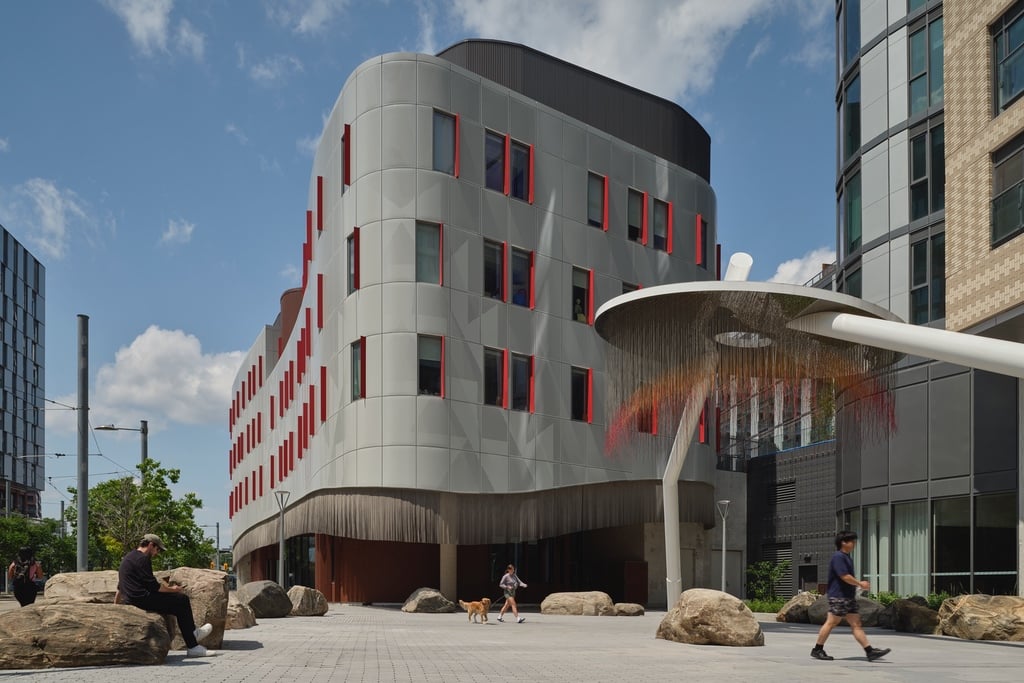
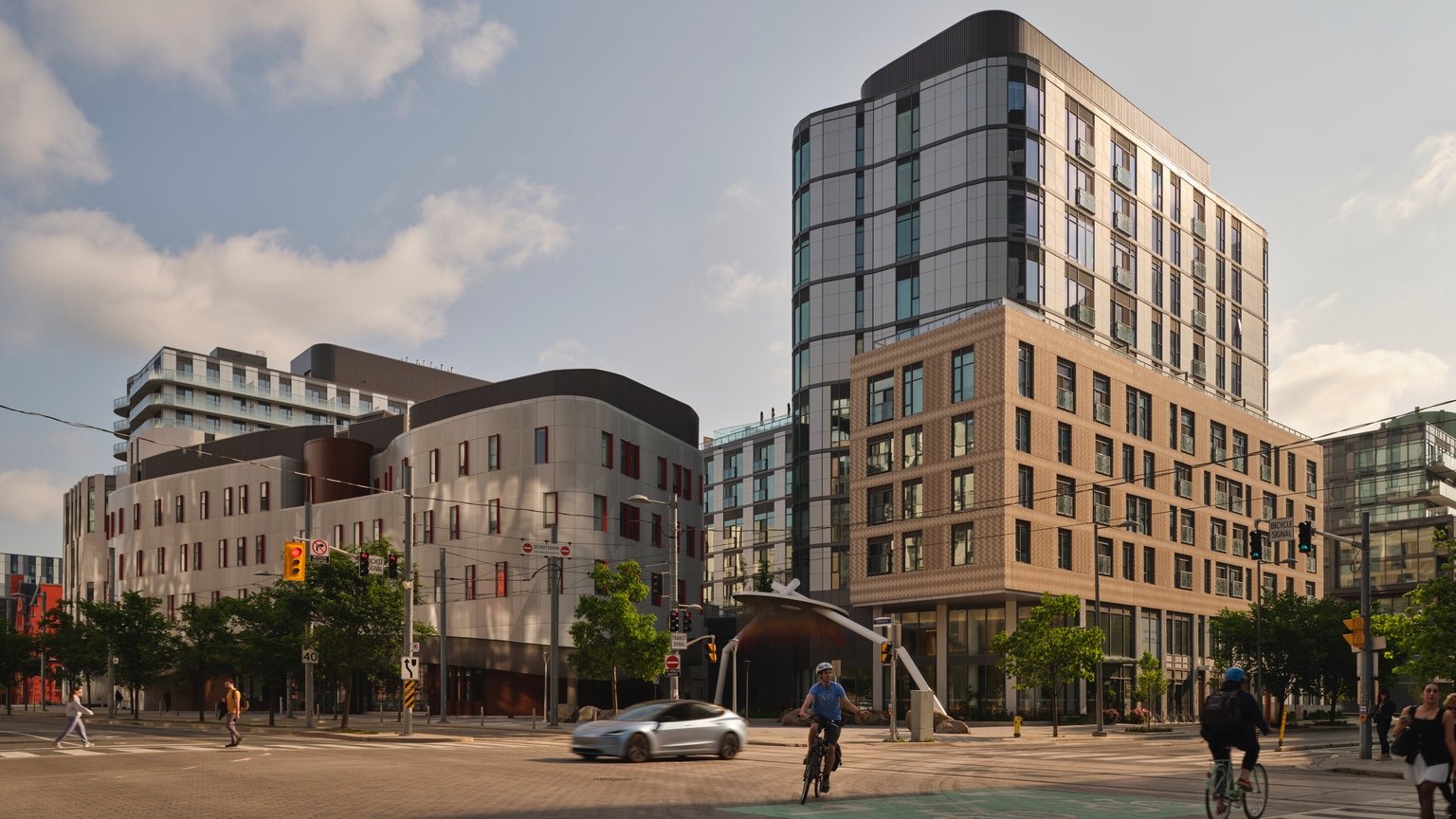
The ICHC is what Hickey calls “the pearl in the oyster” of a larger development known as the Indigenous Hub, which now occupies an entire downtown block. In addition to the Health Centre, Toronto’s Indigenous Hub includes two adjoining residential towers, a public square, and a training and education centre. Two Row collaborated with BDP Quadrangle on the design of the other buildings in the complex. A decade ago, the one-hectare site was part of the 2015 Pan Am Games Athletes’ Village. Around that time, the province of Ontario offered AHT land for a new, purpose-built health centre — a dream long championed by then–executive director Joe Hester, who passed away earlier this year. Leasing part of the site for housing would ensure that AHT also maintains a healthy operating budget. “Once the province agreed to allow residential uses and AHT selected Dream Unlimited/Kilmer Group/Tricon Residential as their development partner, the project was able to proceed,” says Les Klein, a principal, co-founder and studio head of BDP Quadrangle.

The additional buildings continue to emphasize Indigenous values. All structures feature green roofs with soil beds up to 1.2 metres deep. Planted with native species — many of them herbs and sweet grasses used in traditional ceremonies — these roofs help collect and re-use rainwater for irrigation. (“Instead of phrases like ‘stormwater management,’ I prefer to talk about celebrating the rainwater,” says Hickey. “I believe that makes a difference in how we conceive of sustainability.”)

All aesthetic choices across the site were made with deep cultural sensitivity. Works by contemporary Indigenous artists, including Joseph Sagaj and Christi Belcourt, are integrated throughout. The use of brick —extremely common in Toronto and the surrounding neighbourhood — was given much consideration. “Brick is a highly colonial material,” Hickey explains, pointing out that it was often used for residential schools, government-run institutions intended to erase Indigenous identity. “For the Indigenous Hub, the brick doesn’t look anything like what you’d find on, say, a Victorian building,”he says. “It’s patterned to resemble traditional basket weaving, and it floats above a glass band, which is in itself unique. We did everything we could to make it distinct — to make it our own.”
COMMUNITY DEVELOPMENT
The one-hectare Indigenous Hub was carefully designed to reflect the culture, values and resilience of Canada’s First Nations, Métis and Inuit populations. Here are the key elements that make up this inclusive new neighbourhood:

- At its heart is the 4,000-square-metre Indigenous Community Health Centre, where traditional healers work side by side with Western medical professionals to provide culturally safe care.

- The central courtyard features a healing garden with a walking path surrounded by native plants. Tobacco, sage, cedar and sweetgrass — all essential to Indigenous healing — are grown here.

- On the site’s northern edge, the Training, Education and Employment Centre, operated by Miziwe Biik, offers job training, education programs and childcare. Its precast concrete facade is textured to resemble birch bark, a material with deep cultural significance. Next to it, an industrial-era heritage building has been restored and repurposed as a commercial centre in collaboration with ERA Architects.

- Two residential mid-rises, standing 13 and 11 storeys tall, are joined by a continuous eight-storey podium and contain approximately 400 housing units. The third to sixth floors of the southwestern tower are clad in brick patterned after Indigenous weaving.
Toronto’s Indigenous Hub Has Healing Powers
Indigenous values shape the design of an entire city block in downtown Toronto, anchored by a wellness centre that moves with the wind.