


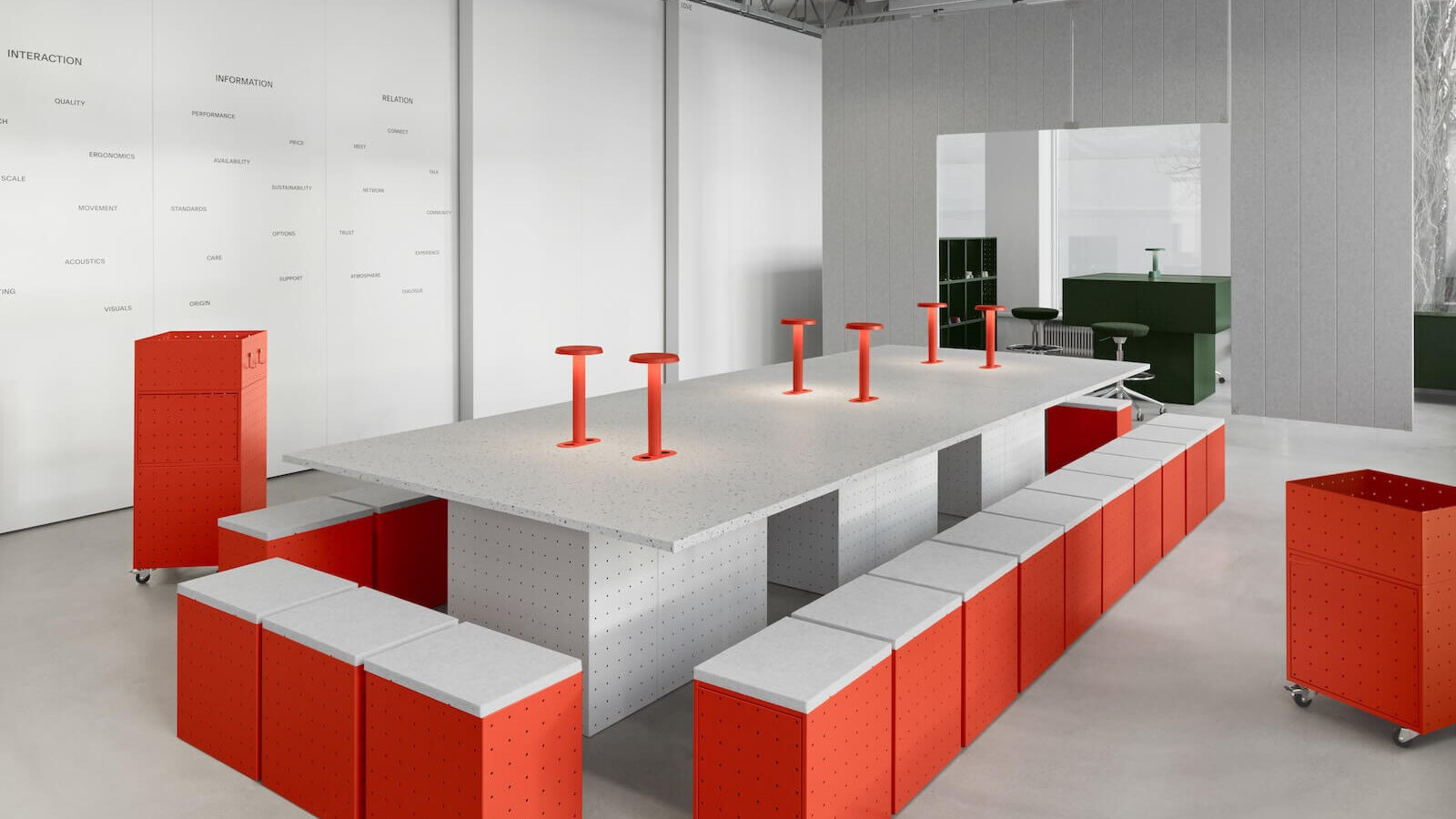
Inside Form Us With Love’s showroom in Stockholm, people are busy trying out the furniture on display. There are stools made from perforated sheet-metal boxes, flexible office storage designed for String Furniture, lamps that also function as charging stations for Forming Function and suspended felt panels for BAUX, as well as the studio’s first-ever textile collaboration with Byborre. This latest project resulted in a bespoke 3D-knitted upholstery for the Savo Spine chair, along with a knitted poster displayed in the large window facing frozen Riddarfjärden, the easternmost bay of Lake Mälaren. The tables custom-created for the exhibition are made of leftover MDF material and covered in flooring by Tarkett, sparking a conversation about how materials can be creatively re-used.

FUWL took over the lease of the 200-square-metre showroom at the beginning of the COVID-19 pandemic; it’s a large space, so they knew they wanted to activate it. For three years running, they’ve been doing so with “Testing Grounds,” an exhibition curated around a specific theme. In 2025, under the theme “Bistro,” it centred on gathering and sharing ideas, with products focused on work, leisure and hospitality; this year, “Showroom?” explores how design may be experienced now and in the future. The role of the fair is a hot topic in Stockholm; the annual Stockholm Furniture Fair has been cancelled, to be reintroduced as a biennial event starting in 2027.

“It’s interesting to think about what it means for the future — what is a fair, what is a showroom?” asks FUWL co-founder Jonas Pettersson while stacking whipped cream into the fridge. Tonight, his team will serve hot shots (coffee augmented by Galliano liqueur and topped with cream) and host a talk session in collaboration with Studio Playground, a Stockholm- and Vilnius-based marketing agency and magazine publisher. “We have to gather and collaborate —that’s why hot shots are important.” (Fun fact: The hot shot was invented by a Swedish bartender named Bosse Bergström; Swedes celebrate HotShot Day every November.) By now, the studio has become as much a pro at throwing parties as it is at designing collections — even if it doesn’t want to be mischaracterized as party people. In fact, the highlight during Stockholm Design Week throughout the past decade used to be the “Form Us With Friends” parties.
Visitors to the showroom are now deciding where to place their green stickers. The exhibition features a live poll: a wall where visitors can rate what a showroom should represent. At the moment, “Connect” and“Network” seem to be the clear winners, but there are also options such as Inspiration” and “Sustainability.” Instead of a static exhibition where brands are lined up, the setting allows visitors to engage with the pieces, arranged in three different zones consisting of a workspace, a gathering area and a material library. Rather than limiting its run to Design Week, FUWL is keeping “Testing Grounds” open for four months filled with events and workshops. “It changes how people interact with design,” Pettersson says. “Next time you come here, it might look completely different. It’s also a slower way of experiencing design. Nothing here is new, only presented in new iterations — which also says something about how the design industry has changed.”


Form Us With Love was founded in 2005 by Pettersson, John Löfgren and Petrus Palmér (who later left to start Hem) while they were still in design school — Linnaeus University in Kalmar. It soon became clear that the trio shared a similar approach to design. They saw an opportunity to make real change through their work, and the school’s location in the middle of Småland, Sweden’s manufacturing centre, enabled them to receive practical support from local craftsmen. “Seeing skilled craftsmen at work really con-firmed our own desire to work hands-on with raw materials, and our belief that form should always follow function,” Pettersson says. Löfgren adds: “the small mechanical workshops welcomed us with open arms and were curious about what we could create together.”
Whether it’s about people, materials or contexts, Löfgren and Pettersson have continued that sense of curiosity. Early on, they started a trainee program and brought in designers from allover the world to gain new perspectives. By prioritizing experimentation in projects, the team sometimes takes detours to find new solutions. “When you have high ambitions — whether it’s doing something unfamiliar to the market or genuinely innovative, such as within materials, behaviour, or a product category — you need more resources than if you’re simply doing what’s always been done,” Löfgren explains. “This also means we have been able to fail. It’s been an incredible luxury.”


Next to the showroom, FUWL staff are busy working at their desks. In total, there are six employees, including an intern, making it a small but close-knit team. Their output is often highly practical and inspired by the materials they encounter while visiting factories. “Walking a factory floor and seeing the potential of what machines can do and what the material itself can become has always been relevant for us,” Löfgren says.
Always staying human-centric in its design approach, the studio has made it a mantra to evolve with the needs of each client. Still, they have created their own language that moves beyond Scandinavian minimalism; they embrace soft shapes, lots of colour and humour — but always centre functional qualities. Some of the studio’s most iconic products include Hood, a light source and sound barrier in one for ateljé Lyktan; the Unfold pendant for Muuto; and the stackable Janinge chair for IKEA. From the beginning, they have aimed for international brands — such as Cappellini, +Halle, Samsung and De Padova — but have also launched products born out of their own curiosity. They’ve made acoustic panels from felt normally used in ceilings (at “Showroom?,” the large X-Felt panels are hung floor-to-ceiling) and developed a sustainable alternative to liquid soap, for instance.

Most recently, they were looking for open and closed storage that could boost their workspace’s flexibility but couldn’t find anything suitable. To this end, they created the Center Center system, whose perforated cabinet doors reference the iconic workshop pegboards that have always captivated Löfgren and Pettersson. Whether used for storing tools, dividing a space or creating intimate rooms within rooms, Center Center has developed into a platform that can be endlessly adapted.
“Architects need to ask how they can create spaces that accommodate change, that don’t rely on fixed solutions that, once obsolete, have to be discarded,” says Pettersson, comparing Center Center to life-sized Lego. “The system makes it possible for companies to adapt, whether that means changes in staff numbers or in the business itself.”

Another recent project is a series of three public drinking fountains —designed as huge taps — at the iconic Stockholm landmark Slussen, which has been completely transformed. FUWL was selected from among other designers and artists invited to present proposals for new public works. “Partly, we managed to send a political signal to stop buying and serving bottled water. Swedish tap water is among the cleanest in the world, yet public access has been limited for years due to dismantled water fountains. Meanwhile, Swedes spend around 6 billion SEK annually on bottled water — equivalent to 6,000 truckloads a year. We want to encourage people to drink from these free, accessible fountains instead,” Löfgren says.

The project democratizes their design and makes it accessible to many people, as is also the case with Odger for IKEA, a click-lock assembly chair made from a post-industrial recycled wood–plastic composite.
As for the future, Löfgren hopes that the same sense of optimism that existed before the pandemic will return. “People used to compete in doing good. There isn’t much of that dialogue at the moment. Things are slow and it’s expensive to make a difference,” he says. “We were in a context where we were invited to create new materials. It’s like a wet blanket when the economy slows down: Now it’s back to fossil-based foam and bent metal because it’s certain to work at a low price. It’s been like that for quite a while, and I think that, as a studio, we are aiming for a different position — where it’s okay for things to squeak and go wrong for a while.”


According to Löfgren, the industry needs to talk less about the next chair or product. “Testing Grounds” is their way of contributing to that. “At the very least, we can raise a small flag for meeting up in person a bit more…under unstructured circumstances. It doesn’t have to be so damn organized.”
Form Us With Love Is Over the Status Quo
The Stockholm studio is not only reimagining furnishings — but also how they’re showcased.