


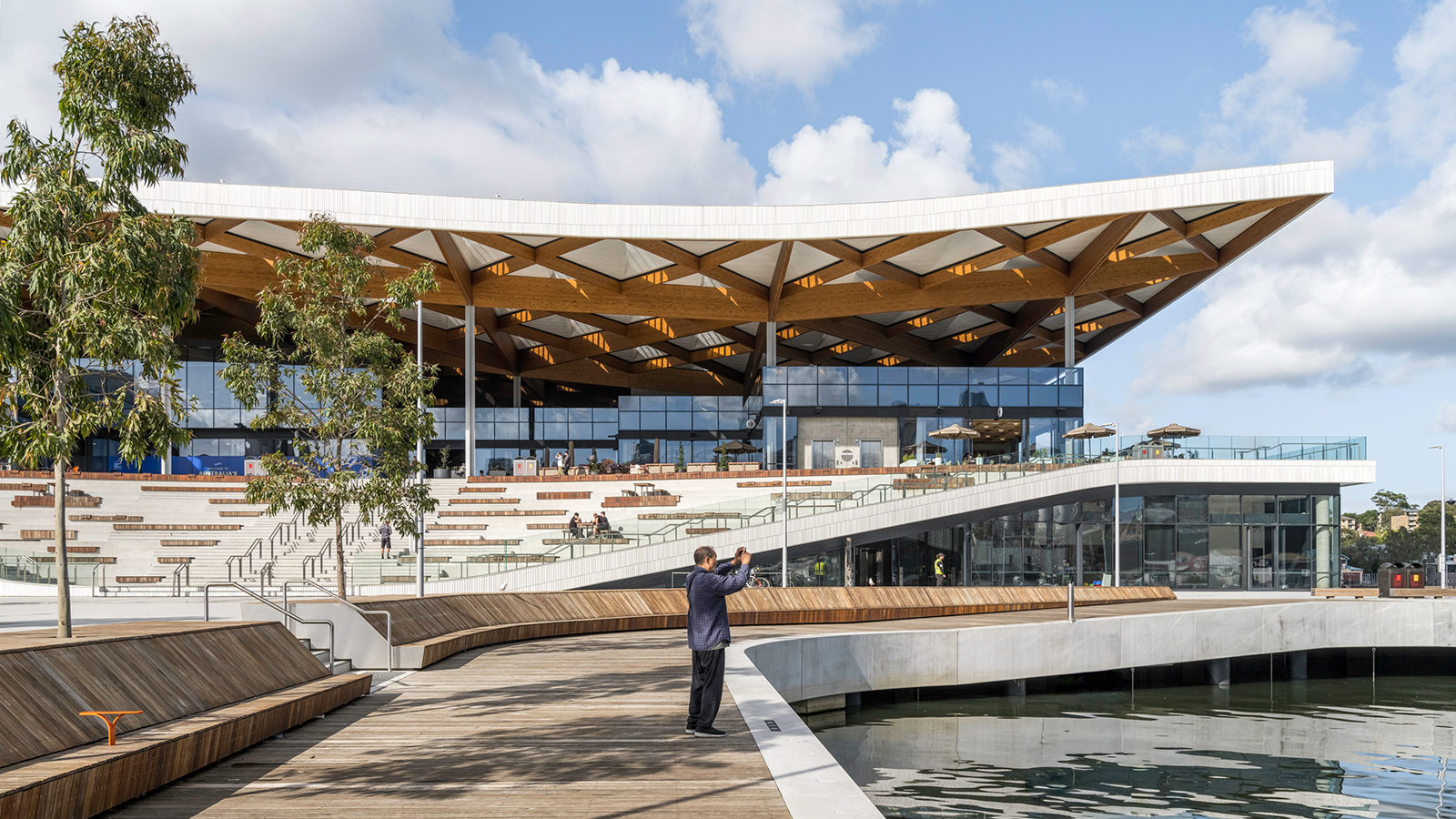
It’s 8:00 a.m. on opening day and the Sydney Fish Market is already packed. Wholesalers have been here for hours, since the building’s first auction began downstairs (more on that in a minute), and shoppers are now jostling to secure the freshest catch from the many options laid out on ice. Outside, people sip coffee on the terraced stairs, boats bob in the harbour and a jogger passes among the curious crowd taking photos of this new landmark. By lunchtime, the market will reach capacity and huge queues will start to form.

The architects are also here, breathing a sigh of relief after the enormous challenge of realizing a building of this scale and ambition. Danish studio 3XN first put its hat in the ring for this project nearly 10 years ago; it was already in Sydney designing a high-rise at Circular Quay when it won the competition in 2017. The final consortium includes 3XN (which now operates a Sydney office), its innovation arm GXN (which led on sustainability), BVN as executive architect and Aspect Studios as landscape architect. And the building is unequivocally a success.

Most striking is the roof, a 200-metre-long marvel that gets better from every angle. Despite its wavelike shape — two portions drop down, achieving a more intimate scale while also draining rainwater for harvesting — the structure is composed of entirely straight lines. Small angled components act like pixels, creating the appearance of a swell from afar. “It’s a grid structure with cross members,” says 3XN partner Fred Holt. “And because of that triangulation, we can get the undulation without having any curved elements.” The grid is made of 407 pyramidal aluminum cassettes (supported by 594 glulam beams), each one with operable windows to introduce soft light that — combined with the natural ventilation enabled by the raised canopy — reduces energy use substantially.

Inside, the building is split over four levels. One of the main challenges was to separate wholesale operations (which require refrigerated delivery and processing areas, as well as a hall for auctioning off each day’s supply) from the public market without losing the charm of Sydney’s previous building, which combined both on one floor. “In the old market, someone on a forklift might run into someone taking an Instagram shot,” explains Holt. “We wanted to maintain that visibility but physically separate the two.” Accordingly, the design team arranged parking in the basement, wholesale operations on the ground floor, the public market on the upper ground, and offices and a cooking school on a partial top floor.

Thrillingly, they still intersect. The central escalator ride up to the public market passes right by the operations areas, offering views through glass walls to thousands of blue plastic bins full of ice and every kind of seafood you can imagine. Holt became so enamoured by these blue bins that he is hoping to get one as a souvenir for his next garden party. “There are 4,000 to 6,000 bins stacked up during the day with fresh seafood,” he says. The auction room is also visible from the market level and the street outside. “It’s a 24/7 building with overlapping functions,” explains BVN principal Catherine Skinner. “But there’s so much less conflict between the two functions now. They are separated but visible to each other.”

For such a technical facility — and for one so important to the city’s tourism and economy — it is the generosity of the design that stands out. Constructed over water, the building and its shoreline could have prioritized paying customers. Instead, all four sides of the site have been given over to the public, with sprawling terraces and landscaped amphitheatre-style stairs that sweep up and around the market. The harbour foreshore here is now accessible in a way it never was before. So go and buy your sashimi, or your fish and chips, and eat it on the stairs. Or just sit and enjoy the view.
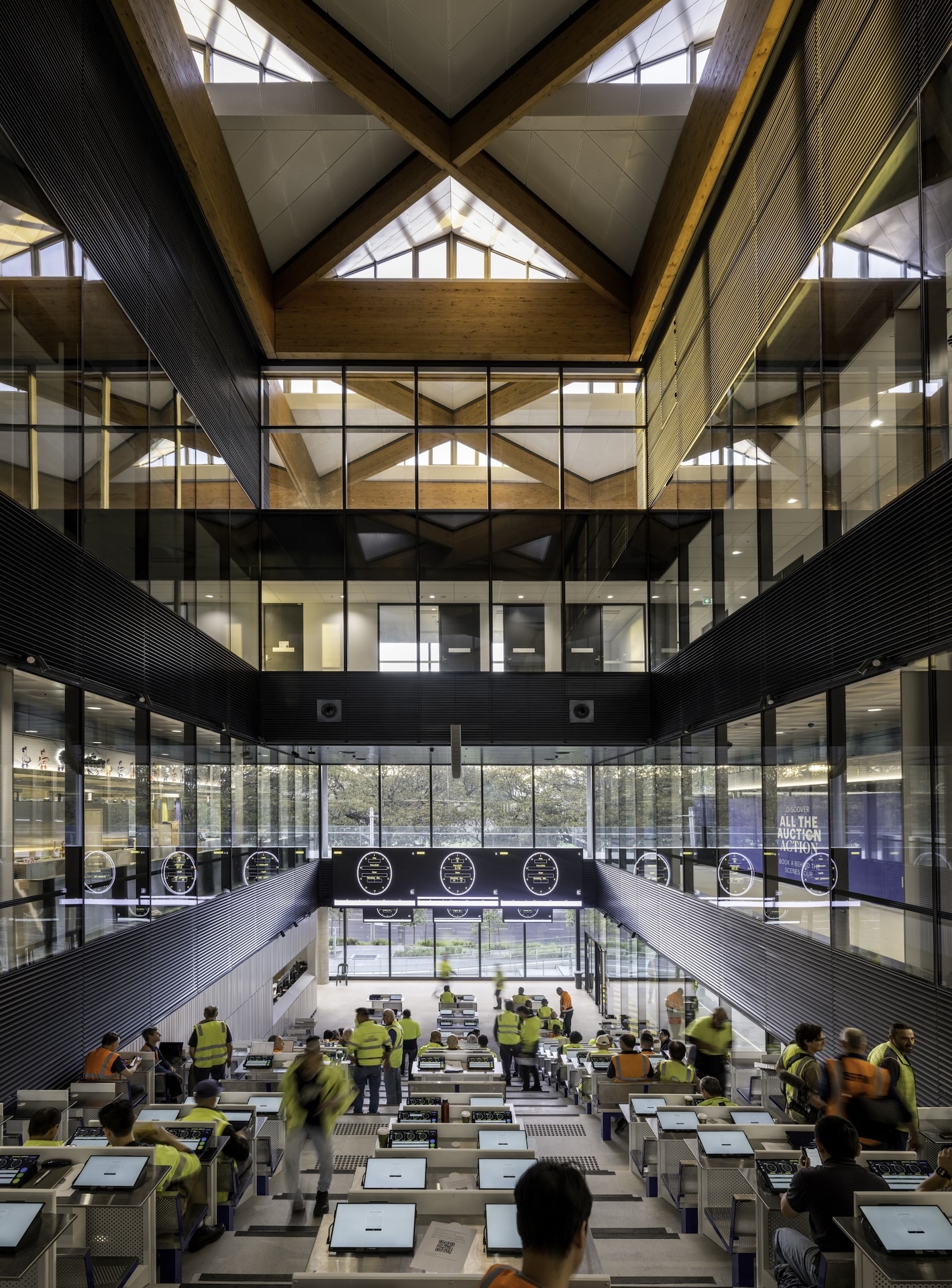
Holy Mackerel! (And Tuna, Prawns and Mussels, Too)
The Sydney Fish Market places the spectacle of a seafood auction on public display:
- Each weekday, fresh catches brought in by boat and truck are auctioned off to the top bidder.
- Prior to bidding, buyers can inspect seafood spread across the auction floor in blue crates.
- Auctions start at 4:30 a.m. sharp, with more than 100 buyers bidding each day, including 19 wholesalers.
- Since 1989, auctions follow the reverse system, originally developed for Dutch tulips, where prices start high, then drop until a bid is made.
- Approximately 20 tonnes of fish are sold every hour — about 50 to 55 tonnes a day.
- Most auctions include around 100 species of seafood, ranging from common staples to rare delicacies. On opening day, a 41.8-kilogram yellowfin tuna sold for AUD$15,000.
- Winning bidders have their boxes sent upstairs (by hand, trolley or forklift) to retailers, or wheeled out to the carpark to transport to restaurants and grocery stores.
Sydney’s New Market Is Filled With Mass-Timber and Plenty of Fish
A landmark new building on the city’s waterfront is as much a destination for seafood wholesalers as it is for architecture fans.