


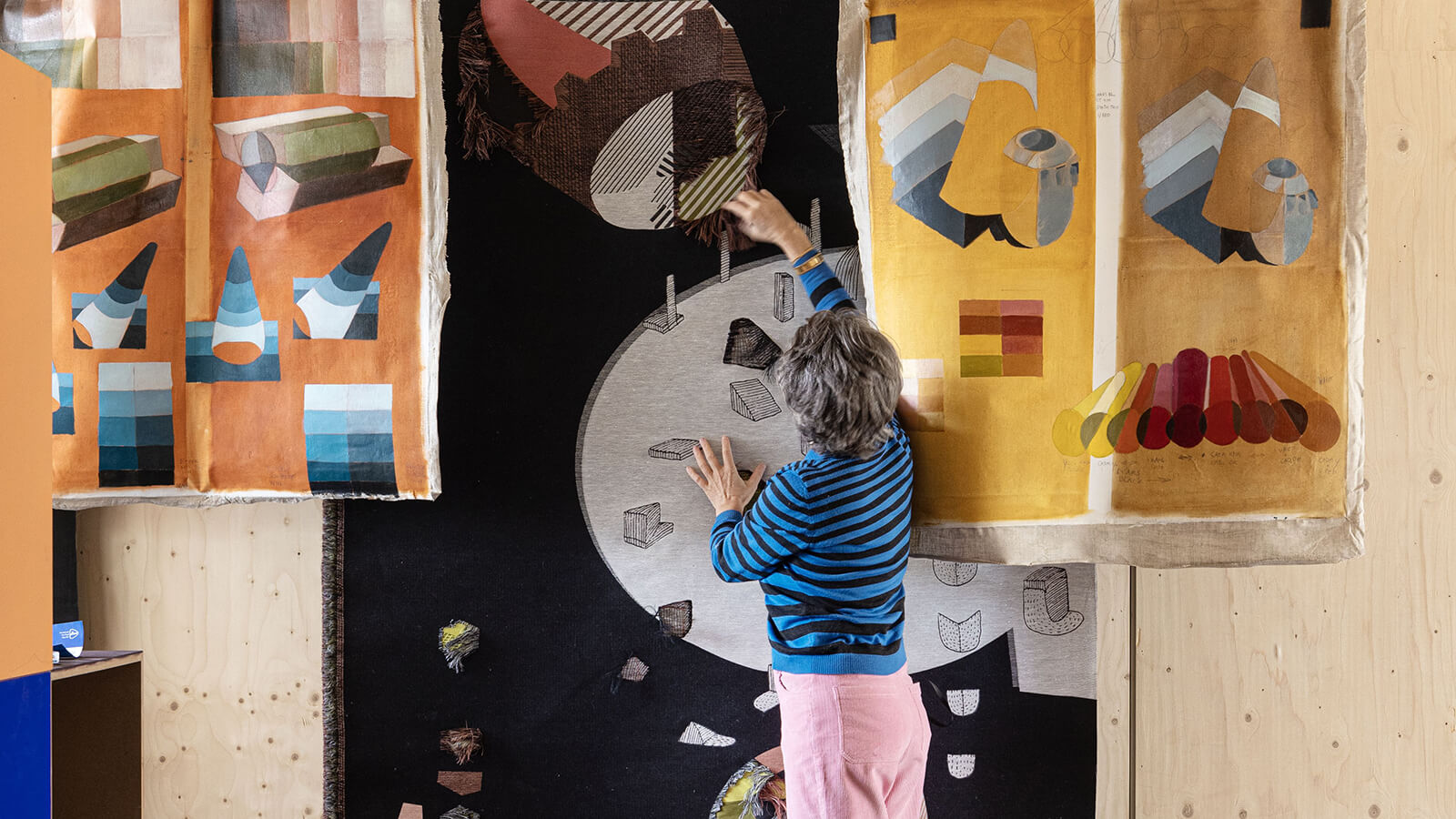
What does it mean to design in a world that already has enough?” This question kicks off a retrospective of work by Dutch visionary Hella Jongerius that is on view at the Vitra Design Museum in Weil am Rhein, Germany, through September. Building on that prompt, the exhibition title, “Whispering Things,” reflects the subtle ways that well-made objects convey their long-term value.

In a crowded landscape, Jongerius’s designs distinguish themselves as one of a kind — even though many have sold in high volume. “Jongerius is unusual in having figured out these very ingenious ways to actually create infinite possibilities within serial production, which is almost a contradiction,” says design historian Glenn Adamson, who curated “Whispering Things.” Her Repeat Dot print for Maharam, introduced in 2002, overlaid screen-printed white circles on top of a mass-produced pattern, while her Polder sofa (launched by Vitra in 2005) upholstered cushions in a wide array of fabrics, then accented them with mismatched buttons. Rather than striving for consistent perfection, both celebrated charming idiosyncrasies. “It takes an extraordinary amount of material intelligence to pull that off,” says Adamson.

Sure enough, hands-on colour and material research underpin much of Jongerius’s work marrying craft with industry — and she carried this rigour from her early days with the Droog design group all the way through to collaborations with big-name brands, including Maharam, Vitra, shoemaker Camper and Dutch airline KLM. Organized into four largely chronological sections that chart this evolution, the exhibition (and its accompanying monograph) ends with “Cosmic Mind,” which captures Jongerius’s recent move to develop more personal (and, to her, environmentally and socially responsible) projects not driven by market forces. Here, hanging fibre “amulet” artworks join a curtain of crystal beads, plus ceramic sculptures of “Angry Animals” that probe human nature. These are works where, as Jongerius summarizes it, “form follows feeling.”

“It does get very mystical and kind of witchy,” Adamson says. “She’s always thinking about the sensory experiences that are generated by her designs — and trying to create objects that heighten our understanding and appreciation of the things around us.” As we head into another spring of product launches, more industry figures would do well to embrace that thoughtful philosophy.
A Retrospective at Vitra Design Museum Maps Hella Jongerius’s Thoughtful Explorations of Craft and Industry
Dutch luminary Hella Jongerius reminds us that product design is not just meant to fuel endless consumption.