

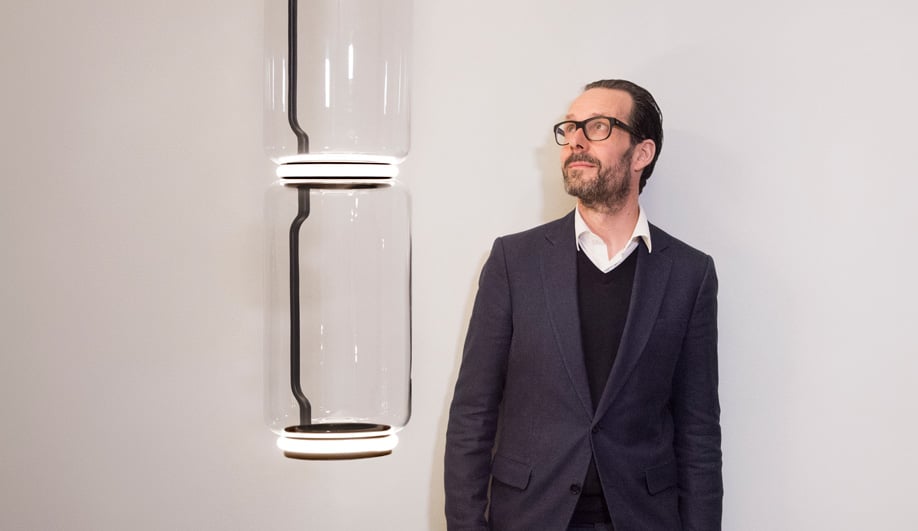
The German designer has channelled old-school craftsmanship to produce a light that can disappear … almost.
Konstantin Grcic is known for his function-first approach to furniture and for his prolific output. In April, during Milan Design Week, the Munich designer stayed true to form, launching seating for Cassina, Magis, Plank and Mattiazzi. But it was his lighting collection for Flos that stood out as something altogether new – an art project of sorts from the pragmatic designer.
Called Noctambule, the prototypes (two pendant and three surface lamps) are composed of glass columns that appear to float between ambient rings of light. Noctambule is French for night owl, or reveller, Grcic tells me, “the kind of creature that is invisible during the day.” Inspired to create an object that would similarly disappear when switched off, Grcic found that LED gave him the means to accomplish this goal. “Fifteen years ago, designers built around a bulb,” he says. “Now we design the light source, which can be as small as a bread crumb, or the shape of a ring. Technology has allowed for total freedom and poetry.”

Fabricating with glass at this scale, however, proved to be the bigger challenge. Grcic usually models with cardboard to build his ideas into 3-D forms. “None of our usual methods worked with Noctambule,” he explains. “I mean, how do you mock up glass in cardboard? You can’t.” Instead, he worked with the experts at Flos to create renderings that led them to break the light up into manageable modules and use the junctures between them to position the LED strips. Illuminated, Noctambule is a totemic volume cinched with halos. Turned off, the light is indiscernible except for its metal fasteners and the translucent bodies bulging between them – a ghostly effect achieved when atmospheric light bounces off the purposefully imperfect glass.
Grcic says his roots in craft still guide his approach, even with objects that include electric wiring. “Understanding materials, processes, technology – it’s all very important. I’m always asking myself, Where can I push the limits of structure?” For the viewer, though, experiencing the light should not involve thinking about how it’s made: “I don’t want anyone who sees the lamp to think about how it works; I want them to see magic.”
